Minggu, 12 Juni 2011

The Red Siren


The marvellously named Oliver Megaton’s 2002 adaptation of Maurice G. Dantec’s prize-winning novel treads a fine line between Euro-pudding and halfway decent thriller. It’s a schizophrenic viewing experience, riddled with narrative and aesthetic conflicts, but the longer it goes on (the film is just short of two hours) the more compelling its fluctuations become. The fact that it veers so close to being an absolute train-wreck is almost a point in its favour.

Let’s get the synopsis out of the way. 12-year old Alice (Alexandra Negrao) wanders into a police station in Paris and asks to speak to Anita (Asia Argento), an inspector who finds herself on shaky ground when she believes Alice’s story of her mother, Eva Christensen (Frances Barber), as a murderer. Although Alice presents Anita with a DVD depicting a vicious scene of torture and death, Anita’s superior warns her off the case implying that the DVD could easily have been staged and referring to Eva as “untouchable”. Nonetheless, Anita starts poking around. There are no leads and Eva’s lawyer materializes faster than you can say “harassment”.

So far, so procedural. A young, vulnerable witness; a difficult to corroborate allegation; an inexperienced cop going out on a limb. The first twenty minutes pretty much play out in expected fashion.


Then Eva turns up, demanding Alice be released back into her care. She brings hired goons Koestler (Andrew Tiernan) and Travis (Johan Leysen) along with her; these squabbling incompetents give chase when Alice legs it from the police station. She evades them by hiding in the back of a car owned by Hugo (Jean-Marc Barr), a hitman on his way to meet his enigmatic handler Vitali (Vernon Dobtcheff).

Hugo is haunted by his accidental killing of a child in a war zone several years previously, and helps Alice out of a sense of expiation. Alice wants to go to Portugal to find her father, long suspected dead in a boating accident but very much alive and well (more than a hint of giallo plotting here). Eva and her well-connected fixer Colonel Vondt (Carlo Brandt) figure Portugal as Alice’s immediate destination, and set off to intercept her. Meanwhile, Anita is given the opportunity to work with the Portugese authorities and track the girl down.

So: we’ve gone from determined cop vs suspected killer procedural, to cross-Europe chase thriller. Throw in the fact that Hugo and Alice bond en route and it all gets very ‘Leon’-revisited.

And indeed if Megaton (arguably the only director who sounds like a Transformer) had focused solely on the Hugo/Alice relationship – which almost the film’s mid section – you could swiftly write off ‘The Red Siren’ as a ‘Leon’ rip-off, give a nod to Barr’s convincing turn as a professional killer, tip the hat to a good understated performance from Negrao, and move on.
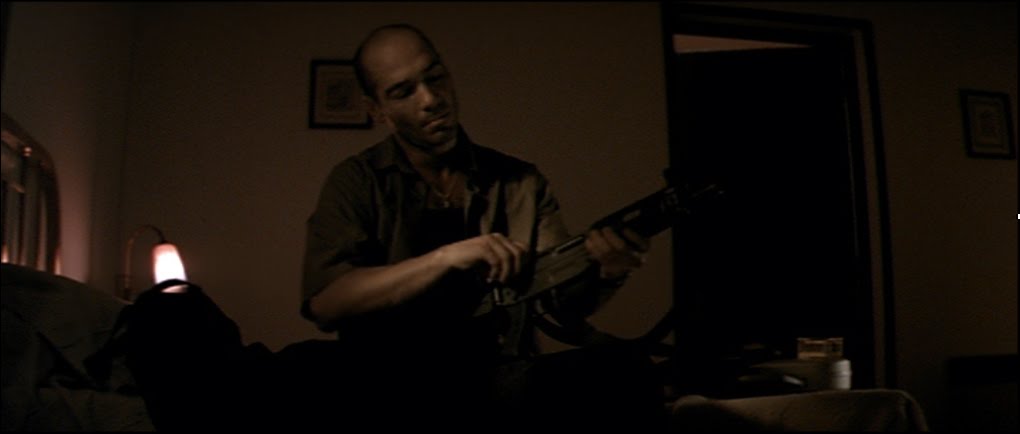


But Megaton flits between so many discontiguous elements, often losing focus, that what could have been a taut if derivate little thriller instead emerges as an increasingly bloated and frequently bonkers piece of work. A whole backstory about Hugo’s association with Vitali and the nature of Vitali’s “organization” hovers in the wings, its shadow touching every scene Vitali’s in but with nothing ever explored, explained or revealed. Likewise the relationship between Eva and Vondt: there are heavy insinuations of voyeurism, sadism, power games and sexual tension, but Megaton doesn’t go anywhere with it. Eva herself is a pantomime villain: we’re told she owns two hundred companies and likes filming orgies and murders, but her psychopathology remains as unexplored as anything relating to Vitali. It doesn’t help either that the usually dependable Frances Barber plays her as a cross between Cruella de Ville and the Marquis de Sade in drag.

Tiernan and Leysen’s characterizations are so clichéd, they make your average Guy Ritchie cockney crim look positively Shakespearean. Dobtcheff delivers his dialogue so portentously you’d think he was doing Strindberg, while Brandt seems to be treating the whole enterprise as an audition for Bond villain duties. Barr and Negrao, as noted earlier, do sterling work, while Argento tries heroically to imbue a nothing role with steely determination but just ends up looking miserable for most of the time. Only the scenes in which Anita repeatedly deflates the ego of the lascivious Portugese cop she’s partnered with have any zing to them.

The decision to shoot the production in English was misjudged: with the cast variously hailing from Italy, France, Belgium, Switzerland, England and Portugal, the accents are all over the place and individual facility with the English language is variable at best. The dialogue smacks of losing quite a lot in translation and there are some howlingly clunky lines.


Aesthetically, stunning widescreen landscapes sit check by jowl with blandly anonymous interiors. Low key character moments are swamped by big action scenes, most notably an extended and brilliantly edited hotel shoot-out. The sense of conflict that I mentioned at the start of this review is omnipresent; the film often seems to be pulling against itself. That it doesn’t entirely derail and go up in flames is an achievement of itself.

Ultimately, ‘The Red Siren’ is an unfocused and deeply flawed film. It’s also entertaining (mostly for the wrong reasons) and I defy anyone to watch the climatic scene where Eva, gun in hand, chases her daughter across a beach yelling “Alice! Alice!” without this coming unbidden to mind:


Asia Argento double bill


I’ve not featured any double bills on Agitation this year, but with the rain settling in on a gloomy Sunday morning it seems to me the ideal time to resume the tradition. Coming up today: two Asia Argento movies, firmly bracketed in the crime genre and finding the sultry Euro-goddess on both sides of the law. Let’s go with Asia on the side of the angels first, and save Asia embroiled in sex and smuggling for later in the day.

Jumat, 10 Juni 2011

PERSONAL FAVES: Bullet in the Head


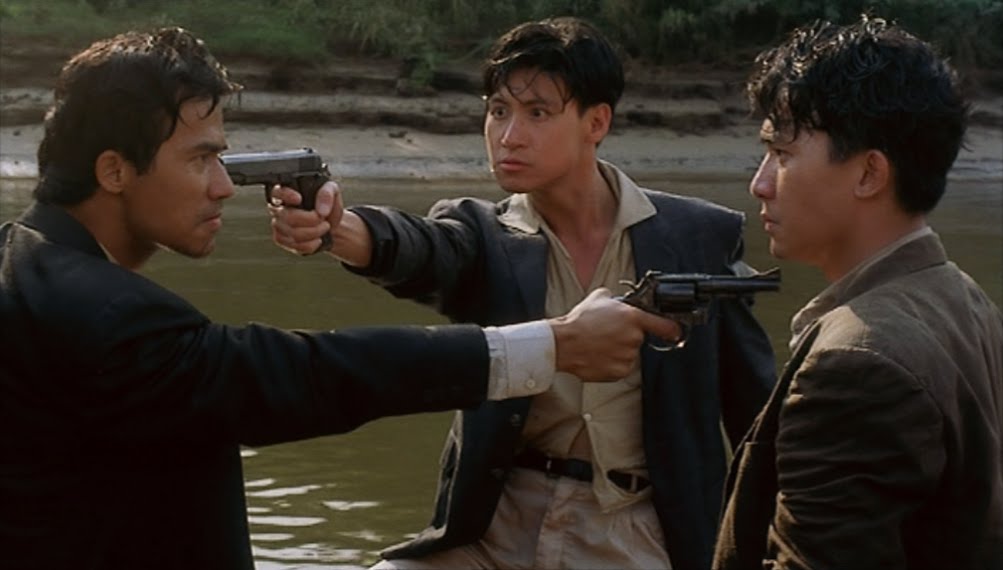
‘Bullet in the Head’ was almost a very different film. John Woo originally conceived it as a prequel to his immensely successful ‘A Better Tomorrow’ and ‘A Better Tomorrow Part 2’. Two things changed the shape, scope and sheer ambition of the film. The ‘Better Tomorrow’ films were produced by Tsui Hark, with whom Woo found it increasingly difficult to work. Parting ways, Hark rushed ‘A Better Tomorrow Part 3’ into production while Woo was left to reconfigure his concept of the prequel. In reapproaching it as a stand-alone film, he was inspired – if that’s the right word; “angered” would probably be more apposite – by the violence demonstrated towards the protestors in Tiananmen Square. Accordingly, ‘Bullet in the Head’ gained a political subtext, Woo setting the first act in Hong Kong in 1967, the riots and heavy-handed military response a grim reflection of then contemporary events.


I first saw ‘Bullet in the Head’ on the big screen at Nottingham’s Broadway Cinema in the mid 90s after the mainstream success of ‘Hard Boiled’ had given Woo’s back catalogue a new lease of life in terms of their overseas distribution. I saw it in a subtitled but still highly Anglicized version where the main characters were called Ben, Paul and Frank; I then bought it on VHS in the MIA release with those selfsame subtitles and watched it to death over the next half decade. Revisiting it last night on DVD, with the character names in their correct appellation – respectively, Ah Bee, Little Wing and Fai – I found it a bit disconcerting that Ben, Paul and Frank weren’t Ben, Paul and Frank any more. So please indulge me, for the purposes of this review, in sticking with the horribly unrealistic western names, otherwise I’d be checking IMDb every other sentence and I’d never get this thing written.

So: it’s Hong Kong, 1967 and Ben (Tony Leung), Paul (Waise Lee) and Frank (Jacky Cheung) are best buds who enjoy chasing girls, riding their bicycles, kicking the everloving shit out of rival gangs and avoiding being billyclubbed into concussion during the riots. Their characters are established quickly: Ben is nominally the more responsible, Paul competitive and somewhat self-centred, and Frank relies on clowning around to disguise effect his bullying family has on him.

Ben gets married to his childhood sweetheart, but things go south on the big day. Frank borrows money to pay for the reception from a loan shark, confident that his father’s capacity on the card table will cover the debt. A rival gang ambush him on his way to the reception and Frank sustains a severe beating, including a bottle broken over his head, rather than hand the cash over. Although Frank initially lies about the injury, Ben is incensed when he discovers the truth. Ben and Frank stage a revenge attack on the gang leader, inadvertently killing him.


Paul, his thoughts turning to the possibility of earning big money by smuggling, joins Ben and Frank when they flee aboard. Laden with contraband and the name of a contact, they head for Saigon. Turmoil reigns here, too. Their contact, Yeung (Chung Lin), is an underworld lynchpin who is holding torch singer Sally Yen (Yolinda Yam) against her will at his nightclub, strung out on H and forced to prostitute herself. Ben takes against this quite vehemently and, together with the enigmatic Luke (Simon Yam) – a hitman with CIA connections – they dispose of Yeung and abscond with a consignment of gold. Unfortunately, where they abscond to is ever deeper into the war zone and their form of private enterprise doesn’t go over too well with the VC.

For what was obviously a very personal film for Woo, he channels several Hollywood classics. The shadow of ‘Apocalypse Now’ hangs omnipresent; a teeth-grindingly horrible set-piece featuring incarceration in bamboo cages and psychological torture at the hands of the VC is an ode to ‘The Deer Hunter’; and Paul’s interrelated obsession with the gold and increasing inability to function with any degree of honour or humanity recalls Humphrey Bogart’s Fred C Dobbs in ‘The Treasure of the Sierra Madre’.

Ben’s erstwhile calm leadership falters as events become increasingly violent. Paul’s descent into greed and, finally, betrayal begins the moment he gets a gun in his hand. Frank, emotionally the most fragile from the get-go, crumbles under what he endures in the prison camp. What happens during the friends’ escape attempt – during a US counterattack – sets the scene for the final act, which sees Woo back in frenetic, hyper-stylized, epic bloodshed mode a la ‘A Better Tomorrow’ or ‘The Killer’. Matters of honour are settled by protracted car chases and gun battles. Balletic action ignites the screen. Shit blows up with such visual poetry that Jerry Bruckheimer and Michael Bay probably cry themselves to sleep at night knowing it’ll never look as good in one of their movies.


The difference, though – and this is what makes ‘Bullet in the Head’ such a standout in Woo’s Hong Kong filmography (we’ll gracefully avert our eyes as we step past the Hollywood outings) – is that the usual crime/action/shoot ’em up elements play out against the backdrop of a war movie instead of being an aesthetic be-all-and-end-all. Moreover, the war movie aspect makes for a grittier approach to the big action scenes. Where the narrative is Vietnam-based, there are no fluttering doves, guttering candles or gorgeous swathes of bullet-addled slo-mo. In fact, apart from a few judicious uses of freeze-frame, most notably in the first third while Woo is setting up the characters, his distinctive tendency to editing-room showmanship remains unindulged.

Consequently, ‘Bullet in the Head’ lacks the choreographed polish of his work with Chow Yuen-Fat. Although still assembled with more energy and insight into the dynamics of big screen action than most studio tentpole releases, it emerges as a more rough and ready beast by comparison. And this, more than any of its other achievements, does the film its biggest favour.

Rabu, 08 Juni 2011

High Sierra


Roy Earle (Humphrey Bogart) is released from prison after eight years, his pardon bought and paid for by ailing mob boss “Big” Mac (Donald MacBride) – perhaps the only eminence grice in American crime cinema who shares a name with a hamburger – and given instructions to make contact with his new partners Red (Arthur Kennedy) and the curiously named Babe (Alan Curtis). Along with inside man Mendoza (Cornel Wilde), this is the crew “Big” Mac has lined up for a casino robbery.

Roy finds them holed up in a cabin at an out-of-season resort, bickering over dance hall girl Marie (Ida Lupino). He is immediately distrustful of their callow behaviour and lack of professionalism (thus establishing jitterbugging loudmouths as the 1940s equivalent of shell-suited chavs), nor is he enamoured of Marie’s clingy attachment to him. Things are complicated when he helps out disenfranchised farmer Pa (Henry Travers), en route to L.A. to lodge with family after the repossession of his farm, and finds himself sympathetic to – and then falling for – the old man’s granddaughter, the club-footed Velma (Joan Leslie).


Nicknamed “Mad Dog” by the press, particularly after the heist goes south and fatalities ensue, Roy Earle is both hard as nails and a man of honour. He stands no nonsense from Red and Babe, but by his own admission is soft-hearted towards Marie and the mongrel who befriends them. He remains loyal to “Big” Mac even as the treacherous Healy (Jerome Cowan) tries to depose him on his deathbed. He’s a friend to Pa, who recognises him as an old-school on-the-level type. He foots the bill (pardon the pun) for Velma’s surgery, even though she spurns him for an oily insurance salesman with a pencil moustache and a nasty suit.

Adapted from W.R. Burnett’s novel by John Huston and Burnett himself (Burnett’s novels include ‘Little Caesar’, ‘Dark Hazard’ and ‘The Asphalt Jungle’, all filmed) and directed by Raoul Walsh, ‘High Sierra’ marked Bogart’s move from memorable supporting roles (‘Angels with Dirty Faces’, ‘The Roaring Twenties’) to bona fide leading man status. Released in 1941, Bogart went on to star in ‘The Maltese Falcon’, ‘Casablanca’, ‘Sahara’, ‘To Have and Have Not’ and ‘The Big Sleep’ in the next five years alone.

In many respects, ‘High Sierra’ – never mind its gangster trappings – is pure melodrama. The crippled heroine who turns into a vituperative good-time girl the moment her club-foot is cured. The good-time girl who turns out to have a heart of gold. The hideously stereotyped comic relief black character. The heist that turns ugly. The yellow-belly who squeals. The wound that slows our hero down. The net that closes in on him. The sentimental commitment to a woman and a dog that proves his undoing. And our hero himself, the career criminal with a code of honour that suddenly doesn’t seem to count for much.


And this is what makes ‘High Sierra’ a classic, flawed and clichéd as it is in more than one respect. Roy Earle is a man who has outlived his times. Time has passed him by in jail. When he’s released in the opening scene, he immediately goes to a park; later, he accepts the fact that he’s been pardoned on Mac’s coin and is in his pocket. It’s not difficult to see the beginnings of Doc McCoy three decades later in ‘The Getaway’. Roy’s old-time ways find vicious contrast with the juvenility of Red and Babe, not unlike Thornton’s enforced association with T.C. and Coffer in ‘The Wild Bunch’. Roy’s final stand is measured against the timeless grandeur of the mountains, like Steve Judd’s in ‘Ride the High Country’. Roy Earle is the prototype Sam Peckinpah hero. “Times sure have changed,” Mac observes at one point, to which Roy responds, “Yeah … sometimes I feel like I don’t know what it’s all about anymore.” Right there, my friends: right there.

In a moment heavy with foreshadowing, Doc Banton tells Roy: “Remember what Johnny Dillinger said about guys like you and him? He said you're just rushing toward death. That’s it – you’re rushing towards death.” In movies like ‘High Sierra’ and ‘White Heat’, Raoul Walsh began to tap into an aesthetic that Peckinpah would render as visceral cinematic poetry.

Senin, 06 Juni 2011

High Anxiety


Dr Richard H Thorndyke (Mel Brooks) disembarks from his internal flight in a somewhat anxious state. A demented old lady and the sexual overtures of a flasher complicate his exit from the airport. His driver (“and sidekick”) Brophy (Ron Carey) greets him with by sticking a camera in his face and taking a montage of intrusive shots. Brophy’s hobby is photography; a vitally important plot point hinges on it. The ad hoc photoshoot completed, Brophy drives Thorndyke to The Psycho-Neurotic Institute for the Very, Very Nervous, where Thorndyke has just taken over as director – much to the chagrin of the oleaginous Dr Charles Montague (Harvey Korman). By the time Thorndyke learns that his predecessor met a grisly end, he is in a state of nervous agitation fit to rival that of any of his patients.


Thus begins ‘High Anxiety’, Mel Brooks’s loving homage to Hitchcock (the opening credits carry a dedication to Hitch). Mainly riffing on ‘North by Northwest’ and ‘Vertigo’, but with a couple of inspired nods to ‘Psycho’ and ‘The Birds’ (the latter arguably Brooks’s most lowbrow skit this side of the beanfeast in ‘Blazing Saddles’), the plot is so nonsensical as to make ‘North by Northwest’ look like a piece by Strindberg.


Thorndyke is crippled by a fear of heights (later revealed as actually being a fear of parents); Montague and the sinister Nurse Diesel (Cloris Leachman) plot mysteriously, as well as indulging in a bit of light BDSM (the nurse’s attire for these sessions? step forward, the obligatory Nazi uniform); there’s a case of mistaken identity that sees an innocent man go on the run; and a seductive blonde (Madeleine Kahn) is mixed up in it somehow. Just about all the Hitch tick-boxes are checked, right down to the slightly artificial cinematography and the Bernard Herrmanesque score. (Subject of the score, Brooks’s show-stopping performance of the title song is a splendid parody of Frank Sinatra.) If there is a problem – and, let’s face it, outside of ‘The Producers’, ‘Blazing Saddles’, ‘To Have and Have Not’ and ‘Young Frankenstein’, Brooks’s work is hit and miss and then some – it’s that Brooks clings too deferentially to the very material he’s spoofing. The broader moments, such as the two supposedly gliding camera movements that fail spectacularly and don’t just break the fourth wall but bulldozer it aside, are textbook examples of classic Brooks slapstick and seem all the funnier for not relying on audience familiarity with the minutiae of Hitchcock.


Elsewhere, though, the frame of reference is very specific, and Brooks wavers between parodying actual scenes (the chase up the stairwell to the top of the tower) and staging set-pieces in the manner of Hitchcock, but layering them with brash and heavy-handed stabs at humour (Thorndyke and his paramour evading cops at an airport by means of deliberately drawing attention to themselves; Montague terrifying a patient into regression). The tone wavers along with the approach and there are a few ploddingly unfunny moments between the belly laughs.


When ‘High Anxiety’ hits its marks, it’s manic, mirthful and memorable, energetically performed by a cast who are all on good form. Particularly Madeleine Kahn who is just the perfect choice to send up the angsty, icy Hitchcock blonde. Having said that, though, any film automatically becomes a more engaging prospect when Madeleine Kahn’s name pops up in the credits.

Jumat, 03 Juni 2011

X Men: First Class (or, How I Learned to Stop Worrying and Get My Sixties Groove On; or, For Your Mutants Only)


Okay, I’m pushing it a bit trying to shoehorn this one into Shots on the Blog. But what the hell, it’s got a CIA department doing covert things. And, uh, there’s more than a shade of Matt Helm to it. And, uh … all right, it’s more a spy movie than a crime movie but, as Lesley Gore almost put it, it’s my blog and I’ll review if want to. Anyway, here’s a picture of January Jones:


Now, where was I? Oh yes. ‘X Men: First Class’, Matthew Vaughan’s piss-take/prequel/showreel for the Broccolis [delete as applicable]. Things kick off with the prologue to Bryan Singer’s original ‘X Men’: the young Erik Lehnsherr being pried away from his mother by Nazi guards in 1944 and responding with a metal-bending display of power until a rifle butt to the head knocks him out. Next we’re in some Ivy League part of America where the privileged young Charles Xavier meets the young Raven. They’re all kids, and they all realize they’re not exactly normal. But whereas Xavier subjugates his power (or, as he calls it, mutation) and impresses on Raven to do the same, Lehnsherr doesn’t have the same luxury. He’s delivered into the hands of Sebastian Shaw (Kevin Bacon), who quickly discovers that the key to unleashing Lehnsherr’s power is his anger. He discovers this by shooting Lehnsherr’s mother.

The juxtaposition of Xavier and Lehnsherr’s formative years continues apace as Xavier (James McAvoy), now in his twenties and a graduate of Oxford (or “Oxford University, England” as the establishing credit trumpets)*, is jarred from his enjoyment of the academic life by CIA agent Moira McTaggart** (Rose Byrne) who recruits him into an unofficial intelligence branch headed up by The Man in the Black Suit (Oliver Platt); while Lehnsherr (Michael Fassbinder) – all growed up and pretty freakin’ mean with it – is on a globe-trotting mission of revenge against Shaw.

Meanwhile, Raven (Jennifer Lawrence) is all growed up and so damned cute with it there ought to be a law against it. Exhibit A, m’lud:


Um, sorry. Lost my train of thought again. Oh yes. Vaughan explicitly establishes that it’s now 1962, through more of those idiot-proof establishing credits and enough stock footage of John F Kennedy that the family’s lawyer is probably writing to Vaughan and co. right now to ask what their percentage point is of the box office gross. The Cold War is heating up (sorry: that was poor, even by my standards) and the world’s attention is focused on Cuba. Shaw is intent on playing the superpowers off against each other and here’s where the whole ‘X Men First Class’-as-Bond-movie thing really kicks in.

After all, we have an egomaniacal supervillain (Bacon’s performance suggests he’s channelled a big fat helping of Blofeld), his sexy but deadly right-hand-woman Emma Frost (January Jones), their entourage of seemingly invicible goons, a globe-trotting narrative, a loose-cannon operative (if Craig hangs up the mantle any time in the near future, Michael Fassbinder should immediately be signed up as the next 007), entire swathes of funky 60s décor, a magnificently unPC attitude to female characters (Rose Byrne’s intro has her sashaying around a go-go bar in her underwear; January Jones’s cleavage puts the fucking missiles to shame; and Jennifer Lawrence exists in an entirely different universe and time zone from the ugly stick), and more gadgets than Q Department could shake a standard issue stick with modifications at (allowing, of course, for the fact that the mutants are pretty much gadgets in their own right). Add to this Shaw’s labyrinthine inner sanctum, a pleasure cruiser whose hull turns into a submarine and various narrative beats that recall at least four different Bond titles and the evidence is nigh on incontrovertible.


There’s also a touch of the ‘Dr Strangelove’ in the politicking and the pseudo-tense council-of-war scenes. There were whole tranches of the movies where I was praying for someone to pop and say, aghast, “Gentlemen, you can’t mutate in here. This is the war room.”

Vaughan’s directorial approach vacillates quite wildly between moody, broody, angsty stuff (the young Lehnsherr suffering at Shaw’s hands), straight down the line action thriller business (Lehnsherr’s pursuit of same) and camp, OTT set-pieces (remember that advert, I think it was for vodka, when all the rammel on the seabed rises up, breaks the surface and erupts into the air? get ready for a re-edited version of same as part of the big finale). It shouldn’t work. It should be piss-awful. But somehow it’s supremely entertaining. Of course, it arrives in the wake of the wrist-cuttingly awful ‘X Men 3: the Last Snore Stand’ which gives it a certain advantage. After ‘X Men 3’, an episode of ‘Postman Pat’ where his black-and-white cat mutated into a slightly bigger cat and they went and delivered some letters would be a hundredfold improvement!

‘X Men First Class’ is a real curate’s egg of a movie. Plot holes abound, not least when Xavier does something during the aforementioned big finale that leaves you wondering why he doesn’t pull the same trick on two other specific people and – hey presto – problem solved. And yet there performances are generally effective, with only – surprisingly – McAvoy struggling to suggest Patrick Stewart’s Xavier. Fassbinder, however, captures every bit of Ian McKellan’s ruthless charm and steely intelligence as Magneto, while Lawrence nails the character arc that transforms Raven into Mystique.

Yup, it’s a weird ’un all right. But it’s the best ‘Dr Strangelove’-meets-James-Bond mash-up you’re likely to see this summer.


*Establishing credits are plentiful and bludgeoningly over-explanatory in this movie. Every couple of minutes, it’s reinforced to us poor geographically-challenged idiots in the audience that we’re in “Oxford, England”, or “CIA headquarters, USA” or “Moscow, Russia”, the latter particularly redundant given the proliferation of mushroom-domed buildings in every Moscow-set backdrop.


**Which is about as subtle as implying a character has Australian heritage by calling her Sheila.

Rabu, 01 Juni 2011

I Saw the Devil


Revenge, they say, is a dish best served cold. If Jee-woon Kim’s ‘I Saw the Devil’ is anything to go by, it’s also a dish best served in one helping. Soo-hyeon (Byung-hun Lee) quite literally makes a meal of it, and the results are graphically disturbing.

The basic premise is so boilerplate you’d think you were watching a committee-made Hollywood identikit genre flick, not an eyeball-searing powerhouse attack on the senses from one of Korean cinema’s leading lights. Here’s a synopsis (and try not to groan): intelligence agent Soo-hyeon is working on his girlfriend’s birthday and phones her to apologise; to make things worse, her car is broken down, it’s a cold and snowy night and the tow truck is taking ages to arrive. A shambolic and persistent stranger pulls over, ostensibly to offer assistance. She politely insists that she’s fine. The stranger takes a hammer to her windscreen, wallops her into unconsciousness and drags her out. Some time later, in a deserted garage, she comes round and the really nasty shit begins.


Soo-hyeon, given a leave of absence after her dismembered body is found, calls in a favour from a buddy on the police force, gloms the files on the four main suspects, and sets out to find which one of them is responsible. And make them pay. Anyone bored yet? Anyone seen this kind of thing a million times before? Whip/deceased equine interface, anyone?

Ah, but Kim – director of ‘A Tale of Two Sisters’, ‘A Bittersweet Life’ and ‘The Good, the Bad, the Weird’ – does things a little differently. Whereas the standard issue narrative arc in a Hollywood iteration of this material would see Soo-hyeon spend most of the movie working his way through the list until facing off with the killer in a mano-a-mano smackdown at the end, Kim has his (anti) hero brace his first two suspects (and by “brace” I mean he flogs one of them with the three-pronged plug end of an electrical cable before causing major trauma to the gentleman’s gonads, and rams the other with his car before beating him to a pulp) in short order, figure Kyung-chul (Min-sik Choi) for the guilty party not long after, and get the drop on him before the two hour twenty minute run time is even half over.


This is where Soo-hyeon crosses the line. Instead of finishing Kyung-chul off or turning him in (although on what evidence would be a moot point given the agent’s total disregard for due process), Soo-hyeon leaves him unconscious and with a broken ankle, forces a tracking device down his throat, plays out the leash a bit, and has his fun making Kyung-chul suffer. That’s “has his fun” as in humourlessly and determinedly makes life hell for him.

There are two drawbacks, as Soo-hyeon soon discovers. The first is that Kyung-chul is a serial killer, rapist and all-round sociopathic bastard and never mind that he’s on the run, a sociopathic bastard’s gonna sociopathic on someone’s ass. Net result, two murders and a rape by the time Soo-hyeon catches up with him. Seemingly oblivious to this collateral damage, Soo-hyeon repeats the ploy: he whales the tar out of his nemesis, again injuring him, then disappears and lets him go on the run again.

This time, Kyung-chul seeks sanctuary with his old buddy Tae-joo (Moo-sung Choi) – a man whose principle interests also run to rape, ultraviolence and Beetho—… uh, wrong movie. Still, the first two apply. Tae-joo is equally sociopathic. He and Kyung-chul knew each other from a terrorist movement they were in as younger men. Again, Soo-hyeon crosses a line: rather than ’fess up to his bosses, call in the big boys and nail two wanted me, he happily storms in and takes on both of them.


If it wasn’t for the rape and the wincingly excessive violence (make no mistake about it, this movie is brutal), ‘I Saw the Devil’ could pass itself off as comedy. Essentially, we have a game of one-upmanship between two equally driven, equally dangerous and equally uncompromising individuals. You could almost say that they’re two professionals in competition: the meticulousness of Soo-hyeon’s surveillance techniques and the economic way he inflicts violence and/or extracts information juxtaposed with the almost world-weary attention to detail which characterizes Kyung-chul’s acts of savagery.

Two sides of the same coin, you might say, except the faces of the Soo-hyeon/Kyung-chul coin gradually become reversed. Soo-hyeon starts out as a faceless government type in a suit with a thousand-yard stare but whose human qualities are evident just beneath the surface. Kyung-chul is presented initially as a blank implacable force of evil; take the mask off Michael Myers and it might be Kyung-chul’s face that you’d see. By the end, Soo-hyeon has inherited Kyung-chul’s impenetrable mask of a face, while cracks appear across the surface of Kyung-chul’s sadistic equanimity. (I don’t know if you can even use the phrase “sadistic equanimity”, but watch the film and you’ll see what I mean.) It’s a stretch to say that you come to feel sorry for Kyung-chul, but under the constant bludgeonings of Soo-hyeon’s misconceived vengeance, he certainly seems a tad more human. Sympathy for the devil, anyone?