Tampilkan postingan dengan label personal faves. Tampilkan semua postingan

Rabu, 09 November 2011

PERSONAL FAVES: The Constant Gardener

Posted to coincide with Fernando Meirelles’ 56th birthday


Reviewing ‘Tinker Tailor Soldier Spy’ got me thinking about how well-served John le Carre has been in terms of adaptations. The seven-part TV adaptation of that novel, starring Alec Guinness, is one of the small screen’s finest achievements. It’s big screen counterpart is arguably a classic-in-waiting. Martin Ritt’s ‘The Spy Who Came in from the Cold’ is one of the bleakest, most compelling cinematic renderings of the spy story, with a blistering performance from Richard Burton – one of his best.

Even the second tier of le Carre adaptations – Fred Schepisi’s ‘The Russia House’, George Roy Hill’s ‘The Little Drummer Girl’, John Boorman’s ‘The Tailor of Panama’ – are perfectly accomplished and entertaining films. There’s no reason to suspect that Anton Corbijn’s ‘A Most Wanted Man’ – currently in pre-production – will be anything less than a class act.

But above all of these – albeit only by a very short head where ‘The Spy Who Came in from the Cold’ and ‘Tinker Tailor Soldier Spy’ are concerned – is Fernando Meirelles’ ‘The Constant Gardener’, a riveting thriller, a humanitarian manifesto and a j’accuse against corporate greed and political chicanery. A beautiful and emotionally devastating work of cinema.


An opening scene peppered with lacunae gives us a deserted stretch of African coastal road, an overturned vehicle, men piling out of a jeep. The next scene has junior diplomat Justin Quayle (Ralph Fiennes) learning of the death of his wife Tessa (Rachel Weisz) from his seemingly avuncular superior Sandy Woodrow (Danny Huston). Tessa was quite the humanitarian – aid worker, activist; the kind of person it would be easily to mislabel a bleeding heart liberal except that the woman had the tenacity of a particularly stubborn bulldog. As well as an unfortunate tendency to rub Justin’s British High Commission colleagues up the wrong way.

The nature of how this extremely unlikely couple got together is the subject of an extended flashback. And as unlikely as their romance is, Meirelles’ portrayal of it is natural, convincing, unforced. It helps, of course, that Fiennes and Weisz – two actors who have never given a bad performance – are on absolute top form here. Weisz’s Academy Award was one of those stand-up-and-applaud moments of Oscar getting it right.


With the murder mystery element in place, and genuine emotionalism underpinning it, Meirelles begins to unravel – unhurriedly but with a palpable sense of tension – a complex web of deceit, secrecy, underhandedness and naïve political allegiance. In one of the most telling moments, a morally compromised but jingoistically indefatigable politico weighs the unholy alliance between government and pharmaceutical corporation in terms of 1,500 British jobs. Murder, conspiracy, malpractice and the violation of a depressed country’s already beleaguered human rights. But 1,500 British jobs, so what ho chaps?

Le Carre’s novel – his best, for my money – is that rarest of beasts: a literary thriller that powers through its narrative with balls-out ferocity; and an incredibly elegant piece of writing that nonetheless seethes with righteous outrage. And so it should. From the existential despair of Alex Leamas in ‘The Spy Who Came in from the Cold’ to the moment of almost unwitting complicity on which his latest novel ‘Our Kind of Traitor’ turns, John le Carre has, throughout his career, transcended the inherent cynicism of the espionage drama and grappled with the thorny moral conundrums at the heart of his characters’ tarnished lives.


If, however, le Carre approaches the material from the perspective of an Englishman sick of the snobbery and the bullshit and the old school tie network and all the sneaky nasty little things that are done by the establishment supposedly for the good of all, then Meirelles brings to the table the authenticity and immediacy of his breakthrough film, the magnificent ‘City of God’. With these two movies – ‘The Constant Gardener’ was his follow-up – Meirelles took shaky-cam to an art-form. The African scenes are vibrant, alive, as gorgeous as they are harrowing. Elsewhere, though, he knows when to step back from the action, when to frame his actors in long-shot. When to hold a shot and just let it play out, an all too rare capacity in contemporary filmmaking. Simply put, every frame of ‘The Constant Gardener’ contributes to its whole.

Two other things to mention: the film was produced by Simon Channing Williams, who died two years; le Carre’s latest novel is dedicated in memoriam. Whilst filming on location in Nairobi, the cast and crew were so appalled at the levels of poverty that they established The Constant Gardener Trust (go here and be amazed at what the Trust has achieved), of which le Carre, Meirelles, Weisz and Fiennes are patrons.

One great work of literature; one great work of cinema; one awe-inspiring humanitarian organisation. That’s a pretty good batting average.

Jumat, 10 Juni 2011

PERSONAL FAVES: Bullet in the Head


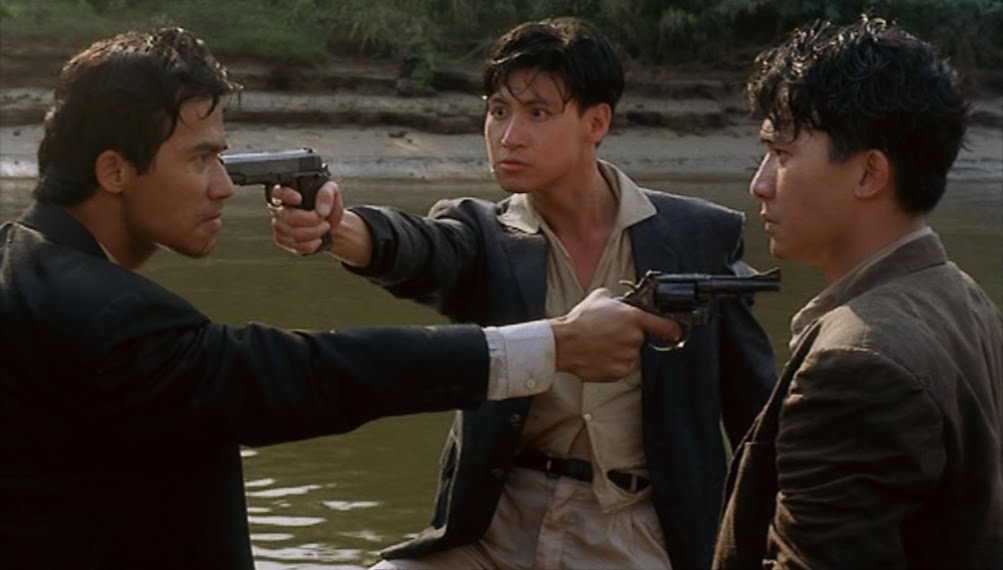
‘Bullet in the Head’ was almost a very different film. John Woo originally conceived it as a prequel to his immensely successful ‘A Better Tomorrow’ and ‘A Better Tomorrow Part 2’. Two things changed the shape, scope and sheer ambition of the film. The ‘Better Tomorrow’ films were produced by Tsui Hark, with whom Woo found it increasingly difficult to work. Parting ways, Hark rushed ‘A Better Tomorrow Part 3’ into production while Woo was left to reconfigure his concept of the prequel. In reapproaching it as a stand-alone film, he was inspired – if that’s the right word; “angered” would probably be more apposite – by the violence demonstrated towards the protestors in Tiananmen Square. Accordingly, ‘Bullet in the Head’ gained a political subtext, Woo setting the first act in Hong Kong in 1967, the riots and heavy-handed military response a grim reflection of then contemporary events.


I first saw ‘Bullet in the Head’ on the big screen at Nottingham’s Broadway Cinema in the mid 90s after the mainstream success of ‘Hard Boiled’ had given Woo’s back catalogue a new lease of life in terms of their overseas distribution. I saw it in a subtitled but still highly Anglicized version where the main characters were called Ben, Paul and Frank; I then bought it on VHS in the MIA release with those selfsame subtitles and watched it to death over the next half decade. Revisiting it last night on DVD, with the character names in their correct appellation – respectively, Ah Bee, Little Wing and Fai – I found it a bit disconcerting that Ben, Paul and Frank weren’t Ben, Paul and Frank any more. So please indulge me, for the purposes of this review, in sticking with the horribly unrealistic western names, otherwise I’d be checking IMDb every other sentence and I’d never get this thing written.

So: it’s Hong Kong, 1967 and Ben (Tony Leung), Paul (Waise Lee) and Frank (Jacky Cheung) are best buds who enjoy chasing girls, riding their bicycles, kicking the everloving shit out of rival gangs and avoiding being billyclubbed into concussion during the riots. Their characters are established quickly: Ben is nominally the more responsible, Paul competitive and somewhat self-centred, and Frank relies on clowning around to disguise effect his bullying family has on him.

Ben gets married to his childhood sweetheart, but things go south on the big day. Frank borrows money to pay for the reception from a loan shark, confident that his father’s capacity on the card table will cover the debt. A rival gang ambush him on his way to the reception and Frank sustains a severe beating, including a bottle broken over his head, rather than hand the cash over. Although Frank initially lies about the injury, Ben is incensed when he discovers the truth. Ben and Frank stage a revenge attack on the gang leader, inadvertently killing him.


Paul, his thoughts turning to the possibility of earning big money by smuggling, joins Ben and Frank when they flee aboard. Laden with contraband and the name of a contact, they head for Saigon. Turmoil reigns here, too. Their contact, Yeung (Chung Lin), is an underworld lynchpin who is holding torch singer Sally Yen (Yolinda Yam) against her will at his nightclub, strung out on H and forced to prostitute herself. Ben takes against this quite vehemently and, together with the enigmatic Luke (Simon Yam) – a hitman with CIA connections – they dispose of Yeung and abscond with a consignment of gold. Unfortunately, where they abscond to is ever deeper into the war zone and their form of private enterprise doesn’t go over too well with the VC.

For what was obviously a very personal film for Woo, he channels several Hollywood classics. The shadow of ‘Apocalypse Now’ hangs omnipresent; a teeth-grindingly horrible set-piece featuring incarceration in bamboo cages and psychological torture at the hands of the VC is an ode to ‘The Deer Hunter’; and Paul’s interrelated obsession with the gold and increasing inability to function with any degree of honour or humanity recalls Humphrey Bogart’s Fred C Dobbs in ‘The Treasure of the Sierra Madre’.

Ben’s erstwhile calm leadership falters as events become increasingly violent. Paul’s descent into greed and, finally, betrayal begins the moment he gets a gun in his hand. Frank, emotionally the most fragile from the get-go, crumbles under what he endures in the prison camp. What happens during the friends’ escape attempt – during a US counterattack – sets the scene for the final act, which sees Woo back in frenetic, hyper-stylized, epic bloodshed mode a la ‘A Better Tomorrow’ or ‘The Killer’. Matters of honour are settled by protracted car chases and gun battles. Balletic action ignites the screen. Shit blows up with such visual poetry that Jerry Bruckheimer and Michael Bay probably cry themselves to sleep at night knowing it’ll never look as good in one of their movies.


The difference, though – and this is what makes ‘Bullet in the Head’ such a standout in Woo’s Hong Kong filmography (we’ll gracefully avert our eyes as we step past the Hollywood outings) – is that the usual crime/action/shoot ’em up elements play out against the backdrop of a war movie instead of being an aesthetic be-all-and-end-all. Moreover, the war movie aspect makes for a grittier approach to the big action scenes. Where the narrative is Vietnam-based, there are no fluttering doves, guttering candles or gorgeous swathes of bullet-addled slo-mo. In fact, apart from a few judicious uses of freeze-frame, most notably in the first third while Woo is setting up the characters, his distinctive tendency to editing-room showmanship remains unindulged.

Consequently, ‘Bullet in the Head’ lacks the choreographed polish of his work with Chow Yuen-Fat. Although still assembled with more energy and insight into the dynamics of big screen action than most studio tentpole releases, it emerges as a more rough and ready beast by comparison. And this, more than any of its other achievements, does the film its biggest favour.

Rabu, 02 Februari 2011

BLACK VALENTINES: PERSONAL FAVES: Short Cuts

Raymond Carver had a genius for writing succinct and emotionally precise stories capturing those transient moments at which relationships are defined or destryoed. Robert Altman had a genius for multi-layered narratives and to-die-for ensemble casts. ‘Short Cuts’ is the cinematic alchemy that resulted from the transition of Carver’s prose to the big screen.

Using the framing devices of a flight of helicopters over L.A. by night at the start of the film (they’re releasing insecticide against a mayfly infestation) and a small earthquake at the end (an extra tremor sent through the protagonists’ already tumultuous lives), Altman charts the disconnections, interrelationships, joys, miseries, camaraderie, bereavements, myriad failings and small redemptions of a couple of dozen disparate characters from various walks of life and social strata.

Affluent couple Howard (Bruce Davison) and Ann Finnigan (Andie MacDowell) – he a TV anchorman, she a brittle lady of leisure – have their lives thrown into touch-and-go uncertainty when their son runs out in front of a car and is knocked down. The (blameless) driver is harassed waitress Doreen Piggott (Lily Tomlin), whose limo driver husband Earl (Tom Waits) drinks too much and gets riled when she receives attention from other men at the diner. Doreen’s daughter Honey (Lili Taylor) is married to wannabe movie FX artist Bill Bush (Robert Downey Jr), a roguish type with a wandering eye, whose best mate Jerry Kaiser (Chris Penn) is an embittered pool cleaner married to phone sex worker Lois (Jennifer Jason Leigh) and driven to distraction by the smut she disinterestedly talks to her callers.


Stopping off at the diner to shoot the shit before they take off on a fishing trip are Stuart Kane (Fred Ward), Vern Miller (Huey Lewis) and Gordon Johnson (Buck Henry). Stuart’s wife Claire (Anne Archer) works as a clown at children’s parties as well as appearing at the children’s ward of the hospital the Finnigans’ son is taken to. It’s here that Howard has an unexpected reunion from his wayward father Paul (Jack Lemmon). Meanwhile, Claire tears Stuart a new arsehole when he returns from his four day fishing trip and confesses that he and his buddies found a dead body of a woman in the water on the first day and left her there while they got on with their fishing.

Vern gets back to discover that his son has taken in a stray dog. Said pooch was abandoned by philandering motorcycle cop (and pathological liar) Gene Shepard (Tim Robbins) after an argument with his wife Sherri (Madeleine Stowe) which was exacerbated by the dog chewing on Gene’s leg. Sherri spends a lot of time either on the phone to or posing nude for her artist sister Marian (Julianne Moore), who is married to jealous and antagonistic surgeon Dr Ralph Wyman (Matthew Modine). Dr Wyman works at the hospital where the Finnigans’ son is being kept under observation; in the next room, and restored to health thanks to the doc’s ministrations, is the son of blues singer Tess Trainer (Annie Ross), who lives with her depressive cellist daughter Zoe (Lori Singer) next door to the Finnigans.


Have I missed anyone out? Oh, yes. There’s Betty (Frances McDormand), estranged wife of helicopter pilot “Stormy” Weathers (Peter Gallagher), with whom Gene is having an affair. And there’s Andy Bitkower (Lyle Lovett), the chef from whom Ann orders a birthday cake just before her son is knocked down; in the immediate aftermath, such social niceties as collecting and paying for said cake slip her mind and Andy, incensed, embarks on a campaign of nuisance phone calls.

In the meantime, Claire and Stuart are invited to a barbeque hosted by Ralph and Marian, the timing proving less than auspicious as both couples are virtually at breaking point in their relationships; nonetheless, the fragile equilibrium the end of the evening finds them at suggests that there might be some chance of conciliation. Other characters don’t fare so well.

Infidelity and incompatibility are the hallmarks of many of the relationships depicted, but Altman’s (and Carver’s) overarching theme is connection. The ways, however tenuous, in which lives overlap – sometimes shatteringly, sometimes by the most whimsical turn of circumstance. And it never feels laboured or contrived as in, say, Paul Haggis’s over-egged ‘Crash’ (for my money one of the most inexplicable Oscar faves in recent years).

Like life, Altman’s film is a thing of contradictory experiences, seemingly random and messy but inextricably interconnected. Sympathetic characters take wrong turns (no spoilers) while a self-obsessed knob-head like Gene comes through at the end and does the right thing by his family. Several characters find solace in the oblivion of alcohol. Some live in the past. Some dream of the future. Some struggle with the tribulations of the here and now. The song that Tess sings over the opening credits – “Prisoners of Life” – pretty much sums it up.


And the crazy thing is – for all that ‘Short Cuts’ trades in bleak subject matter (it contains as much cheatin’, drinkin’, death, heartache and suicide as your average C&W album) – it’s often screamingly funny. Sherri disinterestedly clipping her toe nails while she talks dirty to a caller. Gene bullishly retrieving the dog from its new “owners”. Stormy’s systematic destruction of Betty’s living room interrupted by a vacuum cleaner salesman. Doreen and Earl whooping it up as the earthquake hits, almost joyously embracing the possibility that “this is the big one”.

With more masterpieces on his CV than most, ‘Short Cuts’ might well be Altman’s warmest and wittiest statement on the human condition, no matter how terribly pragmatic that statement might be. As human beings, we royally fuck each other up … but we can’t do without each other.

Sabtu, 13 November 2010

PERSONAL FAVES: Battle Royale

When you were a kid, did your parents ever regale you with terrifying stories of what happens to “naughty children”?

Yeah, mine too. And some of them were pretty inventive.

But I don’t think even my parents could have come up with a cautionary tale as brutally simple and effective in concept as ‘Battle Royale’.

Japan, early twenty-first century: society is fragmenting; unemployment is rife; youth are disaffected. Entire classes skip school on a whim. Teachers are knifed in corridors. Adults are afraid of the new generation. This – if the work of Harmony Korine is anything to go by – would constitute the norm in an American high school. Evidently, the Japanese authorities take a more extreme view and the Battle Royale Act is passed, a statute that’s part response to the rising tide of adolescent lawlessness, part thinning out of the troublesome generation and part media entertainment.

It’s apposite that I’m working my way through a line-up of exploitation movies at the moment, because (a) ‘Battle Royale’ has a narrative hook that Roger Corman is probably still kicking himself for not thinking of first; and (b) director Kinji Fukasaku made a name for himself with a series of crime, vigilante and Yakuza films.

Having directed sections of ‘Tora! Tora! Tora!’ after 20th Century Fox removed original choice Akira Kurosawa from the Japanese half of the production, Fukasaku hit his stride with 1973’s ‘Battles Without Honour and Humanity’ (which lent its title to the instrumental piece by Tomayasu Hotei memorably featured in ‘Kill Bill Vol 1’), the success of which led to four sequels. His 1980 apocalyptic sci-fi epic ‘Virus’ was the most expensive production in Japan at the time; it flopped badly. Nonetheless, Fukasaku made another ten films during that decade, then scored another massive box office success in 1992 with the Sonny Chiba vehicle ‘The Triple Cross’. His output slowed somewhat in the 90s, but he saw in the millennium in magnificent style with ‘Battle Royale’. He was 70 when he directed it, he grabbed the attention of a whole new generation of filmgoers and he proved he could be as immediate, provocative and controversial as any other period in his career.

‘Battle Royale’ is based on a novel by Koushun Takami (it was subsequently adapted into a popular manga serialized over four years). Fukasaku was drawn to the material because of its theme of teenage characters betrayed and dealt with violently by the adult world; it resonated with his experiences as a 15-year old in World War II. Drafted to work in a munitions factory with a workforce chiefly comprised of adolescents, he witnessed colleagues and friends dying in a fire; the survivors burrowed under the bodies of those less fortunate. Afterwards they were tasked with removing the corpses. Fukasaku has said in interview that this was when he realized the government were lying about the nature of the war. As a result, he mistrusted adults and authority.

‘Battle Royale’ was made fifty-five years after this formative experience, but it shows in every frame. The story starts with a high-school class drugged during a school trip. They wake up on an uninhabited island under military guard. Their teacher (Takeshi Kitano) informs them they have been selected for that year’s Battle Royale. The rules are simple: they have three days to kill each other. The last kid standing wins. If there’s more than one survivor, the tracking devices that have been clamped round their necks will activate and an explosive charge be detonated. If anyone attempts to tamper with or remove the device: boom! They’re issued with a map, a compass, basic supplies of food and water, a weapon allocated at random (some get guns and crossbows, others a paper fan or a pair of opera glasses) and turned loose on the island to hide, hunt, kill or die.

And that, ladies and gentlemen, is pretty much all there is to say about ‘Battle Royale’. After the preliminaries have been established, what we’re basically treated to is 100 minutes of what happens when 15-year olds are allowed to get stuck in with guns, knives, tasers, scythes, axes and grenades.


What Fukasaku realizes – and this is what keeps ‘Battle Royale’ from being just a well-produced slice of movie violence – is that not all of them will try to kill each other. Some resort tearfully to suicide rather than take arms against their friends. Some hole up and try to rely on each other, even as the pressure mounts and suspicions come to the fore. Some try to fix upon a way of striking back and/or escaping the island.

But always there are rogue elements. Two exchange students with hidden agendas are introduced into the contest. Some of the kids panic and cause others’ deaths and their own as a result. Some use the extraordinary circumstances to settle petty rivalries or indulge their darker whims. The scariest element of the often brutal vignettes Fukasaku presents is how accurately his 15- and 16-year old protagonists function as a microcosm of the wider adult society in all its vicious and hypocritical glory.

‘Battle Royale’ is the work of an artist at the end of his career who never forget the lessons or experiences of his youth. An established filmmaker who kicked against the establishment. A man who was old and wise but still angry at the way of the world. Fukasaku described the film as a fable. And it’s true: he doesn’t moralize, he doesn’t make a point. He doesn’t fob his audience off. He doesn’t bullshit. ‘Battle Royale’ is a dark and violent fantasia, often funny in the way only the most absurd and satirical humour can achieve. It’s also deeply felt, deeply personal and coruscatingly honest.

PERSONAL FAVES: Glengarry Glen Ross

There are still quite a few items on my “bucket list” that I haven’t ticked off. I have yet to demand of Michael Bay that he refund the ticket price for ‘Pearl Harbor’ and make adequate fiscal recompense for the three hours of my life that I’ll never have again. I have yet to take the stage drunkenly at a staff karaoke night and deliver a tuneless and slurred account of the UK Sub’s ‘So Fucking What’. I have yet to visit Paris, Vienna, New York and San Francisco. I have yet to see Iron Maiden and the Berlin Philharmonic in concert (obviously not at the same time … unless Simon Rattle wants to get Steve Harris a call and work something out, stranger things have happened!)

And I have yet to deliver – in a team meeting, committee meeting, one-to-one or appraisal – the phrase “you fairy, you company man.” (Because it would doubtless cost me my job, I would probably tailor it to include an appropriately Cartman-like “screw you guys, I’m going home” on my way out.)

Like most people, there are moments where I dwell upon the fact that I don’t like my job. I ought to start taking comfort in the fact that what I do for a living doesn’t inspire the levels of desperation demonstrated by the protagonists of ‘Glengarry Glen Ross’. Based on the stage play by David Mamet (less a piece of a theatre than a stake through the heart, a nail in the coffin and a stream of urine on the tombstone of the American dream), James Foley’s black-hearted adaptation throws the viewer into the mercilessly cynical world of Mitch & Murray, a firm whose salesmen are expected to sell entire tracts of real estate to people who are either not interested or don’t have the money (or both); a world where more business is done at a seedy bar than at their desks (“if anybody calls, I’m over at the office”), cold calls are made from pay phones and over the hill salesmen in cheap suits lie through their teeth, pass themselves off as vice presidents of corporations and say or promise anything that might lead to a sale.

Let’s meet the team: we’ve got Ricky Roma (Al Pacino), on a roll and talking a line that’s even slicker than the suits he wears; we’ve got Shelley “The Machine” Levene (Jack Lemmon), old school but down on his luck; we’ve got George Aaronow (Alan Arkin), who’s even more down on his luck – to the point where he’s lost confidence in himself; we’ve got Dave Moss (Ed Harris), a man whose hatred of the job is eclipsed only by his jealousy towards Roma; and we’ve got jobsworth office manager John Williamson (Kevin Spacey), the object of their collective contempt.

Only when the film opens, they’ve got more on their plate than just a grudge against Williamson. Blake (Alec Baldwin) has just arrived from downtown to deliver a motivational seminar. This is how he motivates them:

Blake: I’m here from downtown. I’m here from Mitch and Murray. And I'm here on a mission of mercy … You call yourself a salesman you son of a bitch?
Moss: I don’t gotta sit here and listen to this shit.
Blake: You certainly don’t pal, coz the good news is: you’re fired. The bad news is, all of you’ve got just one week to regain your jobs starting with tonight … Have I got your attention now? Good. Coz we're adding a little something to this month’s sales contest. As you all know first prize is a Cadillac El Dorado … Second prize is a set of steak knives. Third prize is you’re fired. Get the picture? You laughing now? You got leads. Mitch & Murray paid good money, get their names to sell them. You can’t close the leads you’re given, you can’t close shit. You are shit. Hit the bricks pal, and beat it coz you are going OUT.
Levene: The leads are weak.
Blake: The leads are weak? ... You’re weak. I've been in this business fifteen years –
Moss: What’s your name?
Blake: Fuck you. That's my name. You know why, mister? You drove a Hyundai to get here, I drove an eighty-thousand dollar BMW. That’s my name. And your name is you’re wanting. You can’t play in the man’s game, you can’t close them - go home and tell your wife your troubles. Because only one thing counts in this life: Get them to sign on the line which is dotted. You hear me, you fucking faggots? A-B-C. A: always. B: be. C: closing. Always be closing. ALWAYS BE CLOSING. A-I-D-A. Attention, Interest, Decision, Action. Attention: do I have you attention? Interest: are you interested? I know you are, because it’s fuck or walk. You close or you hit the bricks. Decision: have you made your decision for Christ? Action. A-I-D-A. Get out there. You got the prospects coming in ... They’re sitting out there waiting to give you their money. Are you gonna take it? Are you man enough to take it?

Blake’s appearance (and in a film jam-packed with legendary acting talent, Alec fuckin’ Baldwin damn near steals the show!) is the cause of our boys’ desperation. After he departs, Levene wheedles with Williamson, trying to persuade him to break out some of the new leads, the Glengarry leads, that Blake has instructed Williamson are to be locked away in the safe and given only to closers. Aaronow and Moss hit a bar, bitch endlessly about the job, reminisce over the good old days when they were selling Glen Ross real estate, and gradually come round to discussing the possibility of ripping off the office. Stealing the Glengarry leads and taking them to a rival firm.

Only Roma seems unconcerned by the Blake imperative. And that’s mainly because he skipped the meeting. Roma was otherwise engaged at the bar, spieling a line of bullshit so amorally magnificent that Joseph Goebells might have been tempted to rise up from his grave and make with a round of applause. Roma was busy talking to poor dumb shmuck James Lingk (Jonathan Pryce), romancing him the way a player would bring a girl round to the idea of going back to his place and getting her knickers off.

Meanwhile, Levene – pressurized to pony up the money for his wife’s medical care – gets the brush off from Williamson and heads out into the night to try to cultivate a sale from leads he himself recognizes as “dreck”.

Thus does the first half of the film play out. Act two takes place the following morning. The office has been burgled, the Glengarry leads stolen, the police are all over the place and Williamson is pissed off. Nonetheless, Roma and Levene turn up in ebullient spirits, the former having closed a deal with Lingk and Levene having made an early start by selling $82,000 (this in the early 90s) of land. The jubilation is short lived. Roma is faced with the unexpected arrival of Lingk, suffering from a world-class case of buyer’s remorse, while Levene has a nasty surprise in store about his deal, and Williamson and the cops have some thorny questions for everyone.

‘Glengarry Glen Ross’ is almost a comedy. Mamet’s ear for the endless repetitions and petty evasions of the salesmen is acute. The dialogue between Aaronow and Moss in particular is like a verbal tennis match, the little black core of bitterness that is the ball flying back and forth between two players evenly matched in their irascibility. Levene, in his rumpled suit, trying to pass himself off as one of the senior executives of American Express is hilarious. The whole film would be laugh-out-loud funny if it weren’t so bitterly, horribly, unflinchingly true to life.

What makes it more effective is the baggage the cast bring with them. Levene, because he’s played by Jack Lemmon, conjures an old and almost defeated C.C. Baxter from ‘The Apartment’, passed over for every promotion, left behind, sat at the same desk for thirty years, a joke to the younger guys. It’s easy to imagine Pacino’s Roma as a Michael Corleone who never got into the family business, whose best days were in the army, who came out and took a middle-level job that he coasted by one by dint of his personality and the gift of the gab, a man who’s still doing the job because, really, what else is there? Ed Harris’s everyman persona is just below the surface of Moss’s bitterness, a remind of how easily a decent guy can be beaten down by the bullshit of everyday life. And Alan Arkin, who flew dazed through the horrors of war as Yossarian in ‘Catch-22’, finds himself a prisoner of peacetime and a casualty of the day job here.

“God, I hate this job,” Arkin moans near the end of the film. It’s sometimes misquoted as the last line. It’s a key line, but it’s not the last line. That would mean that one of Mitch & Murray’s beleaguered and desperate salesmen would at least get the last word. And Mamet and Foley know the world doesn’t work that way.

Sabtu, 06 November 2010

The people's choice

The Agitation of the Mind celebrates its third anniversary in a week’s time. I’ll be marking the occasion with a double bill drawn from the remaining titles on the Personal Faves list.

Just to make it interesting, you guys get to pick which ones.

Your choices are:

Apocalypse Now (Francis Ford Coppola, 1979)

Battle Royale (Kinji Fukasaku, 2000)

Blade Runner (Ridley Scott, 1982)

Bullet in the Head (John Woo, 1990)

City of God (Fernando Meirelles, 2002)

A Clockwork Orange (Stanley Kubrick, 1971)

The Constant Gardener (Fernando Mereilles, 2005)

Dead Poets Society (Peter Weir, 1989)

The Eye (Danny & Oxide Pang, 2002)

Get Carter (Mike Hodges, 1971)

Glengarry Glen Ross (James Foley, 1992)

Heavenly Creatures (Peter Jackson, 1994)

Hollywood Shuffle (Robert Townsend, 1987)

Howl's Moving Castle (Hayao Miyazaki, 2004)

Lone Star (John Sayles, 1996)

Malcolm (Nadia Tass, 1986)

Matewan (John Sayles, 1987)

Pan's Labyrinth (Guillermo del Toro, 2007)

Providence (Alain Resnais, 1977)

Pulp Fiction (Quentin Tarantino, 1994)

Seven Samurai (Akira Kurosawa, 1954)

The Shawshank Redemption (Frank Darabont, 1994)

Short Cuts (Robert Altman, 1993)

Taxi Driver (Martin Scorsese, 1976)

Went the Day Well? (Alberto Cavalcanti, 1942)

Withnail & I (Bruce Robinson, 1987)

Head over to the sidebar poll. Cast your vote(s). Top two get reviewed Sunday 13th November.

Sabtu, 09 Oktober 2010

PERSONAL FAVES: Ed Wood

Posted as part of Operation 101010
Category: biopics / In category: 10 of 10 / Overall: 96 of 100


Halfway through ‘Ed Wood’ – a film I saw at Nottingham’s Broadway Cinema when it was first released in 1994 and have reapproached every three or four years since – I grabbed a pen, jotted a few words down and congratulated myself on a nifty opening line for this review:

“ ‘Ed Wood’ is what happens when a capable director makes a film about the life of an incapable director.”

Might need tightening, but hey-ho, good opener. I settled down to finish the movie, which has become like an old friend to me over the years, then fired up the laptop to start this review. I took another look at the sentence I’d jotted down and it struck me as inappropriate; a glib generalisation.

Tim Burton a “capable” filmmaker? Talk about damning with faint praise! Excuse me while I put my sniffy, academic, middle-aged Sight and Sound critic’s hat on!

Tim Burton, for want a better all-encompassing, single-word description, is an inspired director.

Nor is it completely accurate to deem Edward D. Wood Jnr “incapable”. Ed Wood was a man who made movies for virtually no budget, their runtimes padded with stock footage, his scripts tortuously contrived to incorporate said elements or explain away the non-existent production values; a man who peopled his opuses with actors who couldn’t act simply because they’d appear for free or they were his friends. A man who didn’t – unlike certain directors (no names mentioned, but dude your car insurance adverts are freakin’ annoying) – start out with the backing of a studio, some semblance of a budget, a script that could actually have worked and cast members who had proved themselves admirably elsewhere and still emerge with a stinker of epic proportions. Wood, too, can best be described as inspired – just in a different way.

Ed Wood (played with wide-eyed gleeful empathy by Johnny Depp) genuinely loves cinema; it’s something he aspires to even as his off-Broadway play (a belaboured wartime morality tale) dies a quiet death in a dingy theatre, its cast significantly more populated than the audience. The play’s a three-hander, by the way.

Encouraged by his long-time (and long-suffering) girlfriend Dolores Fuller (Sarah Jessica Parker), Wood battles to get his hastily penned genre scripts into production. As his bounces from commercial failure to critical failure (usually within the scope of the same movie), collects an entourage of fellow oddballs including supposed psychic Criswell (Jeffrey Jones), voluptuous late-night TV host Vampira (Lisa Marie), camp transsexual Bunny Breckinridge (Bill Murray in excelsis) and faded horror movie star Bela Lugosi (Martin Landau).


It’s the friendship between Wood and Lugosi that forms the emotional core of ‘Ed Wood’, Martin Landau bringing a heartfelt gravitas to his Oscar-winning performance as the elderly Lugosi. Landau provides the anchor upon which Depp’s typically expressive performance is held.

Late in the film – with Lugosi’s health failing and Dolores leaving Wood for the heinous sins of giving a lead role to another actress and having a penchant for wearing her undies and angora sweaters – Wood strikes up a tentative romance with the starry-eyed Kathy O’Hara (Patricia Arquette), a relationship which counterpoints Lugosi’s eventual and inevitable death. It’s from the last bit of footage he shot of Lugosi that Wood crafts his “masterpiece”, ‘Plan 9 From Outer Space’. Funded by a religious organisation deluded enough to think they’re putting their funds into an educational and gently improving blockbuster that will spread the word and swell their ranks, the title is hastily changed from the original ‘Grave Robbers From Outer Space’ when his backers express outrage at the concept of grave robbing.

Still, after much wrangling and a few inspirational words from his hero Orson Welles (Vincent D’Onofrio), Wood gets to make his movie – suffering his entire cast to be baptized in order to secure the funding – and declares it, as he and Kathy head to Las Vegas to get married, “the one I’ll be remembered for”.

He wasn’t wrong.

Kamis, 16 September 2010

PERSONAL FAVES: There Will Be Blood

Posted as part of Moon in the Gutter’s Paul Thomas Anderson blog-a-thon.


Upfront warning: SPOILERS – barrels of ’em.

Critics have found in Paul Thomas Anderson’s work many points of reference with other filmmakers’. And with good reason. ‘Boogie Nights’ is a prime example: the aesthetics of ‘Goodfellas’ welded to the narrative infrastructure of ‘Short Cuts’ with a final scene that plays like a love-letter to Tarantino.

The adjective most critics trotted out for ‘There Will Be Blood’ was "Kubrickian". Again, with good reason. The more I watch it, the more I’m convinced that ‘There Will Be Blood’ is Paul Thomas Anderson’s ‘2001: A Space Odyssey’.

Wait! Put the phone down! No need to summon the men in the white coats. Tear up those committal papers. I can explain.

The lengthy prologue of ‘2001: A Space Odyssey’ has a large black monolith turn up at the dawn of evolution. This is where mankind is at: they’re apes, huddling in packs, unable to find a way to disable, let alone dine on, the lumbering mammals they have dimly identified as a source of food. Stronger packs attack them. The encounter with the monolith changes everything. One particular ape finds a bone, picks it up. A few tentative experiments and the ape realises it can smash other bones with it. Synapses fuse; possibilities open. Hey, you can also use the bone to fend off the aggressor pack. You can bash their skulls in with it. Hey, if you can use it to kill other apes, you can use it to kill mammals. Violence follows: violence, carnivorous instincts and the application of the first tools. An ape flings a bone triumphantly into the air. Match cut: a spaceship drifting elegantly through the silent emptiness of the galaxy.

Kubrick’s genius (ever so slightly borrowed, it has to be said, from Powell and Pressburger’s ‘A Canterbury Tale’) is to edit out the whole bloody and ignominious history of human development while brilliantly suggesting it. To omit wars and genocide and greed and disharmony and transport us seamlessly to a point at which humanity has ventured beyond the stars.

‘There Will Be Blood’ basically fills in the gap. Well, some of it. It fills in the gap where mankind is just about ready to shuck off its agriculturalism, embrace industrialism and the internal combustion engine with a teat-sucking dependency, and fast-forward itself towards advanced technology while at the same time irrevocably fucking up this planet.

Has mankind ever made a more self-destructive discovery than oil? How many wars, how much politicking? Had anything before oil inspired quite so much greed, made money a god quite as intrinsically? The central conflict of ‘There Will Be Blood’ – business vs. the church – doesn’t need any explanation. Anderson’s genius is that he shows both belief systems, both forms of worship, as inherently flawed. And, just to make things even thornier, inherently intertwined.

We first meet Daniel Plainview (Daniel Day-Lewis) in 1898, digging for gold. He’s alone, in the wild, cold and unshaven and squatting where he’s made camp, bedraggled and a barely recognisable figure of a man, his appearance not too far removed from one of Kubrick’s apes.


The finding of it almost kills him, but he strikes lucky. The gold finances his next enterprise: prospecting. He’s running his own outfit, employing some men. They strike oil. Then tragedy strikes. One is killed in an accident, orphaning an infant son. Another jump ahead in time: to 1911. Plainview is passing the boy, H.W. (Dillon Freasier) off as his own, the angelic lad a deal-clencher as the loquacious and persuasive Plainview establishes himself as a contractor. It’s at this stage of his career that the weasly Paul Sunday (Paul Dano) approaches him demanding cash up front for the location of an oil-rich area of land. Paying up – but not before threatening the lad with severe retribution should this information prove false – Plainview and H.W. inveigle themselves into Paul’s homestead. This is where Plainview meets Paul’s twin brother (and fire-and-brimstone preacher) Eli (also Dano) and the two men find themselves at odds.

For all that Eli bashes the Bible with the best of ’em, it’s Plainview who emerges as an almost Old Testament figure – or at least a corrupted and perverse parody of one. Plainview abandons and betrays the son who isn’t his son and mistrusts and finally murders the brother who isn’t his brother. For all that Eli is as obsessed with money as Plainview, for all that his sanctimonious behaviour belies a snivelling cowardice and a petty desire for one-upmanship (at one point he attempts to humiliate Plainview in a travesty of baptism which the oilman has been forced into in order to complete a business deal), Plainview commits the film’s greatest act of hypocrisy: the man who profits from and then turns his back on a false son commits murder when a familial deception is perpetrated on him.

‘There Will Be Blood’ is a deep and troubling film that, for the most part, plays out as supremely entertaining and sometimes darkly funny, particularly in its divisive final scene which I know that some people vehemently hate but which I found so uproariously inspired that almost stood and applauded in the middle of the cinema. "Draaaaaiiinnnnnage, Eli boy!" Fantastic. And don’t get me started on "I drink your milkshake". Also, is it just me, or does the Plainview of this final scene seem to revert to the apelike figure which opened the movie?


You can watch ‘There Will Be Blood’ and take it as a morality tale, as a study in greed, as a comment on the loneliness and soullessness of the financially successful. You can take it as a comedy as black as the oil itself. The more you watch it, though, the more emerges. It’s a film that grows on you, even if (like me) you thought it was a bona fide masterpiece first time round. Again, it’s comparable to the oil: it bubbles up slowly from the depths only for its last scene to burst across the screen like a geyser, Day-Lewis’s incendiary performance searing the whole magnificent thing into your mind.

Kudos, too, to Robert Elswit’s awe-inspiring cinematography (like Day-Lewis, his work on the film earned an Oscar) and Jonny Greenwood’s often daringly experimental score, Anderson only deviating from Greenwood’s music as Plainview starts his drilling operation in celebratory style (and again for the end credits) to the stirring strains of the Brahms violin concerto. ‘There Will Be Blood’ claims the piece the way ‘2001’ claimed Richard Strauss’s ‘Also Sprach Zarathustra’.


When Mikhail Lermontov wrote his great embittered ironic novel, its protagonist Pechorin setting the archetype for the anti-hero in Russian literature (and perhaps in literature as a whole), he called it ‘A Hero of Our Time’. So here’s to Daniel Plainview, a hero of our time. Here’s to Daniel Plainview, huckster, oilman, miser, misanthrope and murderer. Here’s to Daniel Plainview who, perhaps more than anyone in cinema since Kubrick’s apes, truly points the way to the stars.

Minggu, 29 Agustus 2010

PERSONAL FAVES: Monty Python's Life of Brian

Posted as part of Operation 101010
Category: comedies / In category: 7 of 10 / Overall: 66 of 100


‘Monty Python’s Life of Brian’ is not blasphemous.

Okay. Wait a minute. Extinguish those burning torches. Lay down the pitchforks. Dissemble that large wooden cross and desist from waving that hammer and bag of six-inch nails around so threateningly.

It isn’t.

‘Monty Python’s Life of Brian’ takes the piss out of a lot of things.

It takes the piss out of committees and petty minded bureaucracy. Take the Judean Peoples’ Front (“Judean Peoples’ Front? Fuck off! Peoples’ Front of Judea”) … oh, do beg your pardon … the Peoples’ Front of Judea. What is it that makes the “what have the Romans ever done for us?” scene so funny? The fact that it’s so excruciatingly true to life. I’ve had the misfortune to sit on a couple of committees and it’s been my experience that committees, instead of pulling resources and ideas together and focusing on a particular plan of action and accomplishing a common goal, actually squander resources, deflate ideas, lose focus and accomplish very little in the final analysis. The Python boys understand this and the scene nails it.

It takes the piss out of authority, governing bodies and the legal system. Take the stoning scene; it’s the best example of petty rules and mob stupidity you could ever put onscreen without hauling in Ken Loach to direct two hours of miserablism.

It takes the piss out of pedantry and the pointlessness of an education system characterised by parrot-fashion learning by rote. Take the scene where Brian (Graham Chapman) is caught graffiti-ing a wall by a legionnaire (John Cleese). He incurs the legionnaire’s wrath not for his act of vandalism or the anti-establishment sloganeering, but for his bad grammar. His punishment? Write out the correct sentence ad infinitum. The punchline is the one of the most priceless visual jokes in the whole film.

It takes the piss out of speech impediments (“Fwee Woderwick!”).

It takes the piss out of the hard of hearing (“What did he say? Blessed are the cheesemakers?”).

It takes the piss out small-minded parochialism and the you’ve-never-had-it-so-good post-war British mindset:

Beggar: Half a shekel for an old ex-leper?
Brian: Did you say "ex-leper"?
Beggar: That's right, sir, 16 years behind a veil and proud of it, sir.
Brian: Well, what happened?
Beggar: Oh, cured, sir.
Brian: Cured?
Beggar: Yes sir, bloody miracle, sir. Bless you!
Brian: Who cured you?
Beggar: Jesus did, sir. I was hopping along, minding my own business, all of a sudden, up he comes, cures me! One minute I'm a leper with a trade, next minute my livelihood's gone. Not so much as a by-your-leave! "You're cured, mate." Bloody do-gooder.

It uses the old “wrong man” set-up to generate most of its humour. Brian isn’t Christ (“He’s not the Messiah, he’s a very naughty boy”), he’s just mistaken for Him.

‘Monty Python’s Life of Brian’ is chock full of schoolboy humour (educated schoolboy humour, but schoolboy humour nonetheless). Every clever, subtle or sophisticated moment is offset by something profane or lowbrow. It’s gleefully politically incorrect and funny as hell.

But blasphemous? Nah!

Sorry; what was that? The crucifixion scene? ‘Always Look on the Bright Side of Life’?

Oh.

Yeah.

Bollocks.

Sabtu, 31 Juli 2010

PERSONAL FAVES: The Killer

Ostensibly, the ingredients of John Woo’s seminal “heroic bloodshed” opus ‘The Killer’ make it sound like a cinematic cocktail (or, more appropriately, a cinematic Molotov cocktail):

Take one existentially iconic hitman a la Jean-Pierre Melville, a dash of Sirkian melodrama (preferably the ‘Magnificent Obsession’ vintage), a double measure of visual imagery from early Scorsese, and a liberal helping of Peckinpahesque slo-mo. Add white doves. Blend.

Which would constitute a pretty accurate and unprecedentedly short (65 word) review, the only addition to which would be a handful of kick-ass screen shots, were it not for the fact that Woo transcends every borrowing, every homage, every lovingly crafted frame of reference and creates something that is stylistically and emotionally his own.

Or, to put it another way, Woo does what very few other directors have ever done with such a degree of success (I can think only of Tarantino offhand): he synthesises his influences so completely that while the end product is beholden on virtually every level – narratively, aesthetically, everything else that ends in “–ly” – to a plethora of other, earlier works, it nonetheless pulls together these diverse strands in a manner that either goes beyond or in a completely different direction to those selfsame influences.

In ‘Le Samourai’, Melville doesn’t have Alain Delon cauterize an exit wound by tamping gunpowder over it and applying a lighted cigarette. In ‘The Wild Bunch’, Peckinpah doesn’t stage the bunch’s climactic shoot-out with Mapache’s army against a backdrop of religious imagery, flickering candles and white doves. And, yes, Melville and Peckinpah don’t make these aesthetic choices for a reason. But Woo does. And that’s kind of the point in and of itself.

The simplest (and least critically valid) summation is that Woo doesn’t certain things – particularly with regard to his use of slow motion, freeze frames and dissolves – because they fucking look cool as fuck. Which they do. And if you can shoot an action scene that’s as balletic, iconic, dynamic and hyper-kinetic as a John Woo action scene, then screw it, you’ve earned the right to do that kind of thing for its own sake and to hell with anything deeper like thematic content, characterisation and moral imperatives.

Woo, however, does things not just because they fucking look cool as fuck but because they contribute to the thematic content of his work, because they define and develop the characterisation, and because he is concerned with the moral imperatives of honour, guilt and redemption. Then, and only then, does the fact that they fucking look cool as fuck come into play.


Let’s revisit that phrase “moral imperative”. Sometimes it’s the directors whose work appears most violent, or attracts the most controversy, who prove themselves as having the more demonstrable morality: it’s true of Sam Peckinpah, true of Michael Haneke, true of John Woo. Haneke’s approach is one of cool, detached cerebralism; his aesthetic rigidly formalist. Woo, like Peckinpah, is a more emotionally involved filmmaker. He is acutely conscious of the way men interact and the codes that bind or divide them. He understands the mindset of the outcast, the criminal, the (conventionally speaking) bad guy. He sees the wounded and compromised humanity in them. Sometimes it’s a defeated sense of humanity; sometimes it’s retrievable.

‘The Killer’ is about a thoughtful and ultra-professional hitman, Ah Jong (Chow Yun Fat) who accidentally blinds nightclub singer Jenny (Sally Yeh) during a hit that turns into a fully-fledged gun battle. During the aftermath, rather than go to ground, he undertakes the proverbial one last job in order to raise money for the cornea transplant that could restore Jenny’s sight, despite the fact that maverick cop Inspector Ying (Danny Lee) is on his trail and unaware that his former paymasters are about to double cross him.

It sounds generic, clichéd and predictable. In Woo’s hands, it’s a dementedly excessive but savagely beautiful and often ludicrously funny work of art.

Selasa, 20 Juli 2010

PERSONAL FAVES: Badlands

Charles Starkweather was an eighteen year old high school drop-out with a nihilistic attitude towards life and a bum job collecting trash. Caril Ann Fugate was thirteen; she probably liked the fact that he looked like James Dean. After Starkweather killed her mother, step-father and step-sister, she joined him on what a tabloid hack would probably describe as an eight-day killing spree.

Apprehended, Starkweather got the death penalty. Fugate was sentenced to life, but paroled after 17 years. Starkweather died in the electric chair at the Nebraska State Penitentiary on 25 June 1959. Fifty years down the line, thanks to movies, books and a particularly haunting acoustic number by Bruce Springsteen, Starkweather and Fugate are still a part of the cultural consciousness – almost a subversion of it.

Fugate is the exemplar of every parent’s fear: the impressionable and, in the final analysis, disturbingly complicit girl next door whose inner Lolita is unlocked by the swaggering denim-clad bad boy from the wrong side of the tracks. Starkweather is the darkest character Jim Thompson never created: a scab on the values of small town America; a Brylcreemed and dead-eyed “fuck you” to the American dream.

Starkweather and Fugate have inspired at least half a dozen movies, the first – James Landis’s ‘The Sadist’ – released just four years after Starkweather’s execution; the most recent – Bryon Werner’s ‘Starkweather’ – in 2004. Perhaps their most unexpected reflection on the big screen has been in the performances of Martin Sheen and Sissy Spacek (both delivering career-making turns) in Terrence Malick’s extraordinarily poetic ‘Badlands’.


Malick’s film, as spelled out in a post-credits disclaimer, is ostensibly a work of fiction. Ergo his good-looking young sociopaths are called Kit and Holly. And while the order and dynamics of the murders – Holly’s father (Warren Oates) at their home; a friend of Kit’s at his out-of-the-way farmhouse; a couple of college kids in an underground bunker – are patterned on the actual events, other aspects diverge. The redacting of Holly’s family to just her father spares us the brutal killing of Fugate’s two-year-old step-sister. The rich man whose house Kit and Holly hide out at before their final, ill-fated dash for freedom is repaid for his courtesy by surviving their ministrations. Industrialist C. Lauer Ward – along with his wife and their maid – wasn’t so lucky.

Malick’s fictive revisions of the story find their fullest expression in Sheen’s performance as Kit. Laconic, loquacious, querulous and quasi-philosophical, Kit kicks his heels in a cinematic middle-ground between the sanguine and sanguinary. There is nothing here of Starkweather’s determinedly murderous outlook. Malick instead seems to have taken as his starting point Starkweather’s resemblance to James Dean. Notice how Kit, even under pressure, acts out the drawlingly cynical anti-hero part whenever the camera has him in close-up, or in a clinch with Holly, or exchanging shots with deputies during a dusty and high-speed chase. Even moments before his capture, he takes time to arrange a pile of rocks to mark the scene – an unprecedented example of a character organising his own set dressing.


However, the few occasions he seems lost, confused or unable to rationalise his actions with a lazy grin or a wink or a throwaway quip, he’s caught almost accidentally in long shot. Kit, in other words, is acting the lead role in a movie that will only ever be shown in the picture palace of his mind. His relationship with Holly is predicated on her similarly detached and delusive worldview. ‘Badlands’ is narrated by Holly. Not that she lends any context, insight or clarification to the events as they unfold (she even admits to not knowing why Kit commits a particular murder, taking it on trust when he claims that it would be bad luck to talk about it); rather, she talks us through the story via a litany of clichés straight out of the pages of romantic fiction. Or the pages of movie magazines. As Kit drives hell-for-leather for the border, Holly blandly reads the gossip column of one such publication. There are at least half a dozen corpses in their wake at this point, Kit is forcing a stolen car through rough terrain and the most important thing to Holly is whether there’s any truth in the rumours about Rita Hayworth’s love life.

For me, the key sequence is Kit and Holly’s forest idyll. This is where the disparity between Kit and Holly’s fantasy world and the bloody reality of Kit’s trigger-happy tendencies achieves a brief and spectacularly interrupted synthesis. Malick abandons his already slender concession to genre expectations and punctuates a montage of Kit and Holly’s sojourn among the trees with some exquisite and beautifully observational wildlife photography, “Gassenhauer” from Carl Orff’s ‘Musica Poetica’ filling the soundtrack. ‘Badlands’, already something considerably more than just a true crime flick, achieves transcendence at this point. Becomes art. I’ll go as far as saying that ‘Badlands’ gets as close as any American director has ever come to Werner Herzog’s principle of “ecstatic truth”.


Painterly, hypnotic and unforgettable, ‘Badlands’ is shot through with scene after scene demonstrating the relationship between character and landscape and exploring how the two influence and define each other. The result is some of the most striking, poignant and memorable images in the whole of American cinema. Indeed there are moments where Malick conjures visual poetry so profound in its unexpectedness that you could almost mistake ‘Badlands’ for a Werner Herzog movie. And I can’t think of any higher praise than that.