Tampilkan postingan dengan label Asia Argento. Tampilkan semua postingan

Minggu, 12 Juni 2011

Boarding Gate


The first film of Olivier Assayas’s I saw was ‘Irma Vep’, a dreamy fantasia on two highly different forms of cinema – the work of French director Louis Feuillade, and the iconography of Hong Kong movies – starring the strikingly beautiful Maggie Cheung. It was a film in which very little happened, but happened so hauntingly and elegantly that to be anything other than completely mesmerized wasn’t an option.

‘Boarding Gate’ – while poles apart from ‘Irma Vep’ in style and content – is immediately recognizable as the work of the same director. Olivier Assayas gets the language of cinema. Framing, mise-en-scene, use of light, depth of focus, spatial cognizance, editing, performance – every frame of ‘Boarding Gate’ bears the stamp of an artist who knows exactly what he’s doing.


Watching this as the second part of today’s double bill was revelatory. With ‘The Red Siren’, Oliver Megaton attempts juxtapositions, narrative rug-pulls and the conjuration of enigmatic characters and emerges with a wildly variable piece work that only just sidesteps being a big old mess. Assayas achieves all of the same things in ‘Boarding Gate’ and creates an effortlessly cool slice of cinematic existentialism.

Which isn’t bad considering that Assayas himself acknowledged ‘Boarding Gate’ as an exercise in “constructing a project around B-movie economics”, shot on a constrictive budget in just six weeks. If only all cheapies looked this good! The cover blurb on the Revolver Entertainment DVD seems to acknowledge the aesthetic, screaming “More daring than ‘Basic Instinct’, and with more tension than ‘Eastern Promises’, Asia Argento and Michael Madsen deliver the goods in this fast-paced, action-packed thriller.” Which is kind of true one respect and total bollocks in another.


Let’s deal with the comparisons. More daring than ‘Basic Instinct’? Well, it dares to be an intelligently-made thriller rather than a flashy, trashy POS, so score one. It’s got Asia Argento in the kind of tough/vulnerable/sexy/individualistic role she was put on this earth to play. Massive trade up from Sharon Stone’s by-the-numbers femme fatale, so score two. Then we’ve got Michael Madsen looking a tad overweight and rumpled, instead in Michael Douglas looking a tad overweight and rumpled, so we’ll call that one evens.

More tension than ‘Eastern Promises’? Since ‘Eastern Promises’ – like ‘Boarding Gate’ – is an examination of a certain milieu, a certain criminal underclass and its established traditions, rather than a suspense-driven thriller, the point is moot. ‘Eastern Promises’ gives us Viggo Mortensen in a naked smack-down in a bathhouse while ‘Boarding Gate’ gives us Asia Argento in skimpy black underwear getting all BDSM on Michael Madsen’s ass, so I guess it’s a question of you pays your money and you takes your choice.


“Fast-paced, action-packed”? Well, Assayas sure knows how to stage a chase or a shoot-out, and he pulls off a character-sinking-out-of-frame-to-reveal-antagonist shot worthy of Asia’s dad. And he turns up the heat in the second half, his heroine adrift in Hong Kong and encountering treachery at every turn. The early stages of ‘Boarding Gate’ are slow-burn to the point of almost extinguished, with a pivotal twenty-minute scene just shy of the midway point playing out as a two-hander.

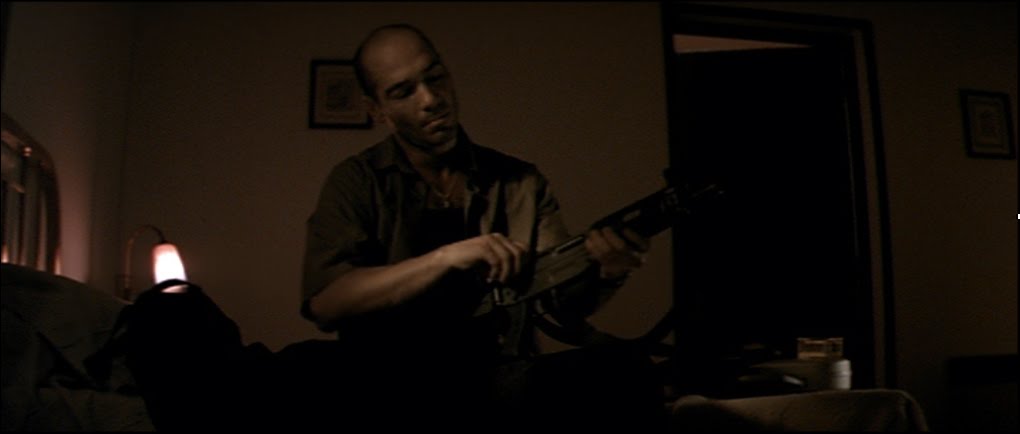
I haven’t mentioned the plot. Not going to, either. Assayas sets up one character, effects a nifty rug-pull by swapping the focus to another very quickly, then concludes the aforementioned twenty-minute scene with a narrative development that sends the film spinning off like a pinball, slamming its way through the crowded streets and neon-bathed clubs of Hong Kong. Some of it is pure pulp, yet Assayas’s subversive intelligence is always present. Argento and Madsen put in great work, and there are stellar supporting turns from Kelly Lin and Carl Ng. The whole thing looks amazing, and there’s an inspired final shot that showcases the most artful use of blurring I’ve ever seen. It captures an uncontrived moment of redemption, and allows Assayas’s heroine to drift upwards, out of the frame and out of the film, as if she were an angel.

The Red Siren


The marvellously named Oliver Megaton’s 2002 adaptation of Maurice G. Dantec’s prize-winning novel treads a fine line between Euro-pudding and halfway decent thriller. It’s a schizophrenic viewing experience, riddled with narrative and aesthetic conflicts, but the longer it goes on (the film is just short of two hours) the more compelling its fluctuations become. The fact that it veers so close to being an absolute train-wreck is almost a point in its favour.

Let’s get the synopsis out of the way. 12-year old Alice (Alexandra Negrao) wanders into a police station in Paris and asks to speak to Anita (Asia Argento), an inspector who finds herself on shaky ground when she believes Alice’s story of her mother, Eva Christensen (Frances Barber), as a murderer. Although Alice presents Anita with a DVD depicting a vicious scene of torture and death, Anita’s superior warns her off the case implying that the DVD could easily have been staged and referring to Eva as “untouchable”. Nonetheless, Anita starts poking around. There are no leads and Eva’s lawyer materializes faster than you can say “harassment”.

So far, so procedural. A young, vulnerable witness; a difficult to corroborate allegation; an inexperienced cop going out on a limb. The first twenty minutes pretty much play out in expected fashion.


Then Eva turns up, demanding Alice be released back into her care. She brings hired goons Koestler (Andrew Tiernan) and Travis (Johan Leysen) along with her; these squabbling incompetents give chase when Alice legs it from the police station. She evades them by hiding in the back of a car owned by Hugo (Jean-Marc Barr), a hitman on his way to meet his enigmatic handler Vitali (Vernon Dobtcheff).

Hugo is haunted by his accidental killing of a child in a war zone several years previously, and helps Alice out of a sense of expiation. Alice wants to go to Portugal to find her father, long suspected dead in a boating accident but very much alive and well (more than a hint of giallo plotting here). Eva and her well-connected fixer Colonel Vondt (Carlo Brandt) figure Portugal as Alice’s immediate destination, and set off to intercept her. Meanwhile, Anita is given the opportunity to work with the Portugese authorities and track the girl down.

So: we’ve gone from determined cop vs suspected killer procedural, to cross-Europe chase thriller. Throw in the fact that Hugo and Alice bond en route and it all gets very ‘Leon’-revisited.

And indeed if Megaton (arguably the only director who sounds like a Transformer) had focused solely on the Hugo/Alice relationship – which almost the film’s mid section – you could swiftly write off ‘The Red Siren’ as a ‘Leon’ rip-off, give a nod to Barr’s convincing turn as a professional killer, tip the hat to a good understated performance from Negrao, and move on.


But Megaton flits between so many discontiguous elements, often losing focus, that what could have been a taut if derivate little thriller instead emerges as an increasingly bloated and frequently bonkers piece of work. A whole backstory about Hugo’s association with Vitali and the nature of Vitali’s “organization” hovers in the wings, its shadow touching every scene Vitali’s in but with nothing ever explored, explained or revealed. Likewise the relationship between Eva and Vondt: there are heavy insinuations of voyeurism, sadism, power games and sexual tension, but Megaton doesn’t go anywhere with it. Eva herself is a pantomime villain: we’re told she owns two hundred companies and likes filming orgies and murders, but her psychopathology remains as unexplored as anything relating to Vitali. It doesn’t help either that the usually dependable Frances Barber plays her as a cross between Cruella de Ville and the Marquis de Sade in drag.

Tiernan and Leysen’s characterizations are so clichéd, they make your average Guy Ritchie cockney crim look positively Shakespearean. Dobtcheff delivers his dialogue so portentously you’d think he was doing Strindberg, while Brandt seems to be treating the whole enterprise as an audition for Bond villain duties. Barr and Negrao, as noted earlier, do sterling work, while Argento tries heroically to imbue a nothing role with steely determination but just ends up looking miserable for most of the time. Only the scenes in which Anita repeatedly deflates the ego of the lascivious Portugese cop she’s partnered with have any zing to them.

The decision to shoot the production in English was misjudged: with the cast variously hailing from Italy, France, Belgium, Switzerland, England and Portugal, the accents are all over the place and individual facility with the English language is variable at best. The dialogue smacks of losing quite a lot in translation and there are some howlingly clunky lines.


Aesthetically, stunning widescreen landscapes sit check by jowl with blandly anonymous interiors. Low key character moments are swamped by big action scenes, most notably an extended and brilliantly edited hotel shoot-out. The sense of conflict that I mentioned at the start of this review is omnipresent; the film often seems to be pulling against itself. That it doesn’t entirely derail and go up in flames is an achievement of itself.

Ultimately, ‘The Red Siren’ is an unfocused and deeply flawed film. It’s also entertaining (mostly for the wrong reasons) and I defy anyone to watch the climatic scene where Eva, gun in hand, chases her daughter across a beach yelling “Alice! Alice!” without this coming unbidden to mind:


Senin, 17 Januari 2011

FINAL GIRL FILM CLUB: The Church


About 30 minutes into Michele Soavi’s ‘The Church’, theologian/librarian Evan (Thomas Arana) delivers a whole screed of expositional dialogue vis-à-vis a group of Knights-Templar-alikes who were assigned to safeguarding the passage of crusaders but became a little too hardcore in their affinity for witch-hunting, punishing the ungodly and putting peaceful villages to the torch. Now, whether the dubbing was particularly poor in the first place or the sound was just dodgy in the print I watched, I had some difficulty in divining whether Evan referred to them as “teutonic knights” or “satanic knights”. I suspect the former, as there’d be no other reason for an Italian-made English-dubbed movie to be set in Germany (not that you’d know it apart from the occasional signboard in the background and a couple of characters called Heinrich and Lotte). But part of me would just love it if in fact it was the latter. The crusaders being protected by an outfit called the satanic knights. Awesome! That’s like a 12-step programme billing itself “the Budweiser temperance society”. Or the ‘Gone in 60 Seconds’ crew providing a secure car parking service.

But I digress.

Evan’s monologue is slightly unnecessary (and probably the only dull part in an otherwise breathlessly active movie) given that a 10-minute prologue has already showed us exactly what this bunch of knights – teutonic or satanic – get up to in the name of the Lord. They ride into town like the Wild Bunch with tin-can helmets (dig those crucifix shaped eye-slits!) …


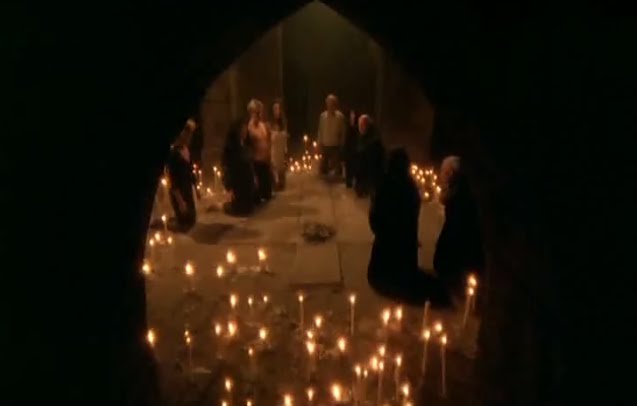
… decide that a young woman with a cross-shaped wound on her foot is an emissary of Satan and next thing you know it’s swords and lances a-go-go and the lime pit they dig to inter all the bodies in is big enough to provide the foundations for a bloody big church.

Then it’s flash forward to the here and now (well, 1989 at least) and guess where the rest of the movie takes place? You know, the movie called ‘The Church’. Yup, you guessed right.

Soavi – a protégé of Dario Argento (who produced and co-wrote ‘The Church’) – quickly establishes the main characters: the aforementioned Evan, fresco-restorer Lisa (Barbara Cupisti), grumpy sacristan Hermann (Roberto Corbiletto), his rebellious teenager daughter Lotte (Asia Argento), a stern Reverend* (Giovanni Lombardo Radice) and the radical forward-thinking Father Gus (Hugh Quarshie). You want to know how forward-thinking and radical Father Gus is? His hobby is archery and he uses the expression “goddamned” as an intensifier. That’s how goddamned radical!


Storywise, things get underway when Lisa discovers a fragment of parchment during restoration works in the cellar and takes it to Evan. It peaks their respective professional interests and they go back to Lisa’s pad to decode it and have sex. And yes, ladies and gentlemen, that’s how perfunctory the romantic subplot truly is.

Evan figures out what the parchment means and becomes consumed with the idea that the church could be built above the resting place of one of the tablets from the Ark of the Covenant. “Shades of Indiana Jones?” Lisa comments archly, but Evan’s deadly serious. So, it turns out, is the malignant force he unleashes during his after-hours treasure hunt in the bowels of the church. Soon enough – SPOILER ALERT – Evan has been possessed, weird shit is happening and it turns out that the psycho teutonic/satanic tin-can-helmet-wearing knights might actually have been right about all that witchcraft guff in the first place. END SPOILERS.


It’s just over an hour into a 100-minute film before Soavi really lets rip with the supernatural hokum and the inventive death scenes, and even then he’s still manically introducing new characters: a bickering teenage couple stranded on their way to a concert; a bickering OAP couple on the tourist trail; a bunch of school kids on a field trip; a narcissistic model, her entourage and a photographer shooting a bridal wear spread at the church. But Soavi’s camera has barely stayed still for that entire hour. ‘The Church’ was his second feature film as director (following the late-in-the-day giallo ‘Stage Fright’**) and his first with any real budget. The guy made the most of the opportunity. ‘The Church’ looks fabulous. The camera prowls and glides and serves up as many subjective POVs as anything in Argento’s filmography. Compositions are striking, sometimes deceptively so and sometimes aggressively off-kilter. There’s barely a single frame that isn’t in some way visually interesting.

This is Soavi’s great strength in ‘The Church’. Which is good, because its flaws are manifold. The narrative isn’t particularly original or engaging and there’s probably only 45 minutes’ worth of actual story if you boil it down. The acting veers between adequate and hammy, with only the 14-year-old Asia Argento showing any star quality.


The dialogue is utilitarian. Characterization? Haphazard, with the most sympathetic character – Father Gus – never being fleshed out into a genuine protagonist. The lack of chemistry between Arana and Cupisti doesn’t help either. Also on the minus list, the effects are rubbery at best, with the fish demon that leaps out at someone from a font leaving me wondering as to whether the ghost of Ed Wood had been summoned at a production-office séance, and the column of writhing figures emerging from the depths at the end less like a Hadean version of Gustav Vigelund’s Monolith than an out-take from Brian Yuzna’s deliberately cheesy ‘Society’.

I first saw ‘The Church’ on VHS in, I think, 1991 or 1992. Last night was only my second viewing. But it reminded me why I’d enjoyed it back then, in my late teens. Firstly, visually it’s as cool as fuck and back than I was even more of a sucker for iconography than I am now. Secondly, it dispenses with coherence and delivers what I wanted from a horror movie back then: hidden secrets, demonic curses, gothic imagery, dark rituals, imaginative gore and a bit of nudity. I’m pleased to report that ‘The Church’ hit all those same notes for me twenty years later. Maybe more so. Because it also provided a nice little nostalgia trip back to a pre-torture-porn era when it was okay for horror movies to be fun.


*If he was referred to as anything other than “your grace”, I missed it.

**Which has nothing to do with the Hitchcock movie. Mainly by dint of Hitch not including a psychotic killer with a bird mask and a chainsaw in his movie.

Senin, 20 September 2010

The Stendahl Syndrome

Posted as part of Operation 101010 (and to coincide with Asia Argento's 35th birthday)
Category:
gialli / In category: 8 of 10 / Overall: 74 of 100


The opening scene in Dario Argento’s ‘Phenomena’ has a young teenage girl left behind on a school trip and murdered by an unseen killer. Her face is smashed through a glass window. She’s decapitated and her head plunges into a river and is carried along by the raging current. The schoolgirl is played by Fiore Argento, the director’s daughter.

The opening scene in ‘The Stendahl Syndrome has Detective Anna Manni attend the Uffizi Gallery in Florence where, afflicted by the titular psychological condition, she suffers a fainting spell, falls and catches her mouth on the corner of a marble plinth, blood spattering across the cool floor of the gallery. The policewoman is played by Asia Argento, the director’s other daughter.

All things considered, Fiore got the better deal. As ‘The Stendahl Syndrome’ progresses, Anna is targeted by Alfredo Grossi (Thomas Kretschmann), a serial rapist who has just started adding murder to his repertoire. He’s present at the gallery, where he steals her gun and finds out where she lives while she’s unconscious. Shortly afterwards, she’s attacked in her home and sexually assaulted. Passing out, she regains consciousness in Alfredo’s car where he’s busy assaulting another woman, who he casually murders in front of Anna. She escapes and, at the behest of the police psychologist, returns to her home town to recuperate. Alfredo follows her and, despite a round-the-clock guard posted by the local constabulary, stages an abduction. More rape follows.

What the fuck was going through Argento’s head when he cast his then 20-year old daughter in this role is not something I want to think about. What it must have been like on set boggles the mind. What kind of direction did Argento give Kretschmann, for Christ’s sake? “Okay, Thomas, in this scene you’ll be raping Asia for about five minutes, she’ll roll back her head as if she’s about to pass out, so you’ll slap her a couple of times to keep her awake, then you’ll take a razor blade out of your mouth and we’ll get to the really good part of the scene. Did I mention I’m her father, by the way?”

It’s this aspect – dude directs his daughter getting psychologically tormented and brutally raped for the first half of the film – that gives me such a hard time with ‘The Stendahl Syndrome’. Any other actress (um, except Fiore Argento of course) and the gruelling scenes between Alfredo and Anna would still be as provocative and uncomfortable; as it is, they’re provocative and uncomfortable for the wrong reason: an almost incestuous, meta-textual reason that takes you out of the narrative and the characters’ lives and reminds you that you’re watching a film.

Anything that throws you out of a film or a book by reminding you that you’re experiencing a piece of fiction that has been manufactured is by its own definition a serious flaw. If you’re subsequently unable to re-engage with that film or book on the same level, then it’s a flaw that characterises the work as a failure. So is ‘The Stendahl Syndrome’ a flawed work or a failure?

Personally, despite my reservations about Argento’s casting decisions, I’d be hesitant to deem it a failure. Although I stand by my assertion, made elsewhere on this blog, that ‘Phenomena’ remains the last great Argento film – ‘Phenomena’ caps a run of at least half a dozen truly great movies whereas ‘The Stendahl Syndrome’ follows the moderate disappointments of ‘Two Evil Eyes’ and ‘Trauma’ and preceeding everything from the fuck-awful ‘Phantom of the Opera’ to the bargain basement ‘Mother of Tears’ – it can’t be denied that‘The Stendahl Syndrome’ takes some interesting turns, benefits from committed and passionate performances from its leads, and has the distinction of being the last truly visually accomplished work on Argento’s CV.

It’s the very concept that allows Argento to go crazy in some of the early scenes. Stendahl syndrome – named after the novelist (best known for ‘The Scarlet and the Black’) – also known as hyperkulturemia results in the sufferer undergoing psychosomatic symptoms in the presence of works of art or overwhelming natural beauty. Argento opens the film with a wordless seven-minute sequence that tracks Anna’s journey to and around the Uffizi Gallery, generating a sense of the off-kilter right from the outset. Inside, visceral and sometimes grotesque Renaissance canvases and sculptures seem to overwhelm her. As she loses consciousness, Argento depicts her plunging into one of the paintings. Later, in one of the film’s best moments, a fully conscious Anna finds herself drawn to – and then into – a huge canvas depicting a waterfall (the location becomes meaningful as events take a darker turn).


If nothing in the second half of the film matches the bravura of these moments (indeed, Anna seems to overcome the Stendahl Syndrome), Argento makes the bold decision to change horses in midstream and turn a psychosexual cat-and-mouse thriller into a study in aftermath. A shade after the hour mark, he delivers a scene most directors would have saved for the climax, then has Anna slowly try to reintegrate into a normal life following her trauma at Alfredo’s hands. She changes her appearance, undergoes a series of brittle appointments with her psychologist, and tentatively begins a relationship with a sensitive young art student. Then she thinks she sees Alfredo on a crowded street.

Between Anna’s transformation from brunette to blonde and the directorial sleight of hand surrounding a late-in-the-game murder, the Hitchcockian parallels are explicit. Anyone who’s been paying attention will see where Argento’s going with the denouement long before a riverbank revelation leaves the film with only one possible outcome. While no more downbeat than the ending to, say, ‘Deep Red’ or ‘Tenebrae’, it’s emotionally downbeat whereas those films are viscerally downbeat. Nonetheless, Argento plays fair with the ending and doesn’t try to sweeten it with any false notes of reassurance.