Tampilkan postingan dengan label Michele Soavi. Tampilkan semua postingan

Minggu, 14 Agustus 2011

GIALLO SUNDAY: A Blade in the Dark


Until I watched Lamberto Bava’s ‘A Blade in the Dark’, my favourite line of dialogue in a giallo was a straight toss-up between “Right, send in the perverts” (‘The Bird with the Crystal Plumage’) and “I killed them because they were dolls, just stupid dolls” (‘Torso’).

I now have not one but two lines of dialogue – from the same film – that challenge these. The first, during an argument between film score composer Bruno (Andrea Occhipinti) and his actress girlfriend Julia (Lara Naszinsky), is apropos of her obsession with sun-bathing: “Is it possible you’re such a vacant nerd?” Bruno snaps. “Your satisfaction is to sit like a frog in the sun.”

Calling your g/f a nerd and likening her to a frog in the same breath – way to go, Bruno, you silver tongued devil, you.


The second concerns the murderer’s psychopathology. Now, I watched a lot of gialli – and I’ll happily admit that there’s still a good number of titles I have yet to acquaint myself with – and the motivations for a genre’s worth of black-gloved psychopaths are manifold: childhood traumas, botched abortions, inheritances, schoolgirl prostitution rings, sexual hang-ups, religious mania, property deals, inconvenient spouses and just plain old blood-lust. ‘A Blade in the Dark’ gives us a killer the key to whose psychology is – ready for this – “a morbid fear of tennis balls bouncing in the night”.

Because I don’t know about you, but those nocturnally buoyant tennis balls give me the willies good and proper. The more I think about it, the more I’m at a loss to understand why other filmmakers haven’t picked up on this. (“Are the snooker cues still screaming, Clarice?” “You can take our lives, but you’ll never take … our penalty!”)

Okay, let’s hit pause on the sarcasm and rewind for a plot synopsis. Bruno rents an isolated villa from rich pal Tony (Michele Soavi) so he can have some peace and quiet while he works on the score for a horror film directed by Sandra (Anny Papa). Between visits from the erratic Julia, he is visited by the flighty Katia (Valeria Cavalli) and the seductive Angela (Fabiola Toledo), both of whom have connections to the previous tenant, an individual known only as Linda.

In short order Katia and Angela go missing, Katia’s diary is torn up and burned, and a tape reel on which Bruno hears a voice saying something that seems to connect Linda to the strange events currently unfolding is destroyed. Bruno questions shifty groundsman Giovanni (Stanko Molnar) about the previous tenant, but he’s less than forthcoming. Then Sandra lets its slip that she has a connection to the mysterious Linda. Bruno grows increasingly edgy as events escalate, but without a body to prove that Katia or Angela have been murdered, and his story roundly scorned by Julia, he finds himself with no-one to whom he can turn.


Where it succeeds, ‘A Blade in the Dark’ does so on Bava’s twitchy directorial style: from his father and Dario Argento he obviously learned the effectiveness of a prowling, subjective camera. The villa – a building so seemingly sprawling that half the time I wanted to cast an eye over the architects drawings just to see if it really was that big – offers opportunities for tense cat ‘n’ mouse sequences and architecture porn cinematography which are both seized with equal glee.

Made in 1983, it harks back to the gialli of the previous decade, particularly Argento’s ‘Deep Red’: musician protagonist, long sequences of said reluctant hero exploring a house that may or may not be deserted, a major clue (visual in ‘Deep Red’; dialogue in ‘A Blade in the Dark’) hidden in plain sight, sexual ambiguity in the last reel revelation. And for the most part it’s a stylish and compelling enough throwback.

However, there’s little investment in the ostensible mystery with Bruno, atypical for a giallo protagonist, neither witnessing an actual murder or getting hung up on an overlooked clue, the importance of which only becomes clear late in the day. Bruno’s tenuous reasons for believing that Katia and Angela have been killed – while explicitly proved to the audience in two extended setpieces – don’t really hold water and make for some awkwardly exposited scenes when he tries to discuss his concerns with Julie, Sandra or Tony.

Katia’s diary, the strange voice on the tape (no explanation for which is ever satisfactorily provided) and the peregrinations of the thuggish Giovanni are herrings of various shades of red, but Bruno never really pursues or discounts any of these angles. There’s an illogicality about ‘A Blade in the Dark’ which – while it’s kind of petty to carp about illogicality in gialli – becomes increasingly notable the longer the film continues. (Subject of which, twenty minutes shorter would have been an ideal length.)


This illogicality is present in scene after scene. It’s there in the discontinuity of Sandra discussing the revelation in the final reel of her film (“wait till you see reel twelve”), a clue which ties in to the killer’s motivation, only for the killer to break into the studio and hack apart the contents of reel ten (“the final reel,” as Sandra’s projectionist breathlessly gasps). It’s there in the ability of the killer to be at Bruno’s villa (described early on in the film as “isolated”) just minutes after vandalizing the film, while it takes Bruno three or four times as long to get back after he realizes that Julia is in danger. It’s there in the scene where Bruno asks Julia to accompany her on an errand and she snubs his company for the pleasures of sunbathing (hence the aforementioned “vacant nerd”/“frog in the sun” diatribe; Bruno’s errand turns out to be a secretive enquiry into Julia’s recent inexplicable behavior … so why invite her along?

‘A Blade in the Dark’ often seems like a collection of cool set-pieces strung together by a patchwork quilt of a narrative that hadn’t been particularly well thought out. Don’t get me wrong, I’ve seen plenty of gialli you can say that about which have been deliriously entertaining. ‘A Blade in the Dark’, for all its technical prowess, doesn’t quite achieve the delirium and grand guignol gratuitousness that defines the top flight examples of the genre.


Senin, 17 Januari 2011

FINAL GIRL FILM CLUB: The Church


About 30 minutes into Michele Soavi’s ‘The Church’, theologian/librarian Evan (Thomas Arana) delivers a whole screed of expositional dialogue vis-à-vis a group of Knights-Templar-alikes who were assigned to safeguarding the passage of crusaders but became a little too hardcore in their affinity for witch-hunting, punishing the ungodly and putting peaceful villages to the torch. Now, whether the dubbing was particularly poor in the first place or the sound was just dodgy in the print I watched, I had some difficulty in divining whether Evan referred to them as “teutonic knights” or “satanic knights”. I suspect the former, as there’d be no other reason for an Italian-made English-dubbed movie to be set in Germany (not that you’d know it apart from the occasional signboard in the background and a couple of characters called Heinrich and Lotte). But part of me would just love it if in fact it was the latter. The crusaders being protected by an outfit called the satanic knights. Awesome! That’s like a 12-step programme billing itself “the Budweiser temperance society”. Or the ‘Gone in 60 Seconds’ crew providing a secure car parking service.

But I digress.

Evan’s monologue is slightly unnecessary (and probably the only dull part in an otherwise breathlessly active movie) given that a 10-minute prologue has already showed us exactly what this bunch of knights – teutonic or satanic – get up to in the name of the Lord. They ride into town like the Wild Bunch with tin-can helmets (dig those crucifix shaped eye-slits!) …


… decide that a young woman with a cross-shaped wound on her foot is an emissary of Satan and next thing you know it’s swords and lances a-go-go and the lime pit they dig to inter all the bodies in is big enough to provide the foundations for a bloody big church.

Then it’s flash forward to the here and now (well, 1989 at least) and guess where the rest of the movie takes place? You know, the movie called ‘The Church’. Yup, you guessed right.

Soavi – a protégé of Dario Argento (who produced and co-wrote ‘The Church’) – quickly establishes the main characters: the aforementioned Evan, fresco-restorer Lisa (Barbara Cupisti), grumpy sacristan Hermann (Roberto Corbiletto), his rebellious teenager daughter Lotte (Asia Argento), a stern Reverend* (Giovanni Lombardo Radice) and the radical forward-thinking Father Gus (Hugh Quarshie). You want to know how forward-thinking and radical Father Gus is? His hobby is archery and he uses the expression “goddamned” as an intensifier. That’s how goddamned radical!


Storywise, things get underway when Lisa discovers a fragment of parchment during restoration works in the cellar and takes it to Evan. It peaks their respective professional interests and they go back to Lisa’s pad to decode it and have sex. And yes, ladies and gentlemen, that’s how perfunctory the romantic subplot truly is.

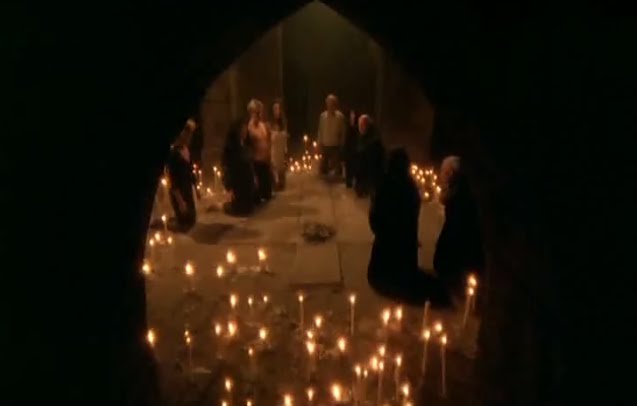
Evan figures out what the parchment means and becomes consumed with the idea that the church could be built above the resting place of one of the tablets from the Ark of the Covenant. “Shades of Indiana Jones?” Lisa comments archly, but Evan’s deadly serious. So, it turns out, is the malignant force he unleashes during his after-hours treasure hunt in the bowels of the church. Soon enough – SPOILER ALERT – Evan has been possessed, weird shit is happening and it turns out that the psycho teutonic/satanic tin-can-helmet-wearing knights might actually have been right about all that witchcraft guff in the first place. END SPOILERS.


It’s just over an hour into a 100-minute film before Soavi really lets rip with the supernatural hokum and the inventive death scenes, and even then he’s still manically introducing new characters: a bickering teenage couple stranded on their way to a concert; a bickering OAP couple on the tourist trail; a bunch of school kids on a field trip; a narcissistic model, her entourage and a photographer shooting a bridal wear spread at the church. But Soavi’s camera has barely stayed still for that entire hour. ‘The Church’ was his second feature film as director (following the late-in-the-day giallo ‘Stage Fright’**) and his first with any real budget. The guy made the most of the opportunity. ‘The Church’ looks fabulous. The camera prowls and glides and serves up as many subjective POVs as anything in Argento’s filmography. Compositions are striking, sometimes deceptively so and sometimes aggressively off-kilter. There’s barely a single frame that isn’t in some way visually interesting.

This is Soavi’s great strength in ‘The Church’. Which is good, because its flaws are manifold. The narrative isn’t particularly original or engaging and there’s probably only 45 minutes’ worth of actual story if you boil it down. The acting veers between adequate and hammy, with only the 14-year-old Asia Argento showing any star quality.


The dialogue is utilitarian. Characterization? Haphazard, with the most sympathetic character – Father Gus – never being fleshed out into a genuine protagonist. The lack of chemistry between Arana and Cupisti doesn’t help either. Also on the minus list, the effects are rubbery at best, with the fish demon that leaps out at someone from a font leaving me wondering as to whether the ghost of Ed Wood had been summoned at a production-office séance, and the column of writhing figures emerging from the depths at the end less like a Hadean version of Gustav Vigelund’s Monolith than an out-take from Brian Yuzna’s deliberately cheesy ‘Society’.

I first saw ‘The Church’ on VHS in, I think, 1991 or 1992. Last night was only my second viewing. But it reminded me why I’d enjoyed it back then, in my late teens. Firstly, visually it’s as cool as fuck and back than I was even more of a sucker for iconography than I am now. Secondly, it dispenses with coherence and delivers what I wanted from a horror movie back then: hidden secrets, demonic curses, gothic imagery, dark rituals, imaginative gore and a bit of nudity. I’m pleased to report that ‘The Church’ hit all those same notes for me twenty years later. Maybe more so. Because it also provided a nice little nostalgia trip back to a pre-torture-porn era when it was okay for horror movies to be fun.


*If he was referred to as anything other than “your grace”, I missed it.

**Which has nothing to do with the Hitchcock movie. Mainly by dint of Hitch not including a psychotic killer with a bird mask and a chainsaw in his movie.