
Full disclosure: I’ve somehow never got round to seeing the original ‘White Noise’. I saw ‘White Noise: The Light’ at the cinema because Mrs F was keen on it and it starred Nathan Fillion, who I’d liked a lot in ‘Serenity’ and ‘Slither’. I watched it again a couple of nights ago (it’s a staple of Mrs F’s DVD collection – she also likes Nathan Fillion, which is kind of understandable: dude has the same initials as yours truly and the same kind of rumpled je ne sais quoi; but having said that, keep your hands off my woman, Nate).
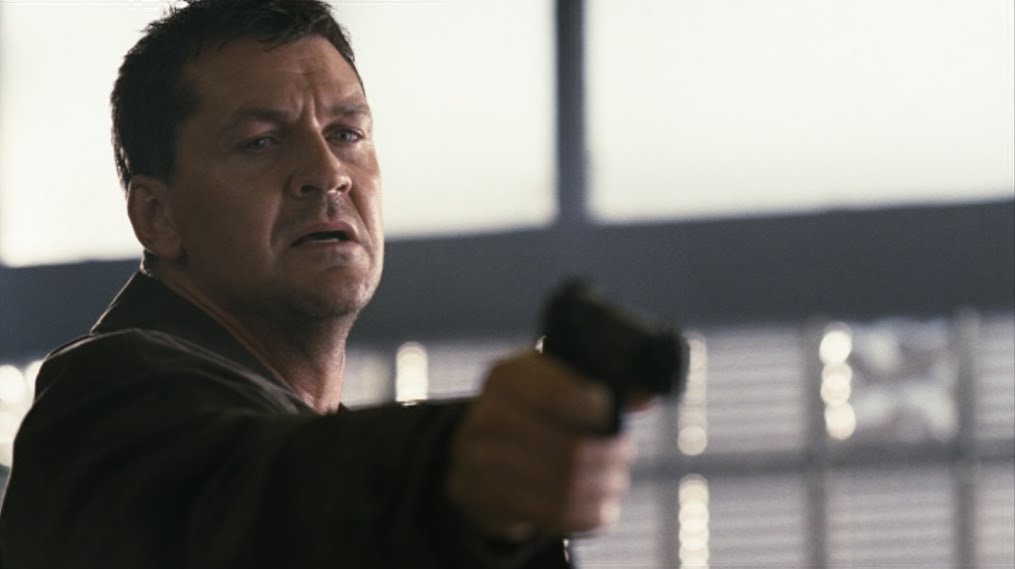
‘WN: TL’ kicks off with Abe Dale (Fillion) and his wife Rebecca (Kendall Cross) celebrating their anniversary. Over breakfast at a diner, their son Danny (Joshua Ballard) complains of feeling unwell. Seconds later, Rebecca appears to have some kind of fit. Seconds after that, a total stranger by the name of Henry Caine (Craig Fairbrass) enters the diner, pulls a gun and shoots Rebecca and Danny before turning the pistol on himself.
As you’d imagine, Abe’s life goes to hell. A few months later, unable to come to terms, he attempts suicide. Due to the intervention of best bud Marty (Adrian Holmes) and a calm-under-crisis medical team, Abe is brought back from the brink of death. Literally.
Dr Karras (William MacDonald), who specializes in near death experiences and precognition, takes on Abe as his patient. Meanwhile, widowed nurse Sherry (Katee Sackhoff) is drawn to Abe. Dr Karras – and if the character name strikes you as heavy-handed horror movie in-joke, consider the Biblical connotations of having the Dale family named Abraham, Rebecca and Daniel, and their antagonist being called Caine – seems to fulfil the purpose of delivery-system-for-expository-dialogue, the audience’s guide to the weird shit that starts happening around Abe, he’s abruptly killed off and Abe realizes the significance of the aura he saw emanating from Dr K during their consultation.
Abe realizes that he can identify people who are about to die. After a couple of initial hesitations and a failed attempt at saving a wino crossing a railway line from death-by-goods-train, Abe gets into his groove and – essentially – starts playing God. As good as he feels about saving the due-to-die, he’s perplexed by the accusatory visitations he experiences from the already-dead.
Halfway through, a decent story about a man’s grief leavened by his ability to save (the kind of thing you’d imagine the restrained M. Night Shyamalan of the early part of his career doing) barrels off in a different direction when Abe discovers that Caine had earlier interceded in his wife and son’s life to their benefit, saving them from a potential automobile accident. Abe investigates why Caine turned from saviour to killer … and this is where things get a bit wobbly.

On one hand, director Patrick Lussier and writer Matt Venne deliver a conceptually interesting morality tale on the dangers of playing God, with Abe’s ostensible acts of charity going spectacularly wrong when those who were supposed to die but didn’t become the vessels of something less than holy on the third day of their faux resurrection. And yes, the Biblical malarkey and the whole “tria mera” idea is incorporated quite effectively. But – and here comes the “on the other hand” bit – this is how the three people Abe saves were supposed to die: crushed under a vehicle while trying to effect a repair courtesy of a speeding motorist; kicked to death by a gang of oiks while trying to protect his girlfriend; and dragged into a van by a rapist/murderer in an underground car park.
Now, it’s one thing to suggest that someone whose time is due shouldn’t be saved, and that by saving them Abe has monkeyed with God’s grand design. But Abe’s terrible responsibility in having to set things, ahem, right kind of loses its moral string when you reflect that God’s grand design includes agonising and unnecessary deaths, not least in the latter case where it’s implied that brutality and sexual assault, for an indefinite period of time, would be the order of the business prior to riding the night train to the big adios.
Granted, one of the key aspects of the horror genre is its admixture of catharsis and schadenfreude, i.e. while all this bad shit is happening to someone else, it’s not happening to you therefore you breathe a sigh of relief, kick back and enjoy having the piss scared out of you. But there’s something about ‘White Noise: The Light’ that leaves a nasty taste in the mouth. The breakdown of internal logic (why doesn’t Abe turn bad on the last day given that he’s essentially been saved against his will? in fact, why isn’t everyone successfully discharged from the emergency ward similarly effected?) isn’t helped by two last-minute narrative cheats designed to give Abe redemption and Caine damnation, even though they were essentially victims of the same cosmic quandary.

Or it could just be that, as James Coburn puts it in ‘Cross of Iron, “God is a sadist and probably doesn’t even know it.”


