Kamis, 16 Desember 2010

WINTER OF DISCONTENT: The Killer Nun


Meet Sister Geraldine (Anita Ekberg). She’s the assistant to patriarchal Dr Poirret (Massimo Serato) at a convent hospital. Poirret has recently removed a benign tumour from Sister Geraldine’s brain, but she is still experiencing symptoms that Poirret is convinced are psychosomatic.

Sister Geraldine has a morphine habit, a guilt complex and the temptation of sharing a room with the nubile Sister Mathilde (Paola Morra); both of them sleep naked in decidedly un-nun-like fashion and Sister Mathilde is sending some fairly heavy Sapphic vibes in Sister Geraldine’s direction.

Sister Geraldine begs Dr Poirret to put her back under observation, but he refuses. She petitions her stony-visaged Mother Superior (Alida Valli) for help, but is curtly told that “a nun’s vocation is to suffer”. Her neuroses spill out into her dealings with the patients. She becomes increasingly domineering in the way she treats them, and hesitates during crucial medical procedures with Poirret, putting lives at risk. Poirret’s frustrations with her behaviour become antagonistic and she responds by scuppering his future at the hospital by blackmailing the Clinical Director (Daniele Dublino) into misrepresenting Poirret before the board.

His replacement, the younger and immediately popular Dr Roland (Joe Dallesandro), begins to have doubts as to the veracity of Poirret’s dismissal. In the meantime, a series of mysterious deaths occur and Sister Geraldine’s behaviour suggests that her mental health is fragmenting.


For all that its title and a couple of almost lesbian scenes between Sister Geraldine and Sister Mathilde (there’s nudity but no sex) scream nunsploitation, Guilio Berruti’s controversy magnet is a giallo from start to finish. Unfortunately, it’s not a particularly inventive one and the killer’s identity is so easily guessable the denouement is an insult.

On the plus side, Ekberg goes at the role full-throttle, and often gives a real sense of someone torn between spiritual piety and the yearning for sexual fulfilment. The whole thing is shot decently enough and the murder scenes are varied, some delivered swiftly for maximum shock value, and one gruesomely protracted. An oblique flashback linking into the killer’s motivation is effectively incorporated into an elliptically edited sequence during one of Sister Geraldine’s morphine fixes, perspective and reality fragmenting as Geraldine’s mind loops the loop.

There’s another great moment where the patients, suspecting that Sister Geraldine has killed at least one of their number, turn a prayer session into an act of rebellion that turns Geraldine into a screaming wreck. The scene is effected as the camera floats slowly back along a corridor (I was reminded of Hitchcock’s ‘Frenzy’) and a chorus of disembodied voices grow louder and louder on the soundtrack.


‘The Killer Nun’ doesn’t work very well as a mystery, and – despite all the boxes it seems to tick based on a cursory synopsis – it’s fairly tame as an example of nunsploitation. It does have enough good moments, however, to make it worthwhile and Ekberg is highly memorable, whether bullying the patients, jacking up (insert ‘Sweet Sister Morphine’ gag) or getting her civvies on and cruising bars for some NSA fun. ‘Inn of the Sixth Happiness’ it most certainly isn’t.

Rabu, 15 Desember 2010

WINTER OF DISCONTENT: Northville Cemetery Massacre


In the last month or so, my trawl through exploitation cinema has taken in blaxploitation, Nazisploitation, sexploitation, hicksploitation, gialli, rape/revenge, home invasion, cannibalism, women in prison and Japanese cheapies of the dude-that’s-fucked-up variety. The delightful wrongness of ‘The Candy Snatchers’ has offset the grubby ennui of ‘The House on Straw Hill’. The hymn to the female form that is Laura Gemser and Ely Galleani taking a shower together is something I focus my mind on with the utmost degree of concentration when the mention of the words “black” and “Emanuelle” in the same sentence threatens to conjure up, unbidden, the sight of a woman polishing some equine lighthouse. So to speak.

Now I find myself halfway through December, with a just a week and a half till the grand finale, when the winner of the caption competition (you’ve still got time to enter; just click the pic on the sidebar) gets to pick, from a shortlist of six, the final title in this year’s Winter of Discontent. I say “this year’s” because the list of titles I drew up, based on their availability online or borrowed from friends, was enough to for at least two more Winters of Discontent as well as a little something I’ve got planned for early next year. More on that later.

So there I was trying to whittle down all the possible bits of filth, depravity, violence, sexual licentiousness and profanity the master list presented me with, when I realised that I hadn’t featured any bikersploitation or nunsploitation. Consider that oversight rectified. We’ll be getting into some bad habits (sorry!) tomorrow, but tonight’s film features a bunch of boozing, brawling, bristly-bearded bad-ass bikers.

Ladies and gentlemen: ‘Northville Cemetery Massacre’.


The opening scene has an elderly couple, stranded on the side of the road after a puncture, cowering in their car as a motorcycle gang terrorize them. Then kindly change their tyre and roar off. While not entirely unexpected in its execution, it’s a reasonably cute scene, playfully subverting audience expectations. For the next twenty minutes, sod all happens. Nah, actually things do happen – stoner Chris (David Hyry) hitches a ride with the bikers on the condition that he’ll break out his stash; some white trash cops hassle them; Chris hooks up with his girlfriend Lynn (Jan Sisk); and everyone whoops it up at a biker wedding – but co-writers/co-directors William Dear and Thomas L. Dyke string everything together so arbitrarily, concentrating more on endless scenes of Harley Davidsons roaring up and down country roads than on characterisation (the biker gang was apparently played by an actual biker gang and I got the impression that Dear and Dyke were kind of hesitant to give them much in the way of direction or foist anything as complicated as a script on them). Dialogue is a minimal and a horrible C&W ballad tells the story instead.

At around the one-third mark, there’s an attempt at a story. Chris and Lynn, left behind after a make-out session in a barn when the police move the bikers on, are set on by corrupt cop Puttnam (Craig Collicott), who knocks Chris unconscious and rapes Lynn. He then bullies her into silence and leads her father to believe that the biker gang were responsible. Lynn’s influential father gives Puttnam his by-your-leave to deal with the bikers unofficially.


‘Northville Cemetery Massacre’ is a grindhouse good ole boy flick, with the bikers sanctified as an essentially peace-loving bunch who just want to ride their hogs, chug some JD, throw darts at a pictures of Richard Nixon and smoke a little weed. So what if they hang up a swastika in their clubhouse? In what seems like a feature-length exposition of the last scene of ‘Easy Rider’ – the freedom-loving bikers arbitrarily gunned down (except with the bikers here at least returning a few shots) – ‘Northville Cemetery Massacre’ wears its anti-authoritarian heart on its sleeve. And that’s fine by me. Only it doesn’t quite work. The freewheeling first third – which I’d be tempted to call experimental in its approach if I wasn’t convinced that it’s actually the product of simple ineptitude – gives way to an entirely predictable narrative which nonetheless wants to freight its no-one-here-gets-out-alive final sequence with an almost Shakespearean hint of tragedy (will Lynn tell her father the real story in time to prevent bloodshed?)

Essentially, ‘Northville Cemetery Massacre’ fancies itself as an avante garde message movie which balances exploitation with pathos and plays out to a C&W soundtrack designed to appeal to the backwoods shit-kicker market. Unfortunately, it fails on just about every level.

Selasa, 14 Desember 2010

WINTER OF DISCONTENT: Vampire Girl vs Frankenstein Girl


Before I begin this review properly (or as properly as can be expected for a review of a film that scores this highly on the what-the-fuck-o-meter), please join me in a round of applause for whoever thought up that title. Seriously. Let me give it its own paragraph:

‘Vampire Girl vs Frankenstein Girl’.

Say it aloud. Drop it in conversation with colleagues. Recommend it to your mother. I guarantee you, the title alone will get a reaction.

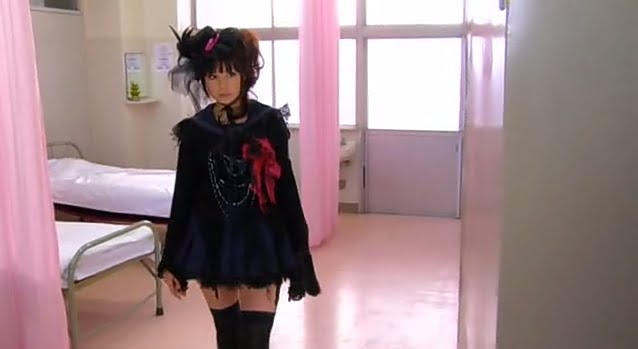
Now consider the fact that the titular antagonists are schoolgirls. One of whom wears ridiculously short and flouncy skirts. Time for a screenshot, methinks. Imagine yourself in a weird alternative universe where this ensemble is an acceptable school uniform:


The young lady in the picture is Keiko (the frankly gorgeous Eri Otoguro), spoiled brat high-school princess and leader of a group of chavettes who terrorize the sensitive Jyugon (Takumi Saito) into being Keiko’s boyfriend. Then transfer student Monami (the appealingly winsome Yukie Kawamura) turns up and decides she quite likes Jyugon as well.

Two girls, one guy, rivalry, jealousy, bitchiness … ho hum, yeah, whatever. Or at least, that would be my response to a normal film which navigated these narrative waters. And by normal I mean any film that isn’t ‘Vampire Girl vs Frankenstein Girl’.

(Can we have another round of applause for that title, please?)

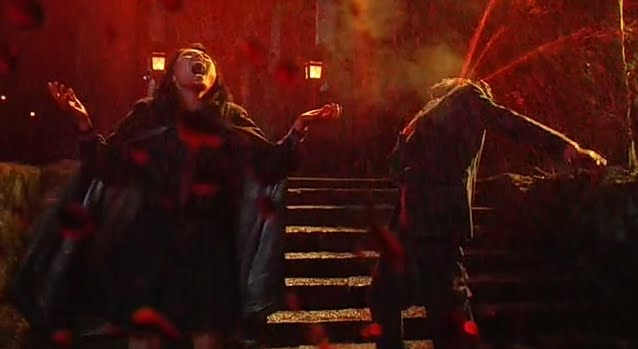
‘Vampire Girl vs Frankenstein Girl’ is about so much more than Keiko and Monami going at it hammer and tongues over who gets to be with Jyugon. (Because, yeah, two extremely fanciable girls bitch-slapping each other for first dibs on that good good Fulwood lovin’ was something that happened all the time during my schooldays … not!) It’s also about the difficulty of an outsider finding acceptance in the hierarchically structured high-school environment. Hence we have the self-harming squad, determined to triumph and this year’s wrist cutting rally …


… and a group of Japanese students who make themselves up as Africa-Americans (“the coolest race ever”) and demand black power.


The above pictures should tell you all you need to know about ‘Vampire Girl vs Frankenstein Girl’. In the temple of wrong, this motherfucker occupies the penthouse suite. Let me add another element into the equation: Monami is a vampire who’s given over to performing slo-mo dance routines after decapitating her victims, while Keiko’s vice-principal father secretly dresses as a witch doctor and conducts scientific experiments towards the reanimation of dead bodies assisted by oversexed school nurse Midori (Sayaka Kametami).


And we’ve not even considered the hunchbacked janitor Igor (Jiji Bu) who spends inordinate amounts of time feeding things into the incinerator. Or the accident which results in Keiko’s father finally succeeding in his reanimation experiments … by using his daughter as a test subject. Hence the title. ‘Vampire Girl vs Frankenstein Girl’.

As with my review of ‘The Machine Girl’, I probably need say no more at this point. You’ll have got the picture by now. Schoolgirls in short skirts, one a vampire, the other the sexiest version of Frankenstein’s monster ever conjured by the magic of the movies. Updated to allow for Phillips head screws instead of bolts through the neck, Keiko is possessed of the ability to detach her arm and either use it as a boomerang kitted out with a Stanley knife, or attach it to her head and effectively turn herself into an autogiro, the better to pursue a schoolgirl vampire whose cloak gives her the ability to fly.

Which is not a sentence I ever envisaged myself typing.

‘Vampire Girl vs Frankenstein Girl’ (I don’t think I could ever get tired of typing that title) was produced by the same company behind ‘The Machine Girl’ and boasts a similar aesthetic, budgetary limitation and thespian-challenged cast. It’s also about a thousand times more fun. The effects are equally cheesy, although a vampire’s POV rendering of humans as walking capillaries is unexpectedly creepy.


Fuelled by a soundtrack that veers from J-pop to J-metal by way of what sounds disturbingly like J-C&W, ‘Vampire Girl vs Frankenstein Girl’ is packed with hysterically stupid set-pieces, tsunamis of blood-letting, humour so politically incorrect (particularly in its racial stereotypes) that it makes your average ‘Carry On’ film look like a Merchant Ivory production, and levels of body horror to make David Cronenberg take a couple of aspirin and lie down in a darkened room.

The what-the-fuck-o-meter malfunctioned while I was watching this film. My sanity was affected by it. I have discovered a new appreciation for schoolgirls in sailor suits played by actresses in their late twenties. I fear my perception of the world may never be the same again.

And if that’s not a recommendation, I don’t know what is.

Senin, 13 Desember 2010

WINTER OF DISCONTENT: The Machine Girl

I’m guessing the genesis of ‘The Machine Girl’ went something like this: writer/director Noboru Iguchi watched the ‘Planet Terror’ half of ‘Grindhouse’, got ridiculously overexcited at the sight of Rose MacGowan with a machinegun leg, rushed out before Tarantino’s ‘Death Proof’ even had a chance to get the handbrake off, dashed into the nearest saki bar, downed a few glasses and drafted a pitch on the back of a napkin.

‘The Machine Girl’ is about a high-school girl named Ami (Minase Yashiro) who is juggling her education with her responsibilities to her younger brother Yu (Ryosuke Kawamura) after the suicide of their parents, shamed by a wholly unfounded murder accusation levelled against them by a corrupt cop who, it turns out, is in cahoots with Yakuza bigshot Ryuji Kimura (Kentaro Shimazu). To complicate matters, Kimura’s thuggish son Sho (Nobuhiro Nishihara) is busily establishing himself as a bargain-basement version of his dear old pa. Sho and his gang are tormenting Yu and his best friend Takeshi, demanding money with menaces.

When Yu can’t pony up enough, Sho and his posse up the ante. Ami’s attempts to save Yu and Takeshi are hampered by the intervention of a bunch of would-be rapists, who she kicks the ever-loving shit out of. As a result of the delay, she finds Yu and Takeshi dead. Ami goes out for revenge.


Quickly tracking down one of the bullies, she gets into a confrontation with the lad’s parents. The ensuing fight results in her arm being badly burned; nonetheless, she extracts a bloody revenge. The trail leads to Kimura’s well-guarded estate. Ami breaches the property and violence ensues. Unfortunately, she’s outnumbered and captured. Kimura and his sadistic trophy wife Violet (Honaka) torture her, during the process of which her arm is cut off.

Nonetheless, Ami escapes and is taken in by mechanic and hard-ass milf Miki (Asami) who, incidentally, is Takeshi’s mother. Initially hostile towards Ami because of the stigma surrounding her parents’ death, Miki blames her for what happened to Takeshi. Eventually, however, Ami and Miki bond over a fistfight and decide to join forces. Miki’s husband kindly makes Ami a prosthetic arm. In the shape of a fucking big machinegun.

‘The Machine Girl’ has enough narrative to fill a postage stamp and still have room for a couple of verses of ‘McArthur Park’. The acting is dreadful. The fight scenes are hilariously bad. The effects are cheesier than a lump of brie left in the sun. And I have no doubt that it’s all deliberate. ‘The Machine Girl’ exists for one reason only: to allow the undiscerning viewer to gawp at a schoolgirl deploy all manner of hardware with the net result of as much blood-letting and dismemberment as possible.

That it would be rated 18 was a foregone conclusion, and yet the violence is so gleefully over the top – blood doesn’t spurt, it geysers; bullets don’t just hit people, they strip the flesh off them – that only the most Mary-Whitehouse-like letter-writing saddo could possibly find anything in this movie the slightest bit offensive. Which is part of the film’s weird charm. It should be unremittingly nasty. This, after all, is a revenge flick wherein a yakuza takes a dozen or so nails in the face before he talks, an errant chef is forced to chop his own fingers off and serve them as part of a sushi platter, and Miki cuts loose with a chainsaw in a manner which would make Leatherface back off with his palms upraised muttering, “Whoa, girl, take it easy.”


Machinegun arms and improperly used power tools aren’t the only hardware on display. Samurai swords and throwing stars get their obligatory outing and Violet models an uncomfortable-looking but nastily effective drill bra.

Yes, you read that right. A drill bra.


I’m winding up this review right here. The image you’ve just seen arguably defines this film even more than Ami’s machinegun arm. It’s an image I can imagine readers responding to in one of two ways:

(a) Fuckin’ awesome! This one’s going on the rental list!

or:

(b) Fuck’s sake, Neil, when are you going to start writing about real movies again?

To those who answered (a), I can only say: stick around for tomorrow’s review – similar kind of movie but it makes ‘The Machine Girl’ look subtle, sophisticated and erudite.

To those who answered (b): soon, very soon. But there are still some dark and depraved cinematic backwaters to be explored.

Sabtu, 11 Desember 2010

WINTER OF DISCONTENT: Shock Waves

Having been disappointed by ‘Dead Snow’ and pleasantly surprised by ‘Outpost’ earlier this year, I decided to revisit the granddaddy of all Nazi zombie films, Ken Wiederhorn’s ‘Shock Waves’.

It had been over a decade since I’d seen it, but I remembered it as a fairly steadily paced but watchable film that at least did something with the concept of Nazi zombies. Unlike most entries in this sparsely-populated subgenre, which are content with being standard issue zombie movies except with the zombies kitted out in German uniforms.

So: how did it hold up?

The short answer is: pretty well.

Wiederhorn fumbles the ball a tad at the start, but things pick up satisfactorily within the first half hour. ‘Shock Waves’ opens with Rose (Brooke Adams) being rescued from a rowing boat adrift in the ocean by a fisherman and his son. They treat her kindly, but she is unable to answer their questions as to what happened. She stares blankly across the waves, obviously traumatized. In itself, a decent enough opening scene. Then the voiceover kicks in. Florid, overwritten voiceover that immediately tells us we’ve started at the end and the rest of the movie will be a flashback.

This immediately establishes Rose as final girl and clues in even the dimmest viewer that the rest of the soon-to-introduced cast won’t be making it to the end credits. This makes for a deficiency of tension in the second half of the film, made more noticeable by the fact that Wiederhorn spends no small amount of time setting up the characters.


The set up is: we have a rustbucket captained by an irascible old salt (John Carradine) and crewed by first mate Keith (Luke Halpin). Two couples are onboard for a pleasure cruise: Rose and Chuck (Fred Buch) and middle-aged bickerers Norman (Jack Davidson) and Beverley (D.J. Sidney). The boat is beset by mechanical problems. A strange solar phenomenon disturbs the passengers. A seemingly crewless ship hoves out of nowhere and broadsides the boat. And, oh yeah, some undead Nazis rise up from the ocean floor.

Not the ideal vacation scenario.

Our heroes pile into a rowing boat and head for a nearby island. They find it deserted but for a crumbling villa occupied by an ageing Nazi u-boat commander (Peter Cushing) who delivers some helpful expositional dialogue then pretty much orders them off the island at gunpoint.

Which is where Wiederhorn starts doing some interesting things. Already earning brownie points for having a cast of adults with established relationships rather than a bunch of smug teenagers who have no defining characteristics other than tan lines and priapic libidos, Wiederhorn wins out by not forcing them into contrived situations where they basically act like characters in a horror movie just so that another splatter scene can take place. When Commander von Cushing orders them off the island, they do their level best to get the fuck off the island.


Which brings us to the next cool thing that ‘Shock Waves’ does. Have you ever had one of those really bad days? Something like this: you fall back to sleep after turning the alarm off, wake up 40 minutes later, the adrenalin kicks in and you try your hardest to get showered, dressed, out the door and on the way to work as quickly as possible. Only Sod’s Law is working against you: the shower’s running cold, you get soap in your eyes, you stub your toe getting out of the bath, the zip breaks on your trousers and two buttons come off your shirt while you’re trying to get dressed, you can’t find your wallet or your car keys or your swipe card for the office; you’re about to leave the house and the postman wants you to take in a parcel for next door that has to be signed for; you’re finally in the car and driving to work and every fucking light is red, every car in front of you is doing 10mph, every other driver on the road is a congenital ditherer, there’s a dustbin lorry blocking the road or a bus has broken down; there’s a diversion. In short, everything that could possibly conspire to prevent you reaching your destination comes together in a symphony of disruption and frustration. Now apply this scenario to being shipwrecked on an island with a loony OAP Nazi and an advancing undead army of the Third Reich’s finest.

In a superb article on ‘After Hours’ a few days ago, Bryce at Things That Don’t Suck described Scorsese’s wincingly uncomfortable acidic comedy as “the cinematic equivalent of that old gag wherein Job asks God why these things are happening to him and God replies, ‘Something about you just pissed me off’.” In this respect, it’s possible to view ‘Shock Waves’ as the bastard B-movie sibling of ‘After Hours’.

Rose and her fellow unfortunates can run but they can’t hide (the film’s best scene has the survivors effectively fuck up their chances of evading the horde when the only available hiding place triggers a panic attack in one of their number who is claustrophobic). They can swim but … ooops, these aren’t just undead Nazis, but undead Nazi submariners. You’re in danger on land … you’re in even more danger in or on the water … and, oh yeah, you’re on an island. Short version: you’re fucked.


Like I said, ‘Shock Waves’ has its flaws. There’s not much tension when you already know that Rose is the sole survivor. Indeed, the last kill is not so much gut-wrenchingly inevitable as blandly arbitrary. Wiederhorn overuses the imagery of pasty-faced Nazis rising slowly from the murky waters. What comes across as genuinely creepy the first few times soon loses its impact. And when he stages it, late in the game, in a swimming pool, it just comes across as silly.

Still, it’s invigorating to watch a horror film whose female leads don’t run around shrieking and die like stupid bimbos; whose protagonists purposefully try to evade the threat rather than inviting it; and whose antagonists, while properly threatening, aren’t the real villain. The message of ‘Shock Waves’ seems to be Nazis: baaaaad. Fate: total motherfucker.

Jumat, 10 Desember 2010

SOMETHING FOR THE WEEKEND: Laura Gemser and Ely Galleani in Emanuelle and the White Slave Trade

A talented fellow blogger and staple of my link list* left a comment on one of my Black Emanuelle posts that constitutes perhaps the final word on my utterly misconceived decision to even approach these piss-stains on the underwear of cinema:

“I’m glad it's you and not me watching these. I'll search out pictures of Laura Gemser and Ely Galleani if need be, but I'll stay far, far away from these films.”

Consider this a public service. Here are three pictures of Laura Gemser and the lovely Ely Galleani. In the shower. Now you need never actually watch a Black Emanuelle film.


You’re welcome.


*Blogger/commenter confidentiality preserved.

WINTER OF DISCONTENT: Ilsa, the Wicked Warden


Also known as ‘Wanda, the Wicked Warden’ and ‘Greta the Torturer’, ‘Ilsa, the Wicked Warden’ probably started out as, I dunno, something like ‘Untitled Cheapie Jess Franco Project’; then, at some point during shooting (I’m guessing the first scene in which the eponymous anti-heroine disrobes) someone said, “Hey, Dyanne Thorne’s in it and she’s wearing a uniform, so let’s call it an Ilsa film.”

And thus Jess Franco’s multi-monikered opus wormed its way into the Ilsa canon.

Having plumbed the depths with some Joe D’Amato Black Emanuelle titles last week, I’m dipping a toe back into the venal pool of sexploitation filth. And once the output of Joe D’Amato has been considered, the next logical fucking useless director of aesthetically redundant sleaze is Jesús Franco Manera.

I am prepared to like Franco a little more than D’Amato, purely because his birth name was Jesús. This is the guy who made ‘Eugenie: the Story of Her Journey into Perversion’, ‘Women Behind Bars’, ‘Love Letters of a Portugese Nun’, ‘Macumba Sexual’ and ‘The Bare Breasted Countess’, all of which demonstrate the two major thematic concerns of his oeuvre (the first being tits and the being second ass) … and his name was Jesús! Awesome!!!

‘Ilsa/Wanda/Greta, the Wicked Warden/Torturer’ [delete as applicable] takes place in some unnamed tinpot little South American dictatorship where a woman makes an escape attempt from a mental hospital. This meticulously planned and logically executed break for it involves running away during shower time (the shower scene – the first of many – goes on for about five minutes) and snatching a shirt that doesn’t button before she heads over the wall and into the jungle. The net result is that she makes her (soon to be dashed) dash for freedom with her tush on display and cleavage all over the place.

Ladies and gentlemen, please give a big Agitation of the Mind round of applause for Señor Jesús Franco.

Here’s the thing about Franco, the thing that differentiates him from D’Amato. Whereas Joe D’Amato was a tasteless hack and he knew it, Franco often seems to be labouring under the gargantuan delusion that he’s an auteur, a cinematic great, the Fellini of B-movies.


An excellent example is the scene where our re-incarcerated escapee’s sister Abbie (Tania Busselier) ambushes the doctor Milton Arcos (Franco himself) responsible for several referrals to the facility in his car and coerces him at gunpoint into aiding her impromptu investigation. This is what probably went through Franco’s mind: I will shoot this five minute scene in one take, framing Abbie and Milton within the cramped confines of a small car. There will be nothing to distract the audience from the narrative import of this crucial dialogue scene. The acting alone will carry it. Moreover, the frame-within-in-a-frame will provide an ironic thematic counterpoint to Abbie’s sister’s imprisonment as well as subtly hinting at what lies in store for Abbie herself. This is how the scene actually plays out: two people who can’t act sit in a car and make no attempt to hide the fact that they’re reading off cue cards.

Or how about the scene where Ilsa hooks up with a corpulent military type (the mental hospital, btw, is merely a cover for a Guantanamo Bay type facility for political prisoners … except with more lesbianism and felching) and the two go at it hammer and tongues in a seedy motel.

Ladies and gentlemen, the master of the mise-en-scene: Señor Jesús Franco.

Again, there’s a long dialogue scene (for a T&A purveyor, the dude sure made talky films!) during which Ilsa seductively caresses herself and finally peels off her slip. Fair enough, except that this is how Franco shoots it:


Let’s just recap: there’s a woman. On a bed. Getting all seductive. And the only fucking thing that’s in focus is the goddamn bedside lamp! W to the T to the F?

So, anyway, Abbie infiltrates the “hospital” and immediately gets on the wrong side of Juana (Lina Romay), top dog amongst the inmates by dint of being Ilsa’s plaything. (Ilsa likes to play rough, incidentally. There’s an acupuncture scene that has nothing to do with acupuncture in the traditional sense that’ll make you wince.) She quickly uncovers the truth about the facility and Ilsa’s ties to the military junta – but alas, alack and oh fucking hell, Milton’s complicity in her little scheme is unearthed and things go pear-shaped for our plucky heroine.

That’s yer lot, plotwise. The rest of the movie is given over to acres of naked female flesh (predominantly in shower block settings) and random and protracted acts of sadistic cruelty. Protracted is a good way of describing Franco’s directorial approach. At about the halfway mark, something happened to me I would never have believed possible: there were naked women onscreen and I started losing interest. Same deal with the violence: the more fetid and extreme it got, the less impact it had on me. Scenes of genital cauterization washed over me with all the tedium of a car insurance commercial. Something is very wrong with a film when it depicts venality and humiliation and your only response is “ho hum”.

And that would have been my last word on ‘Ilsa, the Something Something’, a dismissive little finale to a review that really didn’t need to be 800 words long. Except for the ending. The ending comes out of nowhere. Blindsides you. I’m not saying anything more about it. The ending is one those blow-to-the-solar-plexus WTF moments, and I can only quote Erich Kuersten of the ever-excellent Acidemic, who warned that the film had “a cumulative traumatic power, and left me in a state of disturbed sorrow for days after”. Truer words have seldom been spoken.