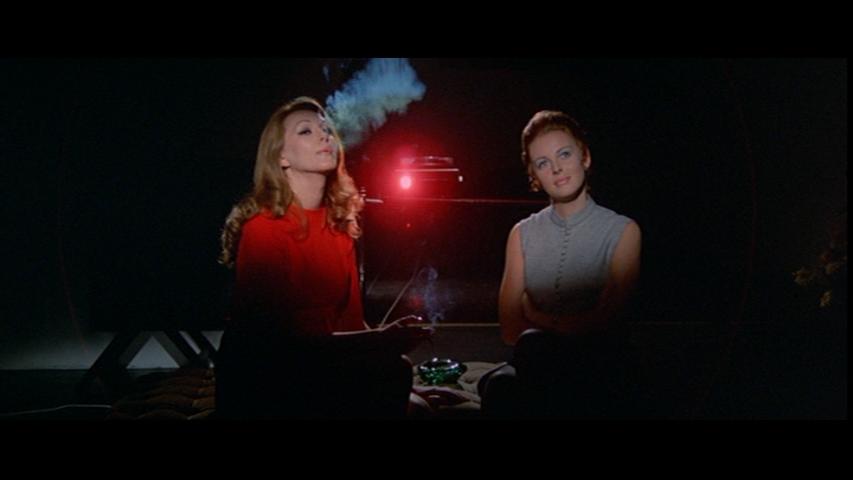
I just love the title. ‘Death Walks on High Heels’. It gives me a mental image that’s half ‘Seventh Seal’, half ‘Priscilla, Queen of the Desert’.
The film itself is similarly schizophrenic: it starts off like a Hitchcock movie in the chic, playful stage of his career (think ‘North by Northwest’ or ‘To Catch a Thief’, but with more in the way of striptease routines and straight razors), then catches a flight to England and holes up in a rural backwater village with a bit of a ‘Straw Dogs’ vibe before sharing a cup of tea with Baxter of the Yard (I kid you not, that’s exactly how the character’s introduced) for an Agatha Christie inspired carousel of twists and turns, murky motives and herrings of a decidedly crimson pigmentation.
Sounds like a mishmash, doesn’t it; an all-over-the-place splurge of WTF? Credit, then, to director Luciano Ercoli – he of ‘Forbidden Photos of a Woman Above Suspicion’ fame – for never letting things degenerate into a scattering of loose ends. And for wrapping the whole thing up satisfactorily despite narrative developments that leave you wondering if a couple of reels from a whole other movie haven’t been spliced in by accident and so much rug-pulling in the final act that you begin to fear for the floorboards.
 Things start off with a jewel thief in the twilight of his career knifed to death on a train to Switzerland. Back in his home country of France, his daughter Nicole (Susan Scott), an exotic dancer, is pulled in by the police and grilled about where he stashed the ill-gotten cache of diamonds from his last job. She denies all knowledge. They give her loser, pisshead boyfriend Michel (Simon Andreu – the sleazy sex fiend from the aforementioned ‘Forbidden Photos’) a grilling as well, but he doesn’t come up with anything either.
Nicole argues with Michel and sends him packing. At the nightclub, she’s propositioned by middle-aged wannabe lothario Dr Robert Matthews (Frank Wolff), who’s looking for a dalliance before he heads home to England. Successfully disentangling herself from his attentions, Nicole is then menaced by a masked figure with piercing blue eyes who breaks into her home and threatens to do unspeakable things with a straight-razor if she doesn’t come up with the diamonds.
Turning to Michel again for comfort, Nicole begins to suspect that he might be involved in the attack on her. She exploits Matthews’ libido and promises to be his mistress if he takes her to England. Hardly believing his luck, the “good” doctor agrees and loses no time installing her in his holiday home on the coast while he tries to arrange a divorce from his wife Vanessa (Claudie Lange). Biding her time during Matthews’ frequent commutes up to London to his practice, Nicole is increasingly unnerved by the too-inquisitive behaviour of the locals. Meanwhile, Michel has got a lead on Matthews’ identity and is determined to track Nicole down. His eventual arrival in the village coincides with a murder. Next thing, the tenacious Inspector Baxter (Carlo Gentili) is on the case and determined to prove that a copper in a giallo doesn’t have to be a bumbling incompetent.
 After a slow midsection in which every suggestive bit of dialogue between Nicole and Matthews, every candlelit meal and every lingering glance is documented in such painfully slow detail that the only thing separating ‘Death Walks on High Heels’ from ‘Elvira Madigan’ is a bit of soft focus and twenty minutes of Mozart’s Piano Concerto N° 21, things perk up no end as Baxter untangles a web of murderous motives, village secrets are revealed, alibis are disproved and Michel goes on the run when things take an even more surprising turn.
Gorgeously shot, featuring generally decent performances (Scott’s range is limited but, damn!, the woman had vamp written all over her) and boasting enough twists and turns to fill half a dozen other movies, ‘Death Walks in High Heels’ transcends its almost comedic title and delivers a thinking-caps-on slice of entertainment, the denouement of which will probably make you, once your head’s stopped spinning, want to rewatch it immediately just to assurance yourself that it did actually fit together so cleverly.