Tampilkan postingan dengan label George Hilton. Tampilkan semua postingan

Minggu, 07 Agustus 2011

GIALLO SUNDAY: The Strange Vice of Mrs Wardh


After a two-month hiatus, Giallo Sunday returns with Sergio Martino’s 1971 giallo ‘The Strange Vice of Mrs Wardh’, his first foray into the genre and his first teaming with Edwige Fenech. How is it awesome? Let me count the ways.

Firstly, its success kicked off a string of stone-cold classic gialli from Martino: ‘The Case of the Scorpion’s Tail’, ‘All the Colours of the Dark’, ‘Your Vice is a Locked Room and Only I Have the Key’ (its title, one of the most magnificent in all of cinema, suggested directly by ‘The Strange Vice of Mrs Wardh’) and ‘Torso’, two of which reunited him with Fenech.

Secondly, it features stellar turns from three giallo legends: Fenech, George Hilton and Ivan Rassimov. Rounded out by Cristina Airoldi (who has one of the most memorable scenes in ‘Torso’), Alberto de Mendoza (a character actor extraordinaire with an incredible eight-decade career in cinema), Carlo Alighiero (who played Dr Calabresi in Argento’s ‘Cat o’ Nine Tails’ the same year) and Bruno Corazzari (one of the “go to” guys for all-purpose villainy in Italian cinema), the cast is tip-top.

Thirdly, it marries stylish thrilleramics with a psychological imperative (the “let’s scare Edwige to death” syndrome: cf. ‘All the Colours of the Dark’) and delivers the whole thing in such a twist-heavy package (the last third of the film is pretty much one narrative curveball after another) that it’s deliriously difficult to keep your eye on the ball.

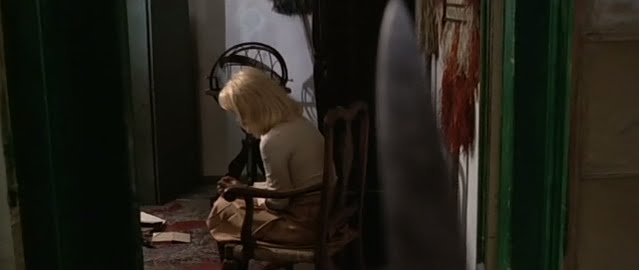
Fourthly, it delivers a generous helping of much-loved giallo tropes, including extended, operatic death scenes (a protracted bit of business in a park bears comparison with Argento’s ‘Four Flies on Grey Velvet’, made the same year), bottles of J&B all over the shop, a beleaguered but still gorgeous heroine, and black-gloved killers with sharp implements. Seriously, take a look at this little collection of screengrabs and tell me if they don’t scream giallo:


I could continue enumerating all the ways in which ‘The Strange Vice of Mrs Wardh’ is one of the defining examples of its genre, but I’d probably end of with a repetitive article that segued into a several thousand word love letter to Edwige Fenech, so let’s get things back on track with a plot synopsis.

Julie Wardh (Fenech) has entered into a marriage of convenience with career-obsessed diplomat Neil (de Mendoza) – a man so stultifyingly dull that he dishonors the name Neil (plus, how dare someone who’s obsessed with work share the same name as me? I hate work) – in order to get away from her domineering and possessive ex, Jean (Rassimov). Jean, it is revealed in flashback, is the chap who happily pandered to Mrs Wardh’s eponymous weird kink. And the kink in question? “Blood both excites and repels her.” Hence Jean making love to Julie on a bed of broken glass. (Don’t try this home, kiddies!)

Returning from a trip abroad with Neil, Julie is unnerved by the ministrations of a psychopath targeting women in their neighborhood, and by the fact that Jean seems to be trying to inveigle his way back into her life – the two, she worries, might not be unrelated. Hanging out with BFF Carol (Airoldi), Julie meets Carol’s playboy cousin George (Hilton), whose attentions provide a welcome distraction from her worries. When a blackmailer observes her passionate interlude with George and threatens to spill the beans to Neil, Carol offers to deliver the pay-off in Julie’s place. Things go badly wrong and Julie’s life spirals into chaos and paranoia.

Any fuller synopsis than that would lead us into spoiler territory, so many great things about this film will have to go by the board, particularly anything relating to that aforementioned last third. I will give a nod, however, to the way Martino seems to wrap things up with a bit of expositional dialogue between two characters which leads to much (perverse) hilarity between them; Martino plays the scene as if he’s about to homage Clouzot’s raised-middle-finger-of-irony ending to ‘The Wages of Fear’ (I was even prepared to forgive him the plagiarism, it was done so gleefully), only to subvert expectations and deliver an equally delicious irony but effected by quite different means.

As with any labyrinthine plot, too much analysis can sometimes be fatal. The climactic revelations depend on alibis aplenty for more than one character, and the lacunae are pretty tenuous in places. Still, it’s no small measure of the film’s success that Martino is pulling unexpected moments out of the hat right till the end.


His direction is energetic. The camera prowls with POV-centric menace à la Argento. The set-pieces – including a cat-and-mouse scene in an underground car park, and a nervy exploration of an old dark house lit only by the guttering flame of a cigarette lighter – are confidently handled. ‘The Strange Vice of Mrs Wardh’ was only his second non-documentary feature (after the spaghetti western ‘Arizona si scatenò... e li fece fuori tutti’), yet every frame demonstrates that with the giallo Martino had found his métier.

Minggu, 29 Mei 2011

GIALLO SUNDAY: My Dear Killer


Tonino Valerii’s ‘My Dear Killer’ opens with something that I can honestly say I’ve never seen before in all my misspent years of watching gialli: death by digger bucket. The poor unfortunate who gets his bonce brutalized between the blades is one Vincenzo Paradisi (Franceso di Federico). The investigation is headed up by Inspector Luca Peretti (George Hilton), who begins his enquiries at the firm who hired out the equipment. The trail leads to the first of several corpses: that of Mario Ansuini (Remo De Angelis), the driver who was booked to operate the digger on the day in question. Everything points towards Ansuini committing suicide, but Peretti suspects otherwise.

Peretti isn’t your typical giallo cop. He’s attentive to detail, intuitive, tenacious and definitely not there for comic relief. In fact, with the exception of the snivelling cop-hating rag-and-bone man Mattio Guardapelle (Dante Maggio), there are no characters who provide comic relief. ‘My Dear Killer’ is populated with as sleazy, cynical and black-hearted a group of characters as you could ever hope not to meet. At least two of them – moist-lipped sculptor Beniamino (Alfredo Mayo) and trucking company boss Giorgio Canavese (William Berger) – are paedophiles, while the various members of the Moroni family are dysfunctional plus VAT.


The Moronis are a moneyed but jealousy-ridden bunch, also the victims of a high-profile kidnapping – their young daughter. The payoff went south, the girl was found dead at an abandoned shack and one of their members died in an attempt to follow the kidnappers. I’m keeping the details of the kidnapping and the Moroni family infrastructure deliberately vague; Valerii dedicates the mid-section of the film to carefully establishing the whys and wherefores. It’s during this section that ‘My Dead Killer’ could almost pass for a Sunday evening BBC television whodunit – and, to his credit, Valerii makes Peretti’s painstaking attempts to connect the clues quietly watchable.

Elsewhere, however, it’s business as usual for this genre. ‘My Dear Killer’ emerges as something of a precursor to ‘Deep Red’, with a child’s drawing providing a crucial clue, while Peretti races from clue to clue, witness to witness, only to find, as the bodies pile up, that the killer is always one step ahead of him. (If Argento and his ‘Deep Red’ co-writer Bernardino Zapponi did rip off ‘My Dear Killer’, all I can say is power to them: they took some elements from a middling giallo and amalgamated them into one of the genre’s bona fide masterworks. Also, ‘Deep Red’ has an ending that functions like a blow to the solar plexus, while ‘My Dear Killer’ winds up in Agatha Christie fashion with Peretti arraying the suspects in a sitting room and delivering a five-minute monologue.)


The death scenes are properly gruesome, involving bludgeoning, strangulation, hanging and the improper use of power tools. Rooftop chases and bottles of J&B are, however, sadly lacking. And the presence of a naked pre-pubescent child at Beniamino’s studio is just plain unnecessary. Worse is the blithely unconcerned way in which Valerii presents the scene. It’s a slap in the face to the viewer’s sensibilities. The filmmakers demonstrate an equal lack of concern with this subject matter in a subsequent scene where Peretti braces Canavese, reminding him that “you were caught in a brothel with a twelve year old” and promising to quash the prosecution if Canavese co-operates!!!

Maybe that’s the essential problem with ‘My Dear Killer’: it goes for the gore as nastily as anything by Fulci with its power tool set-piece, and it baits controversy with the aforementioned imagery, but ultimately it’s slow-burn procedural with a yawn-fest denouement that, for all Peretti’s loquacity, leaves several plot points unanswered. I used the word “watchable” a couple of paragraphs ago: it’s a good epitaph for this film. ‘My Dear Killer’ is consistently watchable, and even delivers a couple of scenes that are genuinely gripping; but it’s memorable for the wrong reasons.

Minggu, 30 Januari 2011

GIALLO SUNDAY: The Killer Must Kill Again

Pop quiz.

Question 1: you’re a businessman with a cashflow problem, a rich wife who’s pissed off at you because of your philanderings and a business deal that’s about to go south. Do you:

(a) start seriously making it up to your wife in the hope that she’ll bail you out;

(b) file for bankruptcy and get realistic about the fact that divorcing proceedings are on the horizon;

(c) commit suicide and rid the world of your loathsome presence because you’re basically an incredibly shitty human being; or

(d) have a blazing row with your wife, storm out, and drive to a pay phone near the docks so that you can ring your mistress?

Question 2: while at the docks, you witness a psychotic-looking individual pushing a car containing a dead woman into the water. Do you:

(a) hide;

(b) sprint for your car and get the fuck out of there at top speed;

(c) redial and this time ask to be put through to the police;

(d) approach the gentleman in question and offer your silence re: his corpse-disposal activities in return for killing your wife?

If you answered (d) to either of these questions, you have just demonstrated a mindset akin to that of Giorgio Mainardi (George Hamilton), the cold bastard who sets the events of Luigi Cozzi’s ‘The Killer Must Kill Again’ in motion, and you might want to consider logging off and contacting a mental health professional.

The anonymous killer (Michel Antoine) – a gaunt, gimlet-eyed and utterly emotionless psychopath who could probably kill with his thousand-yard stare , never mind his recourse to strangulation and stabbing – goes along with Maindardi’s request, mainly owing to (a) Mainardi nicking his monogrammed (and therefore identifiable) lighter and (b) Mainardi offering twenty thousand on top of the lighter’s return. The plan goes swimmingly until the killer’s Mercedes – a car as distinctive as his lighter – is nicked by stud muffin Luca (Alessio Orano) in an attempt to impress his hoity-toity girlfriend Laura (Cristina Galbo).


Luca laughs off the fact that he’s just committed grand theft auto, something he wouldn’t be laughing about if he was aware that Mrs Mainardi’s lifeless body was in the trunk. In order to facilitate the removal of said cadaver – as well as to teach these wise-ass kids a lesson (although a murderer getting on his moral high horse about having his car stolen strikes me as a tad hypocritical) – our skull-faced killer goes off in hot pursuit. Something he achieves by stealing a car himself. Hmmm, definite tendencies to hypocrisy here.

Meanwhile, the police turn up at Mainardi’s hideously decorated apartment, led by a tenacious inspector (Eduardo Fajardo) who smells a rat from the off.

All this within the first twenty-five minutes. Excellent, I was thinking, rubbing my hands, the stage is set for a tense game of cat-and-mouse as the killer tracks down Luca and Laura, while Mainardi and the detective dance a verbal pas de deux as the investigation uncovers more inconsistencies and the questions get thornier .Good old-fashioned Italian exploitation shot through with Hitchcockian tension. Yeah, baby!

And there’s no doubt that Cozzi takes his pointers from Hitch. The business with the lighter recalls ‘Strangers on a Train’, as does the almost homoerotic undercurrent between Mainardi and the killer. Luca and Laura’s journey to the coast in the stolen car – specifically in the attention they invite from a suspicious cop – recalls Marion Crane’s flight with the purloined money in ‘Psycho’. The abandoned beachside property Luca is heading for, and at which much of the nasty final act takes place, is a stand in for the Bates Motel, the windmill in ‘Foreign Correspondent’ or the remote farmhouse in ‘Torn Curtain’.


Unfortunately, Cozzi doesn’t pull off his set-pieces with the same brilliance as Sir Alfred (how many directors could?) and a long middle section with the killer following Luca and Laura drains of tension the longer it goes on. The cuts back to Mainardi vs the inspector become increasingly less frequent and the mechanics of the web of deceit Mainardi tries to weave to satisfy his interrogator’s questions is quickly dispensed with.

That Luca and Laura are a fairly unlikeable couple who spend most of their time bickering adds to the tedium, while the genuine bits of suspense or flashes of violence are misogynistic to the hilt. Perhaps more so than the norm even for such a notoriously phallocentric subgenre as the giallo. Cozzi’s harshest directorial decision is to intercut a sleazily eroticized rape scene with a graphic (consensual) sex scene, scoring the whole grubby sequence to an ‘Elvira Madigan’-style tinkling piano theme.

Overall, women are treated like shit in this film, starting with the anonymous murder victim whose broken body is tossed in the back of a car which in turn is unceremoniously consigned to the deep. Mainardi’s contempt for his wife extends to her continued existence on the planet. Luca compels Laura to expose her breasts to distract an attendant during a gas station robbery. The ditzy blonde (Femi Benussi) whom Luca picks up after an argument with Laura is written in purely to up the sex and violence quota.


If you can get over that – and the draggy middle section – ‘The Killer Must Kill’ again is a decent thriller with good turns from Hilton and, particularly, Antoine. His skeletal visage and unblinking intensity are unforgettable, as much an avatar of the cold and unmerciful workings of fate as Javier Bardem’s Anton Chigurh in ‘No Country for Old Men’.