The great John le Carre adaptations – Martin Ritt’s ‘The Spy Who Came in from the Cold’, Fernando Meirelles’s ‘The Constant Gardener’ and Tomas Alfredson’s ‘Tinker Tailor Soldier Spy’ – work to such great effect because their directors inherently understand the novels. Ditto such second tier work as John Boorman’s ‘The Tailor of Panama’ – he gets the absurdist humour.
But what of an adaptation that fundamentally misses the entire point of the novel? Are novel and film tied into a relationship so osmotic that the latter is automatically consigned to failure? Or can you step back enough to evaluate the film as a stand-alone work?
The answer to that one is simple enough, I guess. If you’re unfamiliar with the novel, then the film by that very definition exists unto itself and can only be evaluated according how successfully it works in that medium. A similar rule of thumb applies if you saw the film first. (Example: I’d seen Alexander Payne’s ‘Sideways’ at least half a dozen times before I read Rex Pickett’s novel, and I was decidedly underwhelmed by the book.)
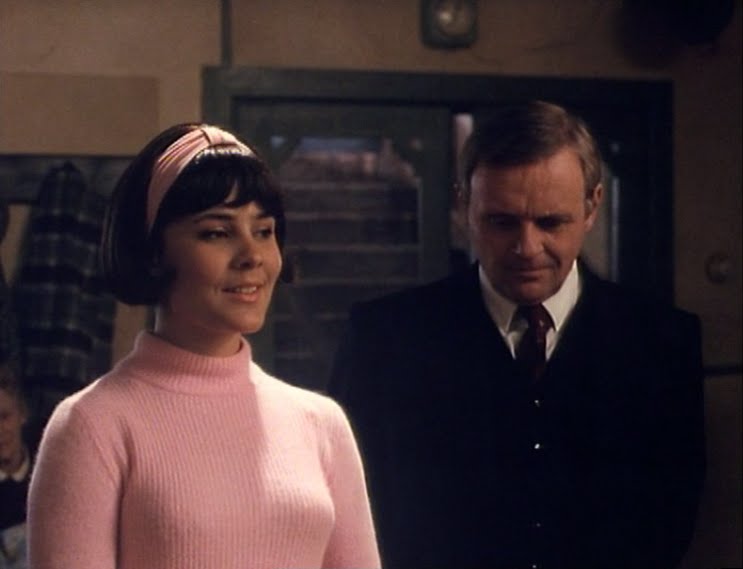
Frank Pierson’s ‘The Looking Glass War’ retains a fidelity to the novel in its early scenes: inexperienced field agent Taylor (Timothy West) collects a roll of film from an airline pilot (Frederick Jaeger) who has completed a risky flyover of a suspected East German military installation of the pretext of being blown off course during bad weather. Taylor is killed in a hit and run shortly after the pick-up. Back in London, Taylor’s boss LeClerc (Ralph Richardson), head of an intelligence department known only as The Department, assumes his death to have been suspicious, the disappearance of the film even more so, and decides that these factors constitute corroboration of an inconclusive photograph which might - might - suggest that a rocket base is being installed near the East German border. Roping in his colleagues Adrian Haldane (Paul Rogers) and John Avery (Anthony Hopkins), LeClerc petitions the Undersecretary of State (Ray McAnally) to sanction an over-the-wire mission to obtain conclusive proof. All the while, he is determined to keep rival department The Circus out of the loop.

There is only one brief scene, where LeClerc gleefully suggests that “we send a man over”, which in any way captures the aesthetic of le Carre’s novel. ‘The Looking Glass War’ was the author’s follow-up to ‘The Spy Who Came in from the Cold’ and is, if anything, even more bleak, cynical and angry at the stupidity of political machinations than its predecessor. Le Carre painstakingly builds up a picture of The Department as a mainstay of British intelligence during the war, but now reduced to trading on its former glories even as the Treasury puts a stranglehold on its budget and The Circus do the real work of Cold War espionage. LeClerc is what Michael Moore would call a “stupid white man”, obsessed with trying to live out the old days, all old school tie and cricket club morality, without having the vaguest idea of how crucially the theatre of operations has changed two decades on.
The novel charts LeClerc’s petty stupidities, his transparent lies to The Circus, his pointless rivalry with Haldane and his almost embarrassing attempts to establish himself as a mentor to Avery. Essentially, ‘The Looking Glass War’ is a novel about how LeClerc sacrifices an operative purely to bolster his ego. A more vehemently anti-spy-story spy story I have yet to read.
Pierson makes one fleeting nod to all of this, then completely ruins the novel’s aesthetic by changing LeClerc’s operative Leiser (Christopher Jones) from the middle-aged former WWII agent desperate for one last shot at self-worth to a youthful immigrant blackmailed into a potentially suicidal operation in return for overlooking his absent passport. First problem: anyone in their right mind would offer LeClerc his middle finger, invite him to spin and get repatriated rather than go over the wire. The Leiser of the film is robbed of motivation. Moreover, the inexplicably top-billed Jones plays him as a narcissistic misogynist with whom it’s impossible to empathize. The entire second half of the film follows him after his border crossing (as opposed to the 54 pages of a 273 page novel which deal with this section of the story), lummoxing the viewer with 50 minutes in the company of a complete knob-head of a protagonist.
Evaluated without reference to the novel, the film still frustrates. Quite apart from how unlikeable Leiser is as a main character, we have character actresses par excellence Anna Massey and Maxine Audley similarly saddled with thankless “wifey” roles, as well as Susan George wasted in a nothing role while the female lead – billed with depressing objectification as The Girl – is essayed by the terminally unemotive Pia Degermark.

There are a handful of terrific moments, though. The training sequence, in which Avery gives Leiser some pointers in hand-to-hand combat, is well choreographed and executed with dry humour. The border crossing itself is properly tense and Pierson achieves an almost Hitchcockian level of suspense. Also, the downbeat ending with its bitterly ironic punchline, are as bleak and corrosive as anything in the novel, but are left to function without the novel’s cleverly established critique of old school stupidity.
It’s an okay – but not great – film. Watchable and, to an extent, entertaining enough. Familiarity with the novel just deep-sixes it. Familiarity with the novel tips you off as how good it could have been.