Tampilkan postingan dengan label Alain Delon. Tampilkan semua postingan

Minggu, 26 Juni 2011

Un Flic


‘Un Flic’ is a film that I want to like more than I actually do. And it’s infuriating that I don’t have the big love for it that I do for Melville’s other crime dramas. That, in fact, it leaves me a little bit cold.

All things considered, it ought to be the ultimate Melville movie: a perfect distillation of his thematic and aesthetic preoccupations. After all, it blends the iconic tropes of the strand of American crime cinema so beloved of Melville with an existential inquiry into loneliness and fatalism that could only be the work of a French director. The casting reinforces the point: Melville’s ice-cool alter ego Alain Delon shares the screen with one of American cinema’s quintessential tough guys, Richard Crenna.

The opening sequence, as Simon (Crenna) and his cohorts execute a bank robbery in a rainy coastal town only for one of their number to be wounded in the ensuing shoot-out, is terrific. Its juxtaposition with Commissaire Edouard Coleman (Delon)’s world-weary film noir style voiceover as he cruises neon-lit city streets, sets up the antagonists effectively. The establishment of Simon and Edouard as unlikely friends recalls the relationship between Bob and Ledru in ‘Bob le Flambeur’. Their rivalry over the same woman – Cathy (Catherine Deneuve) – promises to ramp up the tension.


And yet … and yet …

My main issue with ‘Un Flic’ is how “by rote” it feels. I don’t think I’ve ever seen Delon or Deneuve give such lacklustre performances. There is very little chemistry between the leads. The procedural elements of the narrative are by the numbers. The supporting characters are one-dimensional, particularly Edouard’s transvestite informant – a touch of misogyny permeates their scenes.

The other main problem is Melville’s decision to use model work for the film’s major set piece, a twenty-minute heist that plays out in real time involving an express train, a helicopter, some daring business with a winch and a pared-down-the-nails window of opportunity in which to carry out the operation before the train reaches an open stretch of track and reaches full speed, at which point winching the heist man off becomes too perilous. Granted, this is the kind of thing that adds a lot of zeroes to a film’s budget, and a certain degree of back projection could be expected for a movie made in the early 70s (certainly Melville was no stranger to splicing howlingly unconvincing back projection into his movies – check out the cops’ drive around the nocturnal streets of Paris in ‘Le Doulos’; it makes freakin’ ‘Genevieve’ look like an exercise in documentary realism), but – sacre bleu! – surely we should expect something better from one of the masters of the crime movie than this:


And it’s not just the Gerry Anderson-style model work (“Uh, m’lady, there appears to be a robbery in progress in the next couchet.” “Very good, Parker. Now refresh my G&T.” “Yes, m’lady”) that tips the whole sequence into artifice. There’s nonsensical stuff like Simon’s use of a magnet to draw back a door chain. Never mind how he can manipulative the movement of the chain so accurately when he’s on the opposite side of the door and can’t even see it, take a look at the magnet itself. WTF? Have we wandered into an episode of ‘Inspector Gadget’ by mistake?


This sequence just kills the film for me. I can’t settle back into its melancholic portrayal of Edouard’s life, or the aftermath of Simon’s heist. I can’t get involved with the eternal triangle shenanigans, even though the luminescent Catherine Deneuve is at the centre of it. I can’t latch on to any emotional nuances in the final scene, a non-showdown that simply brings the film to an end rather than a conclusion.

And the devil of it is, I really want to.


(ADDENDUM: there’s an excellent piece on ‘Un Flic’ by Lawrence Russell on the Culture Court website.)

Kamis, 23 Juni 2011

Le Cercle Rouge


‘Le Cercle Rouge’, like ‘Le Samourai’, opens with a portentous quote: “Siddhartha Gautama, the Buddha, drew a circle with a piece of red chalk and said: ‘When men, even unknowingly, are to meet one day, whatever may befall each, whatever the diverging paths, on the said day, they will inevitably come together in the red circle’.” Like ‘Le Samourai’, it lends an ice cool crime flick a quasi-mystical subtext. Like ‘Le Samourai’, the attribution is total bollocks; Melville made it up.

It defines the film as a study in fatalism and the grimly inevitable, though; no question about that.


The two narrative strands that set things in motion occur pretty much simultaneously: Corey (Alain Delon) is released from prison; Vogel (Gian Maria Volonté) escapes from custody. The release/flight contrast is further emphasized by the authority figures who prove their nemeses: just prior to release, Corey is coerced into executing a jewellery heist by a crooked prison guard (Pierre Collet); Vogel goes on the run after getting the jump on Mattei (the mononymous Bourvil), the doggedly by-the-book copper assigned to escorting him across country to stand trial. Another point of comparison is their ages: Corey is the older, aloof, old-school professional criminal; Vogel is the edgy, unpredictable younger man. Their relationship is shadowed by that between Mattei and his boss, the cynically pragmatic Chief of Police (Paul Amiot) who believes that all men are corruptible. ‘Le Cercle Rouge’ is a film of parallels, contracts and corrosive ironies.


At two and a quarter hours (one of the longest works in Melville’s canon – only ‘Army of Shadows’, his Resistance epic, is marginally longer), it’s slow-burn and then some, the pace even more stately than the glacially iconic ‘Le Samourai’. But it exerts a grip like a python with a spine of tungsten carbide. Vogel’s escape from the train, despite Mattei having him handcuffed, is an object lesson in how to set up, develop tension from and excitingly resolve a major set-piece – and it’s just for starters.

Corey’s post-release settling of scores with those responsible for his incarceration recalls Maurice at the start of ‘Le Doulos’; the way he moves through a dangerous underworld with a ruthless lack of emotion is comparable to Jeff Costello in ‘Le Samourai’. No doubt about it, Alain Delon was Melville’s alter ego: enigmatic, relentless, icily cool.


The chance of fate that throws Corey and Vogel together in their jewellery-heisting enterprise is effect by the mobsters who come after Corey following his vengeful exploits. In a squirmily unhurried set-piece that prefigures ‘Miller’s Crossing’, two heavies take Corey into the words with the express intention of leaving him there, riddled with lead. Vogel, hidden in the trunk of Corey’s (obligatorily) flash American car, puts in a surprise appearance: a new element, in effect, is introduced into an already volatile situation.


This scene is a good metaphor for the film entire. Corey and Vogel recruit Jansen (Yves Montand), a former police sniper with a narcotics habit, a monkey on his back and a tendency to hallucinatory episodes of the DTs. A new element; an unpredictable set of variables. (Jansen’s memorable target practice scene – again set in the leafy silence of the woods – prefigures Edward Fox’s bullet-in-the-melon moment in ‘Day of the Jackal’.)


Mattei, pressured by his boss into getting a result, leans on Corey’s associate, nightclub owner Santi (François Périer). A new element; an unpredictable set of variables. Melville’s line-up of criminals, be they world-weary or rigorously disciplined, function with as decisive a sense of purpose as ever, but the difference this time round is how defining a part the vagaries of chance play in the way things resolve.

The colloquial principle Sod’s Law states that if a thing can go wrong it will. If ‘Bob le Flambeur’ functions, in its visual aesthetic, as a metaphor for the cosmic chequerboard on which fate moves us like chess pieces, then ‘Le Cercle Rouge’ demonstrates that fate is also capable of considerably less elegance on occasion; that it can swipe the pieces off the board with all the spiteful vehemence of a moody child. That fate can do such a thing to an ensemble of French cinema’s finest makes it all the more galling.

Selasa, 21 Juni 2011

PERSONAL FAVES: Le Samourai


‘Le Samourai’ isn’t the first Jean-Pierre Melville film to open with a quote – ‘Le Doulous’ sets out its stall with the grim homily “your choice … lie or die” – but it’s the first to suggest something quasi-mystical bubbling away just below the surface.

‘Le Samourai’ opens with this bit of prose, hovering above the prone figure of its anti-hero in the top right hand corner of the screen: “Il n'y a pas de plus profonde solitude que celle de samouraï si ce n'est celle d'un tigre dans la jungle ... peut-être …”, attributed to the ‘Bushido’ (the book of the samurai) but most likely of Melville’s own composition. It means “there is no more profound solitude than that of the samurai expect, perhaps, that of the tiger in the jungle”.


It’s a terrific attention-grabber, particularly as Jeff Costello (Alain Delon) spends the credit sequence lying on a grubby mattress in an equally grubby apartment, smoking with an almost existential determination. Is he the samurai or the tiger? As he straightens up, puts on his hat and overcoat and heads out, he seems to embody the formalism of the samurai. The milieu he moves through – one of clinically ruthless underworld types and coldly professional coppers – is certainly a jungle. Drab, steely-grey and coloured by nary a tinge of exoticism, but a jungle for all that.

Or maybe the title and the quote mean absolutely sod all, and it’s simply a story about a hitman setting up an alibi and a cop trying to break it. That’s the beauty of ‘Le Samourai’: it actually responds to a reductive aesthetic. Anonymous interiors, grim exteriors, characterless offices, and the claustrophobic tunnels of the Metro – all present and correct. A main character who betrays barely a trace of emotion – yup, he’s here. (Seriously, Costello is double-crossed and a hint of mild annoyance crosses his face; he painfully sluices a wound with antiseptic and he barely grunts.) A police superintendent (François Périer) who’s referred to in the credits as simply “the superintendent”. This is a film so characterless that it ought to be hollow. Empty. Bland. A bore.

What it is, however, is cool.


‘Le Samourai’ is cool the way an effortless complex jazz solo is cool. The way dirt-track rider walking away from buckled bike with a shrug and not even bothering that there’s blood on his leathers is cool. The way a snooker player pulling off a 147 is cool. The kind of cool that’s cool purely because us mere mortal know we’ll never achieve it and there’s no point trying.

And it’s cool because of Alain Delon.

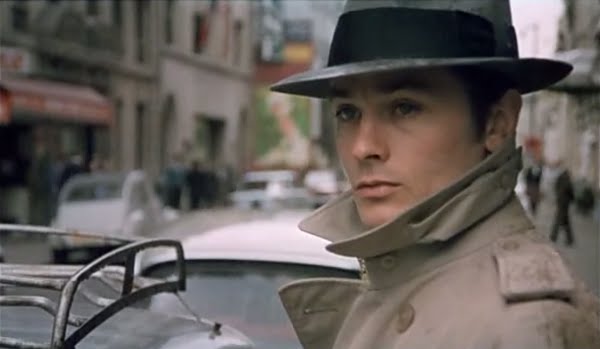
Delon plays Costello as a blank canvas. He wears a suit more convincingly than any other bad mutha in any other crime movie ever made. People probably stopped wearing hats after ‘Le Samourai’ came out because they knew they’d never make them look as good as Delon. Or even put them on so iconically. This, if nothing else, is a measure of the iconography of ‘Le Samourai’: Alain Delon puts on a hat - he puts on a fucking hat – and makes it look like the coolest act ever captured by a movie camera.

At its most reductive, ‘Le Samourai’ is about Alain Delon wearing a hat and walking around looking cool for huge swathes of the running time. And, friends, I wouldn’t have it any other way.