Minggu, 29 Januari 2012

Charlie Wilson's War

Posted as part of an intermittent series of espionage-related cinema leading up to the release of the new James Bond film ‘Skyfall’ later this year


How best to describe ‘Charlie Wilson’s War’? The “based on a true story” tag-line screams biopic, but it’s more like ‘Wag the Dog’ with a covert war instead of a stage-managed one, or ‘Rambo III’ with more in the way of strippers and hot tubs.


This is how we meet our … uh, let’s just go with “hero” and place all moral considerations in cold storage for 98 minutes. He’s the Charlie of the title (Tom Hanks), he’s a Texan congressman and his principle interests appear to be women, whisky and … actually, I think we got done with his interests at women and whisky. He’s hanging out in a penthouse apartment with some – not to be judgemental here, but let’s call it like it is – lowlifes. High-rolling lowlifes, but lowlifes all the same. His choice of company comes back to haunt him later.

It’s the 1980s, the Russkies are in Afghanistan and Wilson is swiftly coerced by hifalutin society lady Joanne Herring (Julia Roberts) to help the Afghanis out in the name of God and country and … well, mainly God. Which he proceeds to do, with the aid of disenfranchised CIA agent Gust Avrakotos (Philip Seymour Hoffman). Avrakotos is given an equally memorable introduction, effectively torpedo-ing his career prospects by telling his boss to go fuck himself and vandalising the fellow’s office into the bargain.


And while Mike Nichols’s film focuses on Wilson wheeling and dealing, and Avrakotos belligerently out to hammer the Red Menace, it’s fast, funny and scabrously satirical, Aaron Sorkin’s script zinging with the razoer-sharp dialogue for which he’s renowned. But all too often Nichols and Sorkin wear their hearts on their sleeves and the review-o-meter dips from “pretty good” to mediocre. Wilson’s transformation from political player to humanitarian never quite rings true. A visit to a refugee camp on the Pakistan/Afghanistan border wants to deliver the same howl of outrage as the last half of ‘The Constant Gardener’, but doesn’t make the grade. An apposite moment, here, to mention Stephen Goldblatt’s flat and utilitarian cinematography: he never fully integrates with any scene, visually parlaying the viewer into the thick of events. The film retains a slightly bland sheen throughout; you’re always aware that you’re watching a film, and that’s never a sign of success.

The cast is top-notch, though: Hanks and Roberts are clearly having big fun, while Hoffman doesn’t just steal scenes but walk away with the whole movie. Amy Adams, Emily Blunt, Rachel Nichols, Om Puri, Ken Stott, Peter Gerety and Ned Beatty all get their moment in front of the camera (even if, in some cases, it is only a moment: Blunt in particular is wasted).
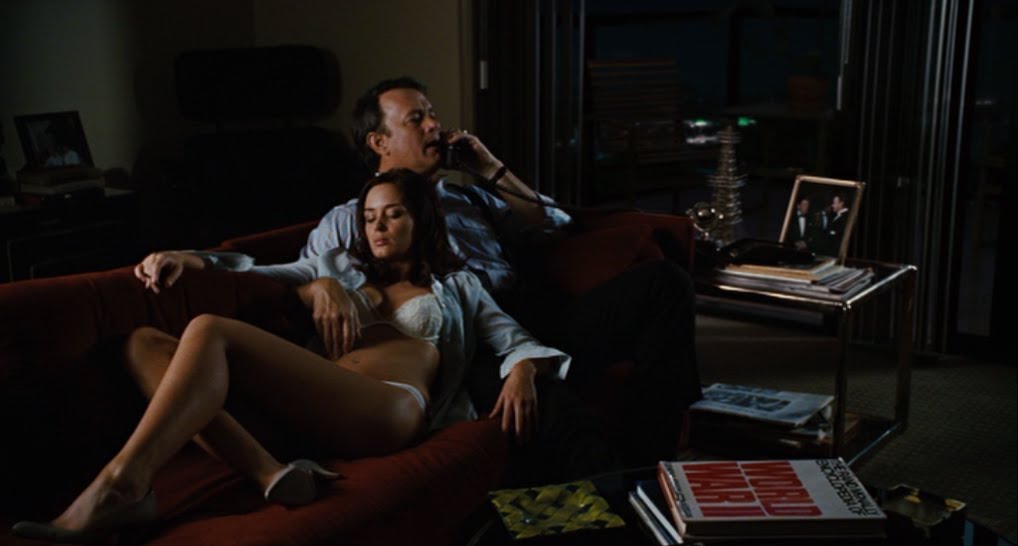

A handful of set-pieces can hold themselves up to anything in Nichols’s distinguished (if, of late, somewhat hit-and-miss) filmography, particularly Wilson and Avrakotos’s first meeting, played out against the revelation that Wilson is being stalked by bad press and a possible subpoena due to the aforementioned lowlife company; it’s beautifully paced, laugh-out-loud funny, with enough entrances and exits to invite comparison with a Brian Rix farce.

And yet … and yet … ‘Charlie Wilson’s War’ never fully coheres. As a satire (how the Americans armed Afghanistan: a timely tale of ulterior motives and irresponsibility!), it pulls its punches. As a political drama, it’s a little too glib to deliver any real insight. As a thriller, it keeps its protagonists away from any element of danger, thereby failing to generate tension. As an exercise in mapping out the contours of conspiracy, it’s never convincingly labyrinthine enough.

All told, that first paragraph ‘Wag the Dog’ comparison arguably sums it up: like Barry Levinson’s film, made ten years earlier, it takes a terrific concept and a powerhouse cast, delivers some genuinely amusing moments but squanders so much potential through its inability to decide what it wants to be.

Senin, 23 Januari 2012

Cowboys and Aliens


Danny Craig and Harry Ford,
Some mighty fine castin, Lord!
Tough guys wearin spurs n guns,
Shootin up them ay-lee-uns.
Sam Rockwell’s also in the cast,
Miss ’Livia Wilde’s a purdy lass.
Too many folk dun wrote the script,
’Haps that’s why it’s hit n miss!
That kinda title, it should be fun,
’Cept it ain’t – it’s moribund.
Danny Craig and Harry Ford,
Who’d thunk I’d be so bored?

Minggu, 22 Januari 2012

Jumat, 20 Januari 2012

THE SILLITOE PROJECT: Road to Volgograd

It’s strange how sometimes a work can be overtaken by time. Even when I discovered Alan Sillitoe, as a teenager in the late 80s, ‘Road to Volgograd’ was the Sillitoe title I knew of only by its inclusion in the “also by” section in the other titles I owned.

When, last year, I found a copy on eBay, it was the original Pan paperback with a pre-deciminalization cover price of three shillings and sixpence. It was a 1966 reprinting of a book first published in 1964. Its pages were sepia. It had been printed six years before my birth.

As early as 1939, Winston Churchill (not a popular figure in the Sillitoe canon – see ‘Key to the Door’) said “I cannot forecast to you the action of Russia. It is a riddle, wrapped in a mystery, inside an enigma.” That was pretty much still the post-divided Berlin, post-Berlin Wall, post-Iron Curtain public perception of the Soviet Union in 1964.

1964 – the year after John le Carre published his watershed novel ‘The Spy Who Came in from the Cold’, a bitter and angry response to the erection of the Wall; the year that Ian Fleming died, whose immortal secret agent – if more in the movies than the books – would give the Red menace a good seeing-to. 1964 – a year which started with British motor manufacturer Leyland exporting buses to Cuba in defiance of the US blockade. 1964 – the year that Alan Sillitoe published an account of his travels and observations in the Soviet Union.

Alan Sillitoe (in translation) was one of the USSR’s bestselling authors. In 1963 he was invited to spend a month in Russia. A socialist, a worker himself and – as ‘Key to the Door’ attests – an avowed leftist, he jumped at the chance. ‘Road to Volgograd’ isn’t as gee-whiz as it might have been (Sillitoe was too perceptive, enquiring, cynical and world-weary to have fallen into that trap), but it’s clear – reading the book with the smug benefit of hindsight – that his hosts took pains to steer him clear of the brutal realities of life under the Soviet regime. Later, when Sillitoe discovered these aspects, he spoke out against the totalitarian rule. It’s interesting to note that ‘Road to Volgograd’ found its corollary and corrective, forty-three years later, in his last published work ‘Gadfly in Russia’. Much of his work emerged in pairings – the short story ‘Mimic’ and the novel ‘The Storyteller’; ‘The Lost Flying Boat’ and ‘The German Numbers Woman’; ‘Raw Material’ and ‘A Man of His Time’; the short story ‘The Good Women’ and the novel ‘Her Victory’ – but never have two interconnected works occurred at such chronological odds to each other as ‘Road to Volgograd’ and ‘Gadfly in Russia’.

History and retrospect make ‘Road to Volgograd’ a strange and awkward book – awkward not in its writing (hell no; Sillitoe is on excellent form here) but in the perspective of retrospect. To repeat myself, it’s a work overtaken by time. It faded all too soon from the Sillitoe bibliography and wouldn’t be readdressed until the very end.

Selasa, 17 Januari 2012

Betty White

Kudos to anyone who looks like your favourite aunt while delivering this line like she means it:


Happy 90th birthday to the inimitable Betty White.

Senin, 16 Januari 2012

John Carpenter


Happy 64th birthday to John Carpenter.

Thanks for some of my all-time favourite horror movies, sir!

Minggu, 15 Januari 2012

THE SILLITOE PROJECT: The Ragman’s Daughter


Published in 1963, this collection of short fiction contains seven stories: ‘The Ragman’s Daughter’, ‘The Other John Peel’, ‘The Firebug’, ‘The Magic Box’, ‘The Bike’, ‘To Be Collected’ and ‘The Good Women’. There is a common theme to the collection, as described in a review in The Financial Times: “these stories are variations on the theme superbly expressed in Sillitoe’s masterpiece ‘The Loneliness of the Long-Distance Runner’; namely, the excitement, the poetry and the integrity underlying an anti-social act.”

The title story explores the psychology of theft. The narrator recalls his first instance of stealing: at primary school, he and the other kids are given cardboard cut-out coins to use in reckoning-up exercises. Although valueless, he is compelled to pocket some. He keeps shtum when the teacher puts him on the spot (a nifty and unforced analogy to the professional criminal saying nothing during police questioning). Is our boy a kleptomaniac? Or is there a core of individualism at the heart of his pilfering? This passage goes some way towards an answer:

In spite of the fact that I nicked whatever I could lay my hands on without too much chance of getting caught, I didn’t like possessing things. Suits, a car, watches – as soon as I’d nicked something and got clear away, I lost interest in it. I broke into an office and came out with two typewriters, and after having them at home for a day I borrowed a car and dropped them over Trent bridge one dark night. If the cops cared to dredge the river about there, they’d get a few surprises. What I like most is the splash stuff makes when I drop it in: that plunge into the water of something heavy …

A romantic subplot manages not to detract from the underlying concept but feed into it: our boy’s relationship with a girl from a nouveau riche family spurs him on to new heights of daring. What follows is an almost arbitrarily truncated Nottingham version of ‘Bonnie and Clyde’ with a misjudged shoe-shop heist in place of a slo-mo blaze-of-glory denouement. As in much of his fiction, Sillitoe dissects the aftermath and finds the compromised humanity in his characters. He writes as a witness, not a moralist.

‘The Other John Peel’ feels like a palimpsest, or a try-out for a possible longer work. Two buddies head off at the crack of dawn for a spot of poaching. A .303 service rifle kept over from the war leads to thoughts of armed revolution. The act of poaching loses its traditional meaning – the placing of meat on the table for those who couldn’t afford it other than by filching it from a rich man – and a more expansive sense of social disaffection becomes apparent. There is very little narrative on offer but the last line – “silent headstocks to the left towered above the fenced-off coppices of Sherwood Forest” – establishes an aesthetic through-line to Nottingham’s most famous outlaw.

If Trash-Can Man in Stephen King’s ‘The Stand’ had spent his childhood years in pre-war Nottingham, the result might have been something like ‘The Firebug’. A companion piece to ‘The Ragman’s Daughter’ inasmuch as it’s narrated by a character who is compelled to commit anti-social acts (here small acts of arson as opposed to half-arsed break-ins) without fully knowing why except that he gets a kick out of it. “I smile as much as feel ashamed at some of the things I did,” he begins, before going on to recount the bitter, tear-stinging frustration of carrying off an effective bit of arson only for the glorious carnage of the fire itself to be utterly ignored. The story ends, somewhat abruptly, with a German bomber attack doing more damage than our anti-social narrator ever could; he’s fourteen by this time and is soon packed off to work in a factory. His pyromania, pardon the pun, fizzles out. It’s like seeing Arthur Seaton in ‘Saturday Night and Sunday Morning’ have the rebellion leeched out of him before he’s even old enough to start boozing and get into real trouble. But an unvoiced hook remains in the reader’s mind: how long till the latent tendency erupts from him again?

Fred, the henpecked protagonist of ‘The Magic Box’, comes across as a less ebullient version of Arthur’s brother Brian Seaton in ‘Key to the Door’. Like Brian, his formative years were spent as a wireless operator in the forces. A pools win gives him the wherewithal to buy a morse set. He tunes into a private world that drives a wedge into his marriage. Morse code and radio operators recur through Sillitoe’s fiction, from the cruise ship radio operator who plays an important part towards the end of ‘The Storyteller’ to the blind yet heroic protagonist of ‘The German Numbers Woman’. Reality and the destructive power of the mind/imagination are also common themes. ‘The Magic Box’ explores ideas that would later find fuller expression in the short stories ‘Mimic’ and ‘The Second Chance’ as well as the two aforementioned novels. Some of Fred’s characteristics inform the quixotic John Handley, one of the key players in the William Posters trilogy. ‘The Magic Box’ is a thorny and unflinching story, and key to a whole sub-section of Sillitoe’s work.

For all that many of his characters don’t particularly like their jobs, it’s a constant of his writing that his protagonists demonstrate a keenly defined work ethic. The unnamed narrator of ‘The Bike’ reacts with hostility to the prospect of a lifetime of hard graft, but soon prefers to earn his way, albeit on piss-poor wages, rather than thieve or freeload. His supposed mate Bernard, who cons him into a buying a bike that Bernard has in fact stolen, is emblematic of a purportedly more intelligent but morally disenfranchised stratum of society. Meanwhile, our hero – personifying the honest but exploited working class, bides his time till he can get even. “If ever there’s a revolution and everybody’s lined-up with their hands out, Bernard’s will still be lily-white because he’s a bone-idle thieving bastard – and then we’ll see how he goes on; because mine won’t be lily-white, I can tell you that now. And you never know, I might be one of the blokes picking ’em out.”

‘To Be Collected’, about a family of scrap metal dealers, stumbling on a cache of weapons, reads like ‘Only Fools and Horses’ meets ‘Billy Liar’ without any of the laughs and played out against a grim and rain-swept background. It’s blunt and compelling.

Little has been made about Sillitoe’s feminist characters (perhaps because many of his first-person male narrators are as laddish and politically incorrect as their working class backgrounds would suggest). ‘The Good Women’, concerning the feminist voice in political activism – from union action to CND protests – is the first step in an increasing empathy with his female characters that would eventually find expression in his longest and arguably most ambitious novel ‘Her Victory’.

If ‘Saturday Night and Sunday Morning’ and ‘The Loneliness of the Long-Distance Runner’ defined Sillitoe for a generation of readers, ‘The General’ proved that he couldn’t be taken for granted in terms of his range and penchant for experimentalism, and ‘Key to the Door’ demonstrated the breadth of canvas he was capable of working on, then ‘The Ragman’s Daughter’ can easily be defined as a setting out of the stall for his later career. But it’s more than that. It’s a box containing seven literary hand grenades. It’s a call for revolutionary thinking and action. It’s the fuck-you to authority that only Alan Sillitoe could have written.

Kamis, 12 Januari 2012

Licence to blog

There's a great article by Kimberly Lindbergs over at Movie Morlocks on James Bond at 50 ('Dr No' was released in 1962) and the program of MGM and Twentieth Century Fox events scheduled to celebrate the anniversary. Of equal interest to any fans of good writing on film is the news that Kimberly will be publishing a monthly on Movie Morlocks, under the banner "Spy Games", with each article focusing on a specific area of the espionage genre, or a particular espionage movie.

Is there any greater display of enthusiasm than wanting to get in on the act oneself - particularly having kicked off 2012 on Agitation with two le Carre adaptations.

What's that? A 007 blogathon - a Bond-a-thon - leading up to the October release of 'Skyfall'? Oh, all right then. If I must.

Minggu, 08 Januari 2012

Attack the Block


Comedian Joe Cornish’s directorial debut presents a couple of challenges from the outset. The first is that its protagonists are an essentially unlikeable bunch of hoodies whose first onscreen act is the mugging of a nurse walking home from her shift, who are incapable of construction a sentence that doesn’t start with “yo” and end with “bruv” or “blood” – worse, delivered in a Sahf End Lahndan accent so that “blood” comes out as “blahd”. “Yo, blahd”, “wassup, blahd”, etc etc. Oh, and they also use weapons grade quantities of American gangsta-speak. Personal bugbear, but I just can’t understand why British kids want to act like they’re East Coast. East Coast may have a certain underworld cachet in the States, but all East Coast means in the UK is crap holiday resorts. Bridlington, Cleethorpes, Maplethorpe, Skegness. “Yo, blahd, we is da Ingoldmells Massiv.” What the fuck?

Oooops, sorry. Rant over.

The second challenge is that the material is so old-school, the homages so plentiful and the basic set-up so patently absurd that – along with the advertising campaign that bigs it up as the new ‘Shaun of the Dead’ (word to the wise: ‘Hot Fuzz’ is the new ‘Shaun of the Dead’ and we’ll leave it at that, shall we?) – that my expectations ran to a fast-paced, irreverent, laugh-out-loud funny slab of creature-feature mayhem. And while ‘Attack the Block’ ticks some of these boxes, Cornish’s script gets too wrapped up in lionizing his hoodie gang heroes (yup, he insists, come the denouement, on painting them as heroes) that he often forgets he’s supposed to be making a knowingly ironic horror-comedy with a deliberate B-movie aesthetic.


The pre-credits sequence has Sam (Jodie Whittaker) robbed at knifepoint by Moses (John Boyega) – his name, given his final act of courageous leadership, is staggeringly unsubtle – Pest (Alex Esmail), Dennis (Franz Drameh), Jerome (Leeon Jones) and Biggz (Simon Howard), during which attack another attack occurs (see what I did there?) and our lovable rascals find themselves battling aliens who plummet to earth during a Bonfire Night fireworks display.

Sorry to labour a point here (I actually enjoyed much about the film, honest!) but the suggestion if you rob a lone woman by pulling a knife on her and knocking her to the pavement, she should somehow be grateful that she wasn’t raped or killed into the bargain is a concept I’m having a fuckton of trouble trying to get my head round. I’m also throwing up a big fat “does not compute” at the knowledge that Cornish was one mugged in like manner and started to wonder whether his aggressors weren’t in fact as scared as he was. Now, I’ve been on the receiving end of hoodie thuggery myself (one punch to the face, one attempted boot to the kidneys which I fortunately managed to deflect), and I can tell you that with a film crew and a budget at my disposal, my artistic response would have been closer to ‘Harry Brown’ than ‘Attack the Block’!

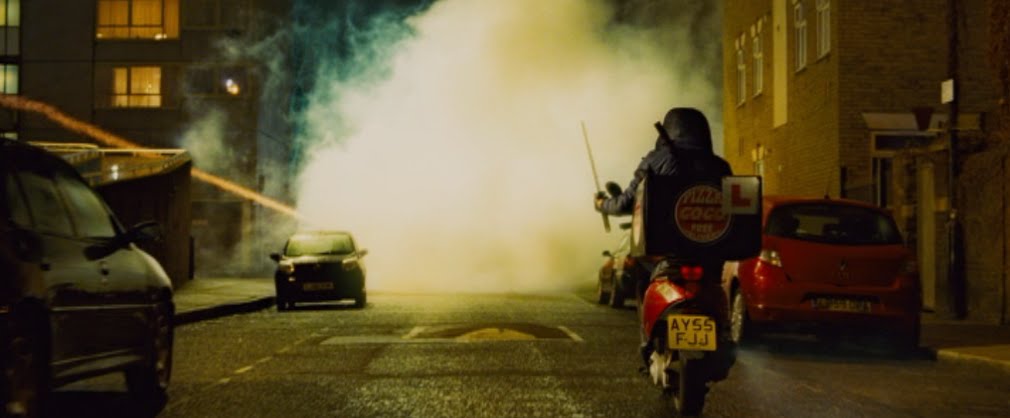
Anyway, Moses and his crew are attacked by something that looks like it didn’t quite make the casting call for ‘Alien’. They respond by tracking it down to a kids’ playground and kicking the shit out of it under a climbing frame. Kudos to Cornish and his DoP Thomas Townend: they turn in some pseudo-iconic Spielbergian imagery while at the same time effectively pointing up the absurdity of the moment. (Similarly, a scene where one of the gang straps a samurai sword to his back, straddles a motorcycle and roars off to get some payback is wonderfully puncture by a cut that shows him puttering away on a 10cc moped with a pizza-delivery box on the back decorated with a learner driver sticker.)


Sorry, another digression there. Anyway, they haul the extraterrestrial corpse back to their council estate apartment block, Wyndham Tower*, where they stow it in Ron’s weed room (“What’s Ron’s weed room?” “It’s a big room full of weed. And it’s Ron’s”) while they figure out the best way to fiscally exploit their find. The lugubrious Ron (Nick Frost) works for edgy crime boss Hi-Hatz (Jumayn Hunter) who, after a misunderstanding, decides he wants Moses’s head on a plate. As do the police, since Sam has by now reported the mugging.

Meanwhile, the alien invasion is gearing up in fine style and the boys find themselves public enemies numbers one to five as far as the invaders are concerned. A word on the aliens: they’re a terrific creation, midnight-black furballs with claws like tungsten carbide blades and teeth that glow with electric-blue light. Cornish’s script picks up and he sends his cast hurtling round Wyndham Towers as they try to find sanctuary, rescue cut-off members of the party and find a way to defeat their furry nemeses. Imagine the grimy locale of Ken Loach’s ‘Ladybird Ladybird’ shot like something out of a Michael Bay film, crawling with the non-human cast of ‘Critters’ (only given a serious upgrade) and everyone locked into a siege situation a la John Carpenter in which a bunch of kids give the adults a Joe Dante-like run-around and ultimately save the day.

This latter aspect works the best, with a frenetically edited moped/pushbike chase vying with a fireworks-as-incendiaries kids vs aliens smackdown as the film’s high point. Credit where it’s due, also, to Cornish’s facility with actors – most of the cast are making their debut here. Of the professionals, Jodie Whittaker makes for an appealing and unsentimental heroine while Nick Frost provides his dependable line of laid-back schtick in an essentially there-for-a-few-belly-laughs role. The man of the match award, however, goes jointly to Sammy Williams and Michael Ajao as, respectively, Probs and Mayhem, a pair of little kids who gleefully embrace the chaos as an opportunity to cut loose and be badasses. God love you, fellas: here’s to the film career you deserve.


‘Attack the Block’ is entertaining. It’s slick, it’s energetic and it doesn’t outstay its welcome (running time: one hour seventeen minutes if you don’t count the ludicrously interminable end credits). It looks great and it bodes well for Cornish’s future as a director. But it’s difficult to get round the fact that, as a horror-comedy, it misses more often than it hits where the comedy is concerned. It’s clever in its construction and the way in which the kids take the fight back to the aliens, but none of this cleverness makes it as far as the dialogue which, with only a couple of exceptions, is devoid of the witty, hip, eminently quotable lines that this kind of material cries out for.

If the filmmakers had gone full-on, one way or the other, and made it funnier or nastier, ‘Attack the Block’ might have achieved cult classic status. As it is, there’s tonal dichotomy that never reconciles. Still, Cornish delivers a hoodie horror movie where the hoodies aren’t the monster, so I guess that’s something.


*Pay attention to place names – they add up to a beautifully sustained in-joke that proves to be the single cleverest thing in the movie.

Kamis, 05 Januari 2012

The Looking Glass War


The great John le Carre adaptations – Martin Ritt’s ‘The Spy Who Came in from the Cold’, Fernando Meirelles’s ‘The Constant Gardener’ and Tomas Alfredson’s ‘Tinker Tailor Soldier Spy’ – work to such great effect because their directors inherently understand the novels. Ditto such second tier work as John Boorman’s ‘The Tailor of Panama’ – he gets the absurdist humour.

But what of an adaptation that fundamentally misses the entire point of the novel? Are novel and film tied into a relationship so osmotic that the latter is automatically consigned to failure? Or can you step back enough to evaluate the film as a stand-alone work?

The answer to that one is simple enough, I guess. If you’re unfamiliar with the novel, then the film by that very definition exists unto itself and can only be evaluated according how successfully it works in that medium. A similar rule of thumb applies if you saw the film first. (Example: I’d seen Alexander Payne’s ‘Sideways’ at least half a dozen times before I read Rex Pickett’s novel, and I was decidedly underwhelmed by the book.)

Frank Pierson’s ‘The Looking Glass War’ retains a fidelity to the novel in its early scenes: inexperienced field agent Taylor (Timothy West) collects a roll of film from an airline pilot (Frederick Jaeger) who has completed a risky flyover of a suspected East German military installation of the pretext of being blown off course during bad weather. Taylor is killed in a hit and run shortly after the pick-up. Back in London, Taylor’s boss LeClerc (Ralph Richardson), head of an intelligence department known only as The Department, assumes his death to have been suspicious, the disappearance of the film even more so, and decides that these factors constitute corroboration of an inconclusive photograph which might - might - suggest that a rocket base is being installed near the East German border. Roping in his colleagues Adrian Haldane (Paul Rogers) and John Avery (Anthony Hopkins), LeClerc petitions the Undersecretary of State (Ray McAnally) to sanction an over-the-wire mission to obtain conclusive proof. All the while, he is determined to keep rival department The Circus out of the loop.


There is only one brief scene, where LeClerc gleefully suggests that “we send a man over”, which in any way captures the aesthetic of le Carre’s novel. ‘The Looking Glass War’ was the author’s follow-up to ‘The Spy Who Came in from the Cold’ and is, if anything, even more bleak, cynical and angry at the stupidity of political machinations than its predecessor. Le Carre painstakingly builds up a picture of The Department as a mainstay of British intelligence during the war, but now reduced to trading on its former glories even as the Treasury puts a stranglehold on its budget and The Circus do the real work of Cold War espionage. LeClerc is what Michael Moore would call a “stupid white man”, obsessed with trying to live out the old days, all old school tie and cricket club morality, without having the vaguest idea of how crucially the theatre of operations has changed two decades on.

The novel charts LeClerc’s petty stupidities, his transparent lies to The Circus, his pointless rivalry with Haldane and his almost embarrassing attempts to establish himself as a mentor to Avery. Essentially, ‘The Looking Glass War’ is a novel about how LeClerc sacrifices an operative purely to bolster his ego. A more vehemently anti-spy-story spy story I have yet to read.

Pierson makes one fleeting nod to all of this, then completely ruins the novel’s aesthetic by changing LeClerc’s operative Leiser (Christopher Jones) from the middle-aged former WWII agent desperate for one last shot at self-worth to a youthful immigrant blackmailed into a potentially suicidal operation in return for overlooking his absent passport. First problem: anyone in their right mind would offer LeClerc his middle finger, invite him to spin and get repatriated rather than go over the wire. The Leiser of the film is robbed of motivation. Moreover, the inexplicably top-billed Jones plays him as a narcissistic misogynist with whom it’s impossible to empathize. The entire second half of the film follows him after his border crossing (as opposed to the 54 pages of a 273 page novel which deal with this section of the story), lummoxing the viewer with 50 minutes in the company of a complete knob-head of a protagonist.

Evaluated without reference to the novel, the film still frustrates. Quite apart from how unlikeable Leiser is as a main character, we have character actresses par excellence Anna Massey and Maxine Audley similarly saddled with thankless “wifey” roles, as well as Susan George wasted in a nothing role while the female lead – billed with depressing objectification as The Girl – is essayed by the terminally unemotive Pia Degermark.


There are a handful of terrific moments, though. The training sequence, in which Avery gives Leiser some pointers in hand-to-hand combat, is well choreographed and executed with dry humour. The border crossing itself is properly tense and Pierson achieves an almost Hitchcockian level of suspense. Also, the downbeat ending with its bitterly ironic punchline, are as bleak and corrosive as anything in the novel, but are left to function without the novel’s cleverly established critique of old school stupidity.

It’s an okay – but not great – film. Watchable and, to an extent, entertaining enough. Familiarity with the novel just deep-sixes it. Familiarity with the novel tips you off as how good it could have been.

Selasa, 03 Januari 2012

The Spy Who Came in from the Cold


Richard Burton was always at his best playing men who were at war with the world and everyone it in, or at war with themselves. Martin Ritt’s bleakly brilliant adaption of John le Carre’s career-defining novel ‘The Spy Who Came in from the Cold’ gave him the role of a lifetime – this is something I do not say lightly – as Alec Leamas, a man at war with himself who is despatched by Control (Cyril Cusack) to undertaken a mission, the full convolutions of which are hidden from Leamas himself, in which he needs to adopt the persona of a bitter, broken, hate-filled former agent. A failure. A little man. A man at war with the world and everyone in it.

Le Carre wrote the novel in less than six weeks while still on the British Embassy staff. “It was the Berlin Wall that had got me going, of course,” he recollected in the afterword to the latest Penguin Modern Classics imprint; “I had flown from Bonn to take a look at it as soon as it started going up … I felt nothing but disgust and terror, which was exactly what I was supposed to feel: the Wall was perfect theatre as well as a perfect symbol of the monstrosity of ideology gone mad.”

He wasn’t exactly impressed with the West’s response and, as I seem to recall him stating in an interview, the novel was le Carre’s way of saying “a plague on both your houses”. This bitterness and anger is certainly there in the book. It practically scorches itself into the pages. The ending is one of the most wrenchingly bleak in modern fiction – and yet Leamas achieves a small redemption. At a huge cost.


Ritt’s film is no less unflinching. I don’t think I’ve ever seen black and white cinematography so stark. The seedy, shabby, emotionally retarded world of espionage is rendered just as starkly. That’s the thing about black and white: it shows up the shades of grey. “ What the hell do you think spies are?” Leamas snaps angrily in the film’s key monologue. “Moral philosophers measuring everything they do against the word of God or Karl Marx? They're not! They're just a bunch of seedy, squalid bastards like me: little men, drunkards, queers, hen-pecked husbands, civil servants playing cowboys and Indians to brighten their rotten little lives.” Watch Burton deliver these lines and the macho posturing of five decades’ worth of would-be tough guy actors pales into nothing. Burton’s disaffection is authentically terrifying.

His performance is balanced in a perfect fulcrum against the almost bored placidity of Cusack as Control, and the inscrutability of Rupert Davies – albeit in a very small role (like film, like book) – as George Smiley. To Davies the distinction of giving us the first onscreen incarnation of Smiley, and while he doesn’t personify the owl-like intelligence of Alec Guinness’s portrayal or the “Smiley waiting patiently to explode” (le Carre’s words again) of Gary Oldman, he’s certainly physically closer to the Smiley of the novels.


Just as distinguished are Oscar Werner as the philosophical Fielder, one of several Communist agents from whom Leamas is passed during his journey further and further behind the Iron Curtain; Peter van Eyck, giving a chilling performance as brutal intelligence head Mundt; and Clare Bloom as the heartbreakingly innocent Nan Perry, the socially-conscious librarian who Leamas gets involved with and who is played as pawn, ruthlessly, by both sides.

Even the lower echelons of the cast list read like a Who’s Who, with Sam Wanamaker, Robert Hardy, Bernard Lee, Michael Hordern, Esmond Knight and Niall MacGinnis doing sterling work. Oswald Morris’s cinematography gives the film a grim, gritty, realistic look which utterly captures the aesthetic of le Carre’s novel. Kudos, too, to Sol Kaplan’s appropriately melancholy score.


Le Carre’s fiction has always been about the ugliness of espionage, the corruption of power and the treachery of those corrupted by it. I’ve not read all of his work (although I fully intend to rectify that), but I have yet to read a le Carre novel that has anything even remotely resembling a happy ending. ‘The Spy Who Came in from the Cold’ certainly doesn’t. And yet his work is often sprinkled with humour, albeit of the blackest variety.

There’s a cynical pleasure to be had in watching the petty little power games that unfold around Leamas’s pseudo-defection: how he’s approached by Ashe (Hordern), only for Ashe to be drubbed out as soon as Carlton (Robert Hardy) takes over as Leamas’s handler, shortly after which he’s just as summarily dismissed when Fielder enters the picture, only for the most spectacular powerplay of all to occur when the villainous Mundt makes his final-reel appearance.

Ritt gets it: the novel is about stupid men given too much power playing essentially silly little games where the stakes are other people’s lives. It’s a despairing vision of humanity, rendered with equally vicious efficiency in both media: it’s one of those rare occasions where the film is every bit as good as the book.

Minggu, 01 Januari 2012

And we'll take a cup o' kindness yet ...

Happy New Year to all who read these pages.

Traditionally, the New Year's Day post on The Agitation of the Mind is a setting out of the stall: a delineation of what my intentions for the year are with the blog. I don't have quite as rigorous a game plan this year, but I can tell you this:

Ten Films That Changed The World won the vote for 2012's major summer retrospective. So between June and August I'll be taking an in-depth look at ten films which can justifiably be said to have had a demonstrable cultural effect. I haven't decided on all of them yet, or the running order, so if you want to lobby for any particular favourites, hit up the comments box and make suggestions.

On the subject of favourites, I started the Personal Faves project a stupidly long time ago and it's kind of fallen by the wayside. Time to get it back on the freeway, methinks, and moving towards completion.

Shots on the Blog will probably be floating around sometime during the summer months, and it just wouldn't be the season of good cheer if I didn't round off the year with the Winter of Discontent.

Finally, I'll be having the odd week away from Agitation now and then while I work on other projects, so don't give up on me if there are a few periods where you don't see any new content.

Sabtu, 31 Desember 2011

WINTER OF DISCONTENT: Tucker and Dale Vs Evil


A group of college kids, travelling through hillbilly country on vacation, stop off at a gas station for fuel and beer. Two dungaree-clad good ol’ boys regard them with silent suspicion. Shortly afterwards, one of them approaches the kids. He’s carrying a scythe and grins as he asks them, “You kids goin’ campin’?”, following up the query with an edgy laugh.

Later, under the impression that these selfsame individuals have kidnapped one of their number – psychology student Alison (Katrina Bowden) – they surveil the ramshackle cabin in the woods to which the titular twosome have repaired. One of them draws the short straw and is elected to creep up to the shack for a closer look. As he does, Tucker (Alan Tudyk) comes running from around back, screaming himself hoarse, waving a chainsaw all over the place, wreathes of petrol fumes spilling out behind him. The kid flees, Tucker following at an uncomfortable distance.


There are perfectly innocent and reasonable explanations for both of these incidents and at its best – i.e. in its first half – ‘Tucker and Dale Vs Evil’ wrings maximum comedic potential from a series of misunderstandings which invariably leave Tucker and his well-meaning but chronically insecure buddy Dale (Tyler Labine) looking like a pair of psychos of the highest order.

And not just to the college kids. Two scenes featuring a curmudgeonly sheriff (Philip Grainger) see the lawman’s perception of Tucker and Dale alter from gay couple to serial killers.


It’s a fine joke, and writer/director Eli Craig and co-writer Morgan Jurgenson sustain it brilliantly for about 45 minutes. I have to give credit where it’s due before the reluctant bit of criticism enters this review. For most of those 45 minutes I was laughing out loud. The chainsaw sequence, and its inappropriately hilarious punchline, had me in tears of laughter. I had to pause the DVD for a few moments.

It’s great when a film gives you so much of a kick. And while it was giving me that kick, I absolutely, wholeheartedly loved ‘Tucker and Dale’.

In the second half, sadly, it goes off the boil. Maybe because they were unable to sustain the joke, maybe because they felt the story needed a bona fide villain and a conventional final act, Craig and Jurgenson abandon the central conceit, jettison the laughs and deliver a boilerplate and increasingly laborious deranged killer finale. Just as bad, they contrive to split Tucker and Dale up, robbing the film of Tudyk and Labine’s marvellous interplay in order to incorporate a particularly unconvincing romantic subplot.


That ‘Tucker and Dale’ works so well to begin with is not because it spoofs the conventions of a horror movie, but because it’s not a horror movie. ‘Tucker and Dale’ is a comedy of errors which cleverly adapts the “waiting in the wings” concept of Tom Stoppard’s ‘Rosencrantz and Guildenstern Are Dead’ and relocates it to the deep south. Deciding, in the latter stages, that oh, actually, this IS a horror film after all is an aesthetic u-turn that comes depressingly close to sinking the movie entirely.

Fortunately, enough grace notes find their way into the second half – most notably a stand-off that turns into an impromptu therapy session – that it’s not entirely squandered. The direction is attentive and David Geddes’s cinematography exploits the backwoods setting well. Tudyk and Labine are terrific, clearly relishing the roles, while Bowden – very easy on the eye – makes for a sympathetic heroine.

In all, a flawed but fun movie. Can’t help thinking, though, that as a 40-minute short it could have been a masterpiece.

Kamis, 29 Desember 2011

WINTER OF DISCONTENT: Hatchet


Genius. Pure genius.

I refer, of course, to the marketing of the film. (Of the film itself … well, all in due course.) “Old school American horror” snarls the DVD sleeve, following up this assertion with “it’s not a remake, it’s not a sequel and it’s not based on a Japanese” – a not particularly literate but certainly effective stiff middle finger to a decade or more’s worth of mainstream genre flicks.

Effective, that is, until you look at the two statements in a little more detail. “Old school American horror” suggests traditionalism: recognizable tropes, characters and imagery; whereas “it’s not a remake, it’s not a sequel and it’s not based on a Japanese” implies originality. Already there’s something of a dichotomy going on.

I’m going to make an assumption that writer/director Adam Green was intending to make a throwback to 70s/80s slasher flicks, on an appropriately low budget. The opening credits, set during Mardi Gras, demonstrate a fratboy aesthetic (beer, boobs and boorishness) unapologetically in tune with a less reconstructed time. While this kind of thing isn’t necessarily a negative, certainly for a horror film (the genre isn’t meant to be PC), there’s a kind of desperation to the way Green stages it. We’re not far off the tedious for-the-camera cavortings of a Girls Gone Wild video here.

The tits-out-but-no-actual-sex business continues as we’re introduced to our protagonists, two of whom – Misty (Mercedes McNab*) and Jenna (Joleigh Fioravanti) – are participating in just that kind of video under the direction of sleazoid Doug (Joel Murray**).


The rest of the gang comprise such finely drawn characters ciphers as Ben the dweeb (Joel David Moore), Marcus the cool kid (Deon Richmond), Marybeth the tough chick (Tamara Feldman) and Jim and Shannon the old couple (Richard Riehle and Patrika Darbo), all of whom set out for a bayou ghost cruise under the woefully incompetent stewardship of tour guide Shawn (Parry Shen).

En route through the murky, misty and atmospheric swamp (or at least it would be if Will Barratt’s cinematography wasn’t so flat and uninteresting), Marybeth recounts – as a corrective to Shawn’s half-arsed rambling – the legend of the deformed, spurned and resultingly psychotic Victor Crawley (Kane Hodder, he of Jason fame). Guess what happens next? The boat gets holed and sinks, our happy bunch find themselves stranded, and the hatchet-wielding Crawley comes raging out of the night to make mincemeat of them.

Anyone who hasn’t, by this point, identified the final girl and figured the black guy as expendable obviously hasn’t watched enough horror movies.


It takes Green half of his short (80 minute) running time to get to the blood and gore, but when he does he lets the broad comedy (the bitchy interplay between Misty and Jenna is cattily hilarious) take a backseat while the effects team deliver some decently visceral stuff in the face of what must have been a highly restrictive budget. There’s death by hatchet, death by shovel, death by handle of shovel, and mortal wounding by industrial sander (which, even allowing for the genre’s long-standing fascination with improperly used tools, is something I’ve not seen elsewhere). There’s also faces ripped open and limbs torn off, all of it accompanied by geysers of blood.

For all the “not based on a Japanese one” braggadocio, the OTT levels of blood-letting are entirely in keeping with the likes of ‘Machine Girl’, ‘Vampire Girl vs Frankenstein Girl’, ‘Hard Revenge Milly’ et al. The presence of horror icons Kane, Robert Englund (a pre-credits cameo as a hillybilly) and Tony Todd (memorable but utterly wasted in a nothing role) point to more homegrown influences, and every situation the gang blunder into has its provenance in another, better, movie.

With more emphasis on the humour, ‘Hatchet’ could have been a piss-taking cult classic. Stripped of its pratfalls and leering douche-bagginess (amazingly, Word hasn’t underlined douche-bagginess, therefore it must be a legitimate expression – fuck me!!!), it could have been the down ‘n’ dirty throwback it was conceived as. However, it doesn’t go all out for either of these and therefore not only falls between two stools, but rips its own entrails out in doing so.


*McNab is still probably best known as the priggish Amanda in ‘Addams Family Values’.

**Bill Murray’s brother, believe it or not.

Selasa, 27 Desember 2011

WINTER OF DISCONTENT: Hard Revenge Milly: Bloody Battle


A veritable epic compared to its predecessor, ‘Hard Revenge Milly: Bloody Battle’ clocks in, staggeringly, at almost an hour and a quarter. Okay, one hour ten allowing for an opening credits sequence that basically recaps the earlier film.

‘HRM: BB’ takes place an unspecified time after ‘HRM’ – long enough, it would seem, for Milly (Miki Mizuno) to develop enough of a reputation that Hura (Nao Nagasawa), a woman mourning the brutal death of her lover, seeks her out to ask her assistance in gaining revenge; but with earlier events still recent enough that the Jack Brothers’ associates Ikku and Hyuma* – themselves brothers – have only just picked up Milly’s trail in their quest for revenge.

Milly, living in heavily armoured isolation, is initially resistant to Hura’s request. No sooner has Hura arrived, though, than she is injured in an attack on Milly’s stronghold. Milly sees off her antagonists and takes Hura to a surgeon she knows at a fortified bazaar called Land where, it seems, everything is available – from medicine to weaponry to body art – if you’ve got the requisite amount of no-questions-asked cash.


The one element of its set-up that ‘Hard Revenge Milly’ failed to exploit beyond the odd moody visual was its implied post-apocalyptic setting. In ‘Bloody Battle’, wastelands and decayed cityscapes are the order of the day. With Land, there’s a sense of an edgy new society establishing itself. Enough ideas and images pattern the film to suggest that with a better budget and a little more depth to his scripts writer/director Takanori Tsujimoto might create something truly iconic. He certainly has an intriguing enough character in Milly (here given some pertinent backstory) and an athletic and strikingly attractive actress in Mizuno. And it has to be noted that Mizuno shows much greater facility in the fight scenes in this instalment.

Tsujimoto doesn’t quite up the villainy on this one, however, with Ikku and Hyuma coming on a bit like Laurel and Hardy if Oliver Hardy were gay. The fact of Ikku’s sexuality is questionable. On one hand, it’s refreshing to see the grubby old woman-in-peril scenario curtailed by Ikku grinding the would-be rapist’s face into a corrugated wall and grumbling about bisexuals. His assertion that he’d “convert” Hyuma if only the lad weren’t his brother, while wrong on many levels, is an unexpected moment of jaw-dropping bad taste humour in Tsujimoto’s otherwise po-faced script. Elsewhere, however, there’s a tang of homophobia that never quite goes away.

Although Ikku’s physicality is never in question – he almost defeats Milly in a manner no-one in episode one even came to close to – the film lacks the sheer arbitrary threat that the Jack Brothers brought first time round. This is absence is compensated for, though, by the ambiguous allegiances of Hura. Pretty much the only person in the whole farrago to get a character arc, Tsujimoto seems to be setting her up for a meaty role in the next instalment. (Though having said that, ‘Bloody Battle’ ends, unlike its predecessor, without a post-credits pointer to the next chapter.)


The downside of backstory, character arcs and other such subtleties is, of course, that ‘Bloody Battle’ is a slower, talkier affair. During the early scenes in which Milly wrestles with the decision to assist Hura or not, there are so many pregnant pauses that I wondered if a few pages of Harold Pinter hadn’t got mixed up with the shooting script. Maybe it’s a harsh comparison, given that the original is essentially a short rather than an actual feature, but the fact that, at just under an hour and a quarter, ‘Bloody Battle’ feels somewhat padded has to be counted as a flaw. It doesn’t help that while Tsujimoto’s cast look cool, none of them quite have the acting chops to carry to the non-smackdown business.

I can’t help thinking that if you took both Milly films, chopped about fifteen minutes out, and edited them into a single feature, you’d have something that equaled the sum of its parts.


*Again, a combination of unsubtitled end credits and sketchy IMDb information leaves me with no performers’ names beyond those of the leading ladies.

Senin, 26 Desember 2011

WINTER OF DISCONTENT: Hard Revenge Milly


A note on the title: both IMDb and the subtitles on the print I watched have it as ‘Hard Revenge, Milly’; likewise the indigenous title (‘HĂ¢do ribenji, MirĂ®’) retains the comma. Which makes it sound like a comment, addressed to the eponymous Milly, regarding the nature of hard revenge. Rendering it, however, as ‘Hard Revenge Milly’ attributes the vengeful business to the protagonist – which makes a lot more sense to me. After all, you wouldn’t refer to Big Bad John as “Big Bad, John”, would you?

So: ‘Hard Revenge Milly’. At just 44 minutes (or 38 if you skip the credits, which I wouldn’t advise as there’s a Marvel-stylee post-credits coda which pretty much sets up the sequel), writer/director Takanori Tsujimoto’s gleefully excessive feature sometimes feels like a fleshed-out showreel and sometimes like the second half of a feature twice the length.

Here’s the plot: Milly (Miki Mizuno) reminisces, while driving to a run-down bar, about the weekend drives she took with her family two years ago. There’s a flash-forward where she cuts a guy in half with a sword and she muses that things are different now. The girl has a talent for understatement! At the bar, Milly speaks with former sword-maker Jubei* (shades of ‘Kill Bill Vol 1’ here) and gets kitted out.


Then she visits the gentleman we met in the flash-forward. We don’t get to make his acquaintance for much longer this time around.

Turns out he’s part of a gang, led by the loathsome Jack Brothers (insert ~ off, ~ shit, or I’m all right ~ fuck you gag here), responsible for murdering Milly’s family. (Flashbacks provide the gory details. And I do mean gory. There’s even a moment of baby conflagration that, notwithstanding the venal filth I’ve waded through during two years of Winter of Discontent, comes across as just a tad unnecessary.) Milly snaps a pic of the dismembered corpse, sends it to the Jack Brothers, waits for their arrival and protracted gunplay, swordplay, hand-to-hand combat and improper use of a teddy bear ensues.

Seriously: keep an eye on that teddy bear.


As a revenge thriller, ‘Hard Revenge Milly’ contains absolutely nothing it doesn’t need to. Even the motive behind the Jack Brothers’ attack on Milly’s family is immaterial (“they were just there when we wanted to kill someone”). There’s almost a purity to it: someone gets fucked over; they dole out a brutal fucking over in return. Job done. End of.

While considerably less silly than, say, ‘Machine Girl’ (Tsujimoto maintains, for the most part, a grimy, punkish aesthetic and makes good use of some post-industrial locations), it’s still as OTT in the blood-letting department and boasts some slapstick (if grotesque) moments, such as Milly impaling a corpse through the head to make him sit up, and one of the Jack Brothers taking a pratfall as he trips over a severed head. Or the perplexed manner in which a gang boss examines the conflagrant remains of a henchman.


The payoff to all this viscera requires an effect that is obviously beyond the production’s budget, hence its depiction as a piece of shadow-play. However, this last-minute revelation of Milly’s capabilities is less likely to leave you in a state of open-mouthed OMG-ness than make you wonder why she didn’t use it earlier and save herself a lot of pain during the climatic smackdown. Speaking of which, the over-foleyed thwack sounds do very little to disguise the fact that the combatants’ fists and bodies are demonstrably several feet apart during much of the shoddily edited hand-to-hand.

But this kind of thing exists in its own filmic universe and serves purely as a delivery system for tough chick iconography and massive gouts of blood. Mizuno fits the bill and then some as regards the former (in fact she’s second only to Christina Lindberg in ‘Thriller – A Cruel Picture’ when it comes to looking kick-ass and full-on vengeful in a floor length leather coat) and the amount of times gouts of blood spatter the camera lens is a testament to the latter.

Right, then. Off to watch the sequel!


*Apart from the leading lady, don’t ask me for any of the cast’s names. The closing credits were in Japanese and IMDb doesn’t marry up the actors to their characters.

Rabu, 21 Desember 2011

WINTER OF DISCONTENT: Island of Death


I’m taking a wild guess here, but I very much doubt that Nico Mastorakis’s ‘Island of Death’ was bankrolled by the Greek Tourist Board.

Unless, of course, they wanted a 102-minute advert that basically says: “Come to the island of Mykonos, where the locals are friendly, sexually promiscuous and easy to kill if you decide their loose morals are an affront to the Lord God. Mykonos teams with wildlife, so if rampant goat-fucking before breakfast is the ideal start to your day, then don’t delay – book now. Mykonos, where life is cheap and the cops are remarkably ineffectual. Visit your travel agent today. Ask about special discounts for misogynists, homophobes and racists. Don’t forget to pick up our glossy, full-colour, blood-red brochure.”

Let’s meet the charming couple who have been the first to take advantage of the “see Mykonos and die” package deal. Christopher (Bob Belling*) is a handsome devil (nah, not really) who hates gays and foreigners and enjoys having sex with his consort in a phone booth while making a long-distance call to his dear old ma back in London. I use the term “consort” since Celia (Jane Ryall) is variously identified by Christopher as his wife and his niece. Truth be told, she’s neither, although they do turn out to be related. Less said about that, the better.

Christopher and Celia are on the run from an English detective of Caribbean heritage named Foster (Gerald Gonalons) – or, as Christopher wincingly describes him “that funny n*gg*r who thinks we’re killers”. Turns out, boys and girls, that actually they are killers. Although Celia’s not enjoying the carnage as much as she used to; neither is she too keen at being pimped out to a predatory drug-addicted lesbian barmaid just so that Christopher can convinced himself that said individual is lacking in virtue and therefore deserves to have her face burned off.

Oh, it’s a nasty little number, all right, is ‘Island of Death’. In addition to the above mentioned sexism, xenophobia, bestiality and a demonstrable absence of equality and diversity training, Mastorakis offers up a melange of rape, voyeurism, urolagnia, beatings, shootings, stabbings, hangings and incest. He also contrives to get his leading lady naked as often as possible, to the point where even a low-key scene of Christopher and Celia playing dimp-the-cigarette requires Celia to be outfitted in this ensemble:


While I’m tarnishing the already tattered reputation of this blog with images from this rancid piece of celluloid, it’s perhaps worth remarking that ‘Island of Death’ is the kind of film in which gay couples look like this …


… a lesbian seduction is depicted as thus …


… convenient murder weapons are just left lying around …


… and a retributive attack on two hippies who try to rape Celia concludes with this example of unsophisticated iconography:


These images, dear reader, may have hinted to you that ‘Island of Death’ is somewhat grubby piece of work. Alas! – the truth is far worse. Many, many things conspired to make this film one of the worst you will ever see. With almost reverse serendipity, these aesthetic failures – each of them ranging from noteworthy to utterly staggering on their individual merits – meshed together like the finely calibrated components of a huge and terrible machine.

Take Jane Ryall’s blank reading-off-a-cue-card performance. It could have killed any movie stone dead. Or the manic overuse of the fish-eye lens during most of the kill scenes. Or the offings themselves, shot with absolutely no flair or frisson and designed purely to provoke controversy. Or the last minute twist that completely obviates the religious dementia element and seems to have been incorporated for no other reason than to offend what few remaining masochists (or curious cinephiles – I’m still debating which category to place myself in) are still giving this POS their attention come the end credits.


Or take the unbelievably inappropriate score. That Mastorakis manages – within the same work – to prove himself staggeringly inept in three disciplines (writer, director, composer) is a jaw-dropping feat that all but demands respect … albeit in an Edward D Wood Jnr kind of way.

Now blend all of these elements into an hour and three quarters of tired, shoddy and desperately attention-seeking filmmaking. The result is something that, while it deserves both its bad reputation and its sojourn on the “video nasties” list, is more likely to induce tedium or a profound sense of depression than actively corrupt or deprave.


*i.e. Robert Behling, who appeared in ‘Smile’, ‘The Enforcer’ and ‘Cujo’ before committing suicide in the early 1980s.

Agitation of Arabia

In December 1919, while changing trains at Reading station, T.E. Lawrence mislaid the thousand-page manuscript of ‘Seven Pillars of Wisdom’. His reaction? He re-wrote the whole thing from memory.

In December 2011, while sitting at a computer desk in Nottingham, Neil Fulwood kissed goodbye to a half-written review of ‘Island of Death’ when his laptop crashed and the auto-recovery function decided not to work because the file was corrupt. His reaction? Swear, open another beer and start rewriting. Expect review at some point in the next few hours.

Senin, 19 Desember 2011

WINTER OF DISCONTENT: The Texas Chain Saw Massacre

As I mentioned in my review of ‘Mardi Gras Massacre’ a couple of weeks ago, those bastions of public morality and censorial hyberbole the BBFC and the DPP drew up their “video nasties” hit list based on little more than dodgy-sounding titles and lurid VHS cover artwork; therefore anything from the terminally dull and chronically inept (the aforementioned ‘Mardi Gras Massacre’) to challenging arthouse oddities (‘Possession’) found themselves rubbing shoulders as the slavering UK press decried them as depraved filth that needed banning.

Tobe Hooper’s ‘The Texas Chain Saw Massacre’ – a harrowing and brilliantly visceral cinematic experience that exploits its grainy film stock, gauche performances and low-budget aesthetic to unforgettable (and, indeed, uncomfortable) effect – has the words “chain saw” and “massacre” in its title.

You don’t really need me to spell this one out, do you?

The biting irony is that ‘The Texas Chain Saw Massacre’ contains exactly two onscreen deaths, neither of which are courtesy of said power tool. Which is hardly a massacre in anybody’s book. One less and it’d be ‘The Texas Didn’t-Actually-Use-a-Chain-Saw incident’. A couple more and you might get away with ‘The Texas Non-Use-of-a-Chain-Saw Spree’. But two? What the fuck kind of title does that give you? ‘The Texas Double Homicide, No Evidence of a Chain Saw’?

You see, BBFC and DPP people, the title is a hook. It’s designed to get people to hand over their spondoolies at the box office and park their posteriors on a movie theatre seat.

So, putting aside the hype and allowing that “chain saw” and “massacre” are more a tag line than an actual prĂ©cis, how come Hooper’s most (in)famous film remains one of the 1970s’ most gruelling and unnerving works? Quite simple: it throws an ominous, doom-laden shadow over its protagonists from the outset and sends them deeper and deeper, with each passing scene, into a primal landscape (both geographical and emotional) where intellectual and civilized retardation reach a point of brutal mockery where the concepts of family and home are exploded and reimagined as something out of Hieronymous Bosch.

The film starts with brother and sister Sally (Marilyn Burns) and Franklin (Paul A Partain) journeying with a couple of friends to the isolated cemetery where their grandparents are buried. Reason for the trip: concern that the graves have been vandalized (i.e. the first hint that we’re entering cinematic territory where moral concerns and civilized behaviour are not to be relied upon). They pick up a hitchhiker who works at a nearby slaughterhouse (cue an unflinching montage of almost documentary precision which demonstrates exactly how cows are turned into hamburgers), who proceeds to whip out a knife and go beserk.

This is merely the prelude. Our already freaked-out group soon encounter Leatherface (Gunnar Hansen), and Hooper shifts things up a notch, the second half of the film playing out as (by turns) poetic, surreal, disturbing, exploitative and ludicrously amusing. Nominally based on the life and crimes of Ed Gein, ‘The Texas Chain Saw Massacre’ pays homage to its twisted muse in an especially eerie sequence where Sally, prowling nervously through the Leatherface household, comes upon a room filled with strange bone sculptures and clumps of feathers. The effect is more chilling than any amount of blood and gore. Elsewhere, the emphasis is on the comedy of the absurd, as in a character managing to escape when Leatherface’s geriatric father – given the job of dispatching them – proves unable to grip his weapon of choice (a hammer), and the implement keeps slipping from his fingers.

It’s a damn shame that ‘The Texas Chain Saw Massacre’ owes much of its reputation to the “video nasties” witch-hunt. It’s a much better, much more genuinely scary movie than its title suggests. It lingers in the mind, it reminds you how anodyne many modern horror films are (even as they cut loose with the blood and guts like there’s no tomorrow), and it makes you wonder why the hell Tobe Hooper never went on to make anything even remotely as good.