
Alex de la Iglesia made an inventive if somewhat frenzied debut with the sci-fi satire ‘Accion Mutante’. Rough and ready and with its set-pieces belying its budget, nonetheless the talent behind the film was evident.
His follow-up, again a genre film and again satirical in tone (at least in its early stages), proved that de la Iglesia was a filmmaker with full confidence in the medium and a wicked sense of the irreverent. The genre this time was horror.
‘The Day of the Beast’ begins with mild-mannered and very nervous priest, Father Curo (Alex Angulo) consulting his superior. He has cracked a code hidden in an abstruse text and determined that the son of the devil is to be born on Christmas Eve – a date just days hence. He confesses that he is now about to leave the church and commence sinning like it’s going out of style. By sinning he will be able to broker a pact with Satan (price: his soul) and thus discover the location of the Adversary’s birth. And then, hopefully, prevent it.

Curo’s superior warns him that the Evil One will attempt to foil him at every turn. Curo turns to take his leave. A massive fresco of the cross detaches itself from the church wall and flattens Curo’s compadre. De la Iglesia stages it as pure slapstick, a comic-book start to the movie that’s underlined by the graphic novel style title credit, a crucifix, a shadow and the silhouetted figure of the devil featuring prominently in the design.
For maybe half an hour or so, de la Iglesia keeps things simmering away at this level: Curo, determined to become a great sinner, curses a dying man and lifts his wallet while he’s meant to be giving absolution; refuses to behave charitably to a beggar; steals someone’s luggage; and blunders into a record shop specializing in heavy metal in search of the devil’s music. Said establishment is managed by Jose Maria (Santiago Segura), whose crotchety mother runs the grubby boarding house at which Cura ends up.

As an unlikely friendship develops between priest and metalhead, the latter points the former in the direction of TV celebrity, supposed medium and 100% charlatan Cavan (Armando De Razza) as a possible candidate to expedite Curo’s contact with Beelzebub. Curo seizes on the idea far too eagerly and what ensues is a melange of home invasion, proto-torture porn (Curo’s exposition speech, punctuate with whacks of a golf club to the forcibly restrained Cavan’s kneecaps is considerably funnier than it has any right to be), slapstick comedy (events are interrupted by the arrival of Cavan’s buxom girlfriend – played by Maria Grazia Cucinotta, a woman with an hourglass figure and a décolletage like a photo-finish in a zeppelin race) and Satanic shenanigans.

The ritual Curo and Jose Maria compel Cavan to undertake (which, apparently, was a genuine Satanic ritual – now there’s a commitment to the Method) proves all too successful and Curo and co. flee the powers of darkness.
This is where ‘Day of the Beast’ changes gear and I don’t want to go into much more detail. If you’ve not seen the film, I don’t want to spoil how subtly the tonal shift of the second half is effected. I’ll just observe that things get darker and more genuinely horrific the more the focus shifts from the gothic to the socio-political. The cinema of Spain, from the rediscovery of artistic freedom of speech in the mid-70s through to the emergence of genre-savvy talents like de la Iglesia in the 90s, is a cinema still informed by the shadow of Franco. Fascism and the arrogance of class is an important factor in the latter stages of ‘Day of the Beast’. The absurdist humour remains (even taking on a wistful tinge in the closing scene), but the aesthetic is darker and the effect more cutting, more bruising more acidic after the ritual.
Conjure something up, de la Iglesia seems to be suggesting, and its shadow remains. ‘The Day of the Beast’ is deceptively entertaining; its subtext breaks ground by the end and hits you like a sledgehammer. It’s a textbook example of laughter in the dark – the laughter is nervous and the darkness is pitch black.


 Naturally, when Laura finds him gone – and figures out very quickly when he’s ended up – the shit hits the fan. Not content with interrupting Julian’s wild west show and publically tearing him a new arsehole in front of the biggest crowd he’s played to in years, she responds to her business partner Scott (Eusebio Poncela)’s news that the theme park deal could be scuppered because the proposed site is off the market, by targeting Texas Hollywood. Suddenly out of work, enraged at Laura’s pettiness and facing his own guilt over his son’s death, Julian trades in his blanks for the 800 bullets of the title and takes the law into his own hands.
 Alex de la Iglesia’s contemporary western is one of the most playful works in his filmography. It’s not quite as slapstick as ‘Accion Mutante’, but it has a wistful sense of nostalgia and a shabbily good-natured humanity which that film lacks. It’s also cynical and racy enough that the proceedings never get bogged down with sentiment. Take the scene where the proverbial hooker with the heart of gold Sandra (Yoima Valdes) catches Carlos peeking at a couple making out and decides to, ahem, give him his first lesson … a Hollywood director would have yelled “cut” before the scene had even begun. De la Iglesia, however, delivers a vignette that’s as touching as it is daring, never exploitative but beautifully observed.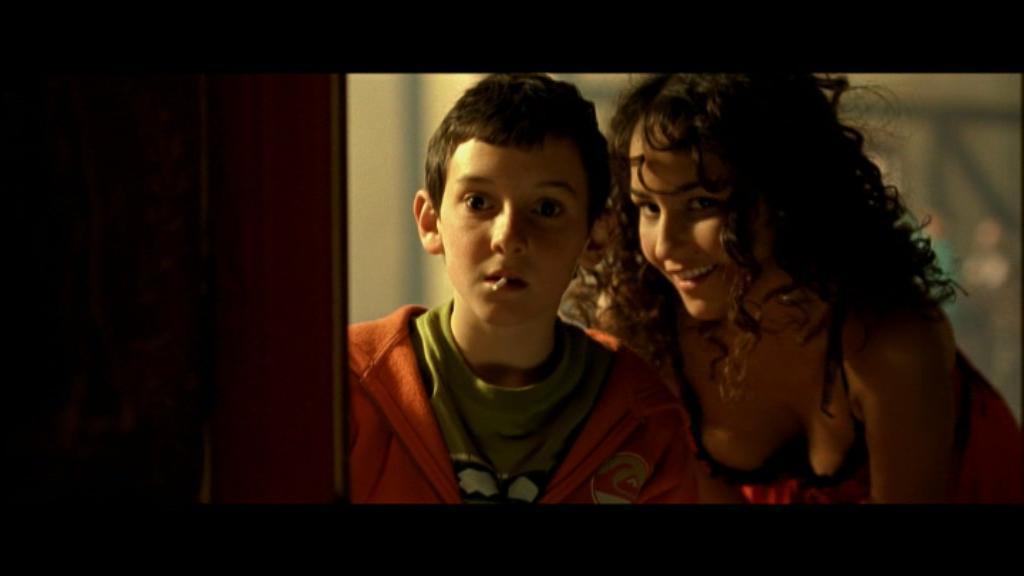

 De la Iglesia plays with the imagery and conventions of the western, but it’s plain to see he has a great love and respect for the genre. ‘800 Bullets’ is an exhilarating, often uproariously funny ode to the western in particular and the love of movies in general. Highly and unreservedly recommended.