


 In the early hours of 13 November 1974, Ronald DeFeo – a 23-year old with a history of drug abuse and personality disorder – shot his parents and his four siblings at 112 Ocean Avenue, Amityville, Long Island. After initially telling the investigating officers a highly suspect story that his family had been wiped out by a mob hitman, he confessed to the murders saying that he’d heard voices telling him to kill. Thirteen months later, following a five-week trial, DeFeo was given six consecutive sentences of 25 years to life. Today, he remains in the Green Haven Correctional Facility, Beekman, New York.
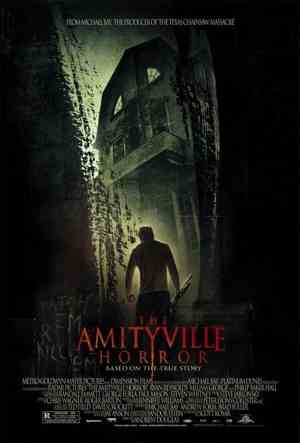 Full disclosure: I’ve never read Jay Anson’s book. A friend of mine describes it as “a real page-turner and very entertaining, but total bollocks”, citing masses of inconsistencies throughout the text, even extending to ambiguity over the actual date the Lutzes moved in. Trawling the internet for background information having watched Rosenberg and Douglas’s films back-to-back, there seems to be a lot of hyberole-ridden Amityville speculation out there but very little in the way of academic, level-headed, collaboratively researched material.
 I’ll do the book courtesy of reading it before I publicly disparage it on this site, but between the fact that it appeared so quickly after the Lutzes’ departure and that the book and movie deal seem to have been brokered on the Lutzes’ behalf by William Weber (the defence lawyer at Ronald DeFeo’s trial!), it’s hard not to be of the opinion that ‘The Amityville Horror’ was conceived as a highly saleable product (particularly with the huge success of ‘The Exorcist’ in 1973 and ‘The Omen’ in 1976) rather than a seriously investigative account of George and Kathy Lutz’s experiences.
 Sandor Stern’s script is uneven, doggedly taking the Lutzes’ point of view for the first half then drifting off to follow first Steiger’s priest (the real Catholic priest whom Kathy Lutz consulted has stated for the record that he only discussed the Lutzes’ concerns about the house over the phone) then an entirely fictitious police detective who all but waves at the camera and says “Hi everybody, I’m here to remind you of Lieutenant Kinderman in ‘The Exorcist’, please tell all your friends to come see this movie” before fucking right off having fulfilled no narrative or expositional purpose whatsoever.
 … and ‘The Amityville Horror’ of 2005 where the babysitter’s played by Rachel Nichols and, oh my sweet lord, why did I never have a babysitter who looked like this?
 Now, notwithstanding that we’ve racked up an immediate point to the remake in terms of the braces vs. cleavage decision, the babysitter/closet scene is so much more effective in Douglas’s hands. Whereas the original gives us a shrieky girl batting her hands against the closet door until they’re bloody followed by a redoubling of the efforts in the screaming department once the lights go out, the remake pointedly shows us what she’s screaming about. It may not be particularly original (Douglas has definitely got his J-horror funk on) or unexpected, but it works.
 … and I’m not thinking Eeeeeewwww, scary dead ghost girl. Uh-uh. I’m thinking Hey, scary dead ghost, that’s the future Hit Girl you’re fucking with. An exorcist is going to be a walk in the park compared to pissing this one off.
 Credit where it’s due, though, the original makes better use of the immediately recognisable look of the house, effortlessly portraying those creepy quarter-windows as eyes behind which something evil lurks. Moreover, Brolin’s performance tops Reynolds’ … although Reynolds is served by a script that gives George Lutz a little more credit. In the original he goes wacko pretty much from the start and doesn’t come through for his family until the very last scene. The remake shows George struggling throughout against the darker impulses inexplicably manifesting in him; there’s never any doubt that he’s basically a decent family man trying to fight what’s happening to him. In virtually all other aspects though – and most crucially, in not feeling any need to treat Anson’s book as sacrosanct and instead just cutting loose and having some dark and cynical fun with the material – the remake wins out.


 Hey, I’m favouring a Platinum Dunes production over the original. Now that’s scary!
 ... but this is beyond the pail?
I mean, if she was topless and sprawled out on the floor of the gym with nothing but a stragetically placed pom-pom between Middle America and her holiest of holies, yeah I can see how that would be controversial.
But you'd have to be Hojatoleslam Kazem Sedighi to get that upset over a few inches of midriff and a shapely pair of legs!
 Welcome to Wheelsy. Let’s take a walk down Main Street, past R.J. MacReady’s funeral parlour and Max Renn’s video store. We could drop by Henenlotter’s bar for a drink, or grab a bite at Meg Penny’s diner.
 Starla becomes suspicious, and when Grant goes beserk and attacks her she turns to laconic town sheriff Bill Pardy (Nathan Fillian) for help. Bill’s been carrying a torch for Starla for a while.

 Unfortunately, ‘Slithers’ is very hit-and-miss in terms of how well it uses its borrowings. When the town is under siege by the slugs and the good folk of Wheelsy are turning into lumbering zombies – and when, as a result, Bill emerges as the hero of the day, the hugely likeable Fillion taking centre stage – ‘Slither’ fires on all cylinders. The pace is fast, the set-pieces are well executed and the humour quotient is acceptable.
 ‘Slither’ follows in the footsteps of the likes of ‘Tremors’, ‘Arachnophobia’ and ‘Eight Legged Freaks’ – all of which manage to have their cake and eat it, being affable and entertaining films which nonetheless deliver suspenseful scenes and enough of an ick factor to satisfy the horror fan – but never quite lives up to them. The posters trumpeted it as “the best horror comedy since ‘Shaun of the Dead’.” It’s a decent 90-minute timewaster with enough belly-laughs to make it worth your while, but it’s definitely not in the ‘Shaun of the Dead’ league.
 Boston, 1942. A young boy crouches on the floor of his room, completing a jigsaw. The door opens behind him. His mom enters, gazes lovingly at him. She moves forward, craning her head to look at the puzzle he’s doing. This is where the pastoral scene goes south. Junior’s putting together a jigsaw that shows a naked woman. Mom goes off on one, slapping junior around and shrieking that he’s just like his father. She bawls him out of the room, telling him to get a plastic bag to put this filth in, then tears through his drawers, ranting as she pulls out a stash of girlie mags. Junior reappears. It seems he’s mistaken “plastic bag” for “axe”. He buries said implement in mom’s head. Cut to: concerned neighbour at the door. Cut to: junior hacking away with a saw, blood spattered all over him. Cut to: concerned neighbour and two police officers bursting in. Junior does an Oscar-worthy job of playing the scared kid. Result: junior gets packed off to stay with an aunt while mom’s disembodied head stares lifelessly across the blood-drenched room.
 Anyway, once the tactful and understated opening credits are out of the way, the movie jumps forward forty years and we’re on the campus of a perennially sunny American university populated by sweater girls, geeky guys and bristly teachers. Oh yeah, and a masked dude with a chainsaw whose chief means of getting his jollies is the evisceration of nubile girls.
 While never stymied by inclusion on the DPP’s “video nasties” list, ‘Pieces’ shares much with the majority of titles that were. Namely, an unapologetic desire to shock terminally undermined by bargain basement production values and a stultifying lack of talent both behind and in front of the camera.
 But whereas ‘Deep Red’ is, uh, good, ‘Pieces’ isn’t. ‘Pieces’ is woefully, wantonly, wonderfully inept. ‘Pieces’ is one of those bona fide so-bad-it’s-good horror movies. Everything about it – from the attempt to graft giallo stylings onto a straightforward stalk ‘n’ slash template, to a monumentally hypocritical aesthetic which disallows a character utter an oath stronger than “wretched” but has no moral objection to a teenage girl getting beheaded by a chainsaw – is misjudged to such a degree that scene after scene squanders its very real potential for offensiveness and provocation and emerges instead as hysterically funny.
 Illogicality reigns supreme. The detective in charge of the case assigns a famous tennis player to go undercover at the school and appoints some hormonally-charged kid as her back-up. ’Coz, like, that’s how police investigations work, right? I mean, I can’t understand why I’ve never encountered this scenario in an Ian Rankin novel.
 Sisters Ginger and Brigitte Fitzgerald (Katharine Isabelle and Emily Perkins) are two normal teenage girls living in a Canadian suburb when –
 School’s not much better than home, populated as it is by asshole jocks like Jason (Jesse Moss) and bitch teen princess Trina (Danielle Hampton). It sucks, too, that going out at night is strictly verboten given the spate of vicious attacks on neighbourhood dogs. When an eviscerated canine turns up on the hockey field, Trina vengefully trips Brigitte so she falls face-first into the decomposing mess. (The catalyst for this act is Brigitte referring to Trina as a “cum bucket”.)
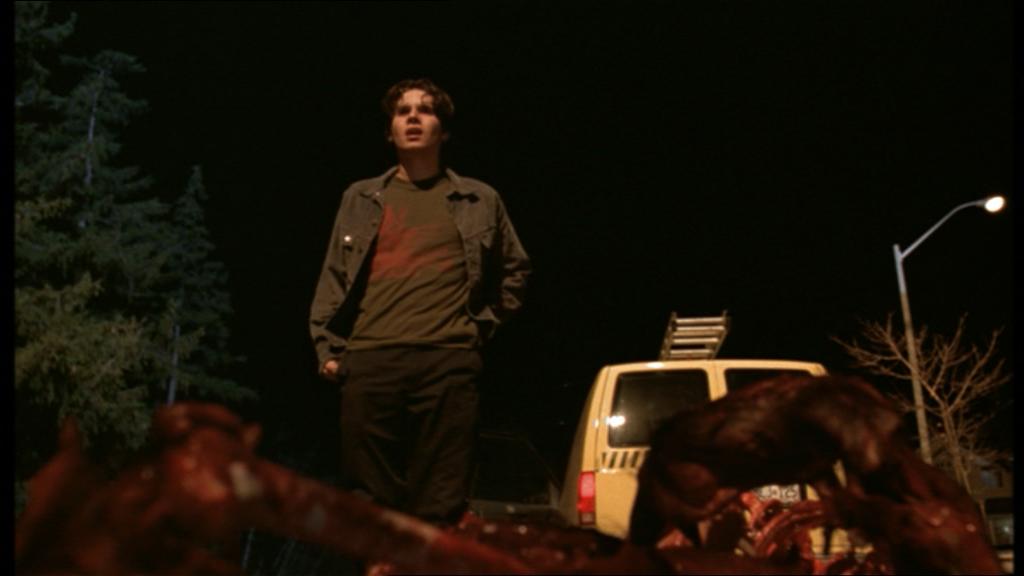 In your average werewolf movie, this would be the point at which Ginger develops a tendency to sprout hair (which she does), howl at the moon (which she doesn’t) and randomly devour people (the movie has “snaps” in the title; take a guess). Director John Fawcett, working from a gem of a script by Karen Walton, does a hell of a lot more with the material. Allaying Ginger’s late menstruation with a different and more feral change – the tagline “they don’t call it the curse for nothing” sums up the concept pithily – the film becomes a metaphor for sexual awakening, female empowerment and the dangers of heightened self-awareness.

 … and promptly starts smoking weed, arguing with Brigitte, pissing her mother off even more than usual, and hanging out with Jason the asshole jock. Initially Jason can’t believe his luck, particularly when Ginger comes on all hot and heavy during a back-seat make out. He soon gets scared, though. It’s bad enough when she takes the lead and starts treating him like a girl. Worse is Ginger’s extreme version of a love bite. The final straw is when Jason pisses blood. At this point, he rounds on Brigitte, wanting to know what the deal is with her sister.
 Yay! After the disappointment of ‘Dead Snow’, Steve Barker’s ‘Outpost’ is a Nazi zombie movie which actually does something with the concept of Nazi zombies. It keeps the zombies more or less offscreen for a good two-thirds of the movie, throws in a science vs. the supernatural subtext that explains the manifestations, and delivers the gore when it needs to but never resorts to blood and guts for their own sake. It’s easily the best group-of-soldiers-meet-something-evil movie this side of Neil Marshall’s ‘Dog Soldiers’. Unlike ‘Dog Soldiers’, though, there’s barely a trace of humour in ‘Outpost’. Barker plays it straight and delivers a nice line in slow-burn tension.
 They arrive at a World War II bunker and a firefight with unseen assailants immediately results in one of their number injured and the rest of them pinned down. Inside the bunker, they discover Nazi paraphernalia, a strange-looking machine that Hunt takes an obsessive interest in, and a room full of corpses … No, wait; one of them’s still breathing.
 Tensions exacerbate amongst the mercenaries. A revelation courtesy of a Nazi propaganda film reel scored to Wagner* puts things in context. We’re nearly an hour into an 86 minute film before the first of the group discovers how little the Geneva Convention matters to undead National Socialists. By this point, Barker’s ramped up the tension and created an atmosphere you could cut with a knife.